Brand Name
Evkeeza
Generic Name
Evinacumab
View Brand Information FDA approval date: February 11, 2021
Classification: Angiopoietin-like 3 Inhibitor
Form: Injection
What is Evkeeza (Evinacumab)?
EVKEEZA is indicated as an adjunct to diet and exercise and other low-density lipoprotein-cholesterol lowering therapies to reduce LDL-C in adults and pediatric patients, aged 1 year and older, with homozygous familial hypercholesterolemia . EVKEEZA is an angiopoietin-like 3 inhibitor indicated as an adjunct to diet and exercise and other low-density lipoprotein-cholesterol lowering therapies to reduce LDL-C in adults and pediatric patients, aged 1 year and older, with homozygous familial hypercholesterolemia .
Approved To Treat
Save this treatment for later
Not sure about your diagnosis?
Related Clinical Trials
There is no clinical trials being done for this treatment
Related Latest Advances
Brand Information
Evkeeza (evinacumab)
1INDICATIONS AND USAGE
EVKEEZA is indicated as an adjunct to diet and exercise and other low-density lipoprotein-cholesterol (LDL-C) lowering therapies to reduce LDL-C in adults and pediatric patients, aged 1 year and older, with homozygous familial hypercholesterolemia (HoFH).
2DOSAGE FORMS AND STRENGTHS
EVKEEZA is a clear to slightly opalescent, colorless to pale yellow solution available as follows:
- Injection: 345 mg/2.3 mL (150 mg/mL) and 1,200 mg/8 mL (150 mg/mL) in single-dose vials.
3CONTRAINDICATIONS
EVKEEZA is contraindicated in patients with a history of serious hypersensitivity reaction to evinacumab-dgnb or to any of the excipients in EVKEEZA. Serious hypersensitivity reactions, including anaphylaxis, have occurred
4ADVERSE REACTIONS
The following clinically significant adverse reactions are described elsewhere in the labeling:
- Serious Hypersensitivity Reactions
4.1Clinical Trials Experience
Because clinical trials are conducted under widely varying conditions, adverse reaction rates observed in the clinical trials of a drug cannot be directly compared to rates in the clinical trials of another drug and may not reflect the rates observed in practice.
Adverse Reactions in Adult and Pediatric Patients (aged 12 to 17 years) with HoFH
Safety data are based on pooled results from two randomized, double-blind, placebo-controlled trials that included 81 patients treated with EVKEEZA. The mean age of EVKEEZA-treated patients was 48 years (range: 15 to 75 years); 52% were females; 5% were Hispanic; 82% were White, 7% Asian, 3% Black or African American, and 9% other races. Forty-four (54%) EVKEEZA-treated patients had HoFH. Patients received EVKEEZA as add-on therapy to other lipid-lowering therapies, including maximally tolerated statin, ezetimibe, proprotein convertase subtilisin kexin type 9 (PCSK9) inhibitors, lomitapide, and apheresis.
Adverse reactions led to discontinuation of treatment in 1 (2%) patient who received placebo, and 2 (2%) patients treated with EVKEEZA, including 1 case of anaphylaxis. The most common adverse reactions (reported in greater than 3% of EVKEEZA-treated patients and more frequently than in placebo) are shown in Table 2.
Other adverse reactions occurring in less than 3% of patients treated with EVKEEZA and greater than placebo included constipation, upper respiratory tract infection, nasal congestion, and abdominal pain.
Transient, mild to moderate decreases in diastolic blood pressure and increases in heart rate occurred in clinical trials of EVKEEZA infusion but did not require intervention and resolved post-infusion.
Serious Hypersensitivity Reactions
Anaphylaxis was reported in 0% patients who received placebo and 1 (1%) patient treated with EVKEEZA.
Infusion Reactions
Infusion reactions were reported in 2 (4%) patients who received placebo and 6 (7%) patients treated with EVKEEZA. The following infusion reactions occurred in EVKEEZA-treated patients: infusion site pruritus, pyrexia, muscular weakness, nausea, and nasal congestion.
Adverse Reactions in Pediatric Patients (aged 5 to 11 years) with HoFH
Safety data are based on pooled results from a three-part, open-label trial in 20 pediatric patients with HoFH (aged 5 to 11 years) with a median treatment duration of 50 weeks. Part A was a trial of 6 patients who received a single intravenous dose of EVKEEZA 15 mg/kg to determine the dosage for the rest of the trial. Part B was a single-arm, 24-week trial of EVKEEZA 15 mg/kg given intravenously every 4 weeks in 14 unique patients
5DESCRIPTION
Evinacumab-dgnb is an angiopoietin-like protein 3 (ANGPTL3) inhibitor monoclonal antibody (IgG4 isotype) produced by recombinant DNA technology in Chinese hamster ovary (CHO) cell suspension culture. Evinacumab-dgnb has an approximate molecular weight of 146 kDa.
EVKEEZA (evinacumab-dgnb) injection is a sterile, preservative-free solution for intravenous use. The solution is clear to slightly opalescent, colorless to pale-yellow, and free from visible particles.
Each vial contains 345 mg/2.3 mL or 1,200 mg/8 mL. Each mL contains 150 mg of evinacumab-dgnb, and L-arginine hydrochloride (14.8 mg), L-histidine (0.74 mg), L-histidine monohydrochloride monohydrate (1.1 mg), L-proline (30 mg), polysorbate 80 (1 mg) and Water for Injection, USP. The pH is 6.
6CLINICAL STUDIES
Adult and Pediatric Patients Aged 12 Years and Older with HoFH
Trial ELIPSE-HoFH (NCT03399786; Trial 1) was a multicenter, double-blind, randomized, placebo-controlled trial that evaluated the efficacy of EVKEEZA compared to placebo in 65 patients with HoFH (63 adult patients and 2 pediatric patients). During the 24-week, double-blind treatment period, patients were randomized to receive EVKEEZA 15 mg/kg given intravenously every 4 weeks (n=43) or placebo given intravenously every 4 weeks (n=22). After the double-blind treatment period, 64 of 65 patients entered a 24-week open-label extension period in which all patients received EVKEEZA 15 mg/kg given intravenously every 4 weeks.
Patients were on a background of other lipid-lowering therapies, including maximally tolerated statins, ezetimibe, PCSK9 inhibitor antibodies, lomitapide, and lipoprotein apheresis. Enrollment was stratified by apheresis status and geographical region. The diagnosis of HoFH was determined by genetic testing or by the presence of the following clinical criteria: history of an untreated total cholesterol (TC) >500 mg/dL and either xanthoma before 10 years of age or evidence of TC >250 mg/dL in both parents.
Baseline Disease and Demographic Characteristics
In this trial, 40% (26 of 65) patients had limited LDL receptor (LDLR) function, defined by either <15% receptor function by
The mean LDL-C at baseline was 255 mg/dL (in patients with limited LDLR function, the mean LDL-C at baseline was 307 mg/dL). At baseline, 94% of patients were on statins, 75% on ezetimibe, 77% on a PCSK9 inhibitor antibody, 22% on lomitapide, and 34% were receiving lipoprotein apheresis. The mean age at baseline was 42 years (range 12 to 75) with 12% ≥65 years old; 54% females; 3% Hispanic; 74% White, 15% Asian, 3% Black or African American, and 8% other races or race was not reported.
Endpoint Results
The primary efficacy endpoint was percent change in LDL-C from baseline to Week 24. At Week 24, the least squares (LS) mean treatment difference between the EVKEEZA and placebo groups in mean percent change in LDL-C from baseline was −49% (95% confidence interval: −65% to −33%; p <0.0001). After 24 weeks of open-label EVKEEZA treatment (Week 24 to Week 48), the observed LDL-C reduction from baseline was similar in patients who crossed over from placebo to EVKEEZA and was maintained in patients who remained on EVKEEZA for 48 weeks. For efficacy results see
At Week 24, the observed reduction in LDL-C with EVKEEZA was similar across predefined subgroups, including age, sex, limited LDLR activity, concomitant treatment with lipoprotein apheresis, and concomitant background lipid-lowering medications (statins, ezetimibe, PCSK9 inhibitor antibodies, and lomitapide).
The LS mean LDL-C percent changes over time are presented in Figure 1.
Pediatric Patients (aged 12 to 17 years) with HoFH
In an open-label trial (Trial 2), 13 pediatric patients with HoFH (aged 12 to 17 years) received 15 mg/kg of EVKEEZA given intravenously every 4 weeks as an adjunct to other lipid-lowering therapies (e.g., statins, ezetimibe, PCSK9 inhibitor antibodies and lipoprotein apheresis) for a median treatment duration of 33 weeks. The mean percent change from baseline in LDL-C at Week 24 was −52% in the 9 patients who completed treatment and had a lipid assessment at Week 24. Overall, the effect of EVKEEZA on lipid parameters in pediatric patients aged 12 to 17 years with HoFH was generally similar to that seen in adults with HoFH.
Pediatric Patients (aged 5 to 11 years) with HoFH
Trial R1500-CL-17100 (NCT04233918; Trial 3) was a multicenter, three-part, single-arm, open-label trial in pediatric patients aged 5 to 11 years with HoFH
Baseline Disease and Demographic Characteristics
In Part B, the mean LDL-C at baseline was 264 mg/dL.
At baseline, 86% of patients were on statins, 93% on ezetimibe, 14% on lomitapide, and 50% were receiving lipoprotein apheresis.
The mean age at baseline was 9 years (range 5 to 11); 57% females; 0% Hispanic; 57% White, 14% Asian, 7% Black or African American, 7% American Indian or Alaska Native, and 14% other races. Mean body weight was 40 kg. Body mass index (BMI) was 20 kg/m
Endpoint Results
The primary efficacy endpoint was percent change in calculated LDL-C from baseline to Week 24. At Week 24, the mean percent change in calculated LDL-C from baseline was −48% (95% confidence interval: −69% to −28%). For efficacy results see
At Week 24, the reduction in LDL-C with EVKEEZA was similar across baseline characteristics, including age, sex, limited LDLR activity, concomitant treatment with lipoprotein apheresis, and concomitant background lipid-lowering medications (statins, ezetimibe, and lomitapide).
Pediatric Patients (aged 1 to less than 5 years) with HoFH
Clinical data were collected through an expanded access program that required each patient's treating physician to provide adequate documentation to demonstrate that the patient met the eligibility criteria for the program and to provide effectiveness information, including LDL-C values. The efficacy of EVKEEZA was evaluated in 6 patients aged 1 to less than 5 years with HoFH. Four females and two males were enrolled in the program. At baseline, 83% of patients were on statins, 83% on ezetimibe, 17% on PCSK9 inhibitors, and 17% were receiving plasmapheresis. The mean LDL-C at baseline was 499 mg/dL (range 238 to 872 mg/dL), the mean age was 3.2 years (range 1.1 to 4.4 years), and the mean weight was 14.5 kg (range 8 to 17 kg). Patients received 15 mg/kg EVKEEZA every 4 weeks for up to 98 weeks. Administration of EVKEEZA resulted in a reduction of LDL-C [mean (standard deviation) change at Week 40 of -60% (16.8)].
7HOW SUPPLIED/STORAGE AND HANDLING
EVKEEZA (evinacumab-dgnb) injection is a clear to slightly opalescent, colorless to pale yellow solution. It is supplied as one single-dose vial per carton.
- 345 mg/2.3 mL (150 mg/mL) NDC 61755-013-01
- 1,200 mg/8 mL (150 mg/mL) NDC 61755-010-01
8PATIENT COUNSELING INFORMATION
Advise the patient to read the FDA-approved patient labeling (Patient Information).
Hypersensitivity Reactions
Inform patients that hypersensitivity reactions have occurred with EVKEEZA. Advise patients to contact their healthcare provider immediately if they experience signs or symptoms of a hypersensitivity reaction
Embryofetal Toxicity
Advise pregnant patients and patients that may become pregnant of the potential risk to a fetus and to inform their healthcare provider of a known or suspected pregnancy. Advise patients who may become pregnant to use effective contraception during treatment with EVKEEZA and for 5 months after the final dosage. Encourage patients who become pregnant to report their pregnancy to 1-833-385-3392
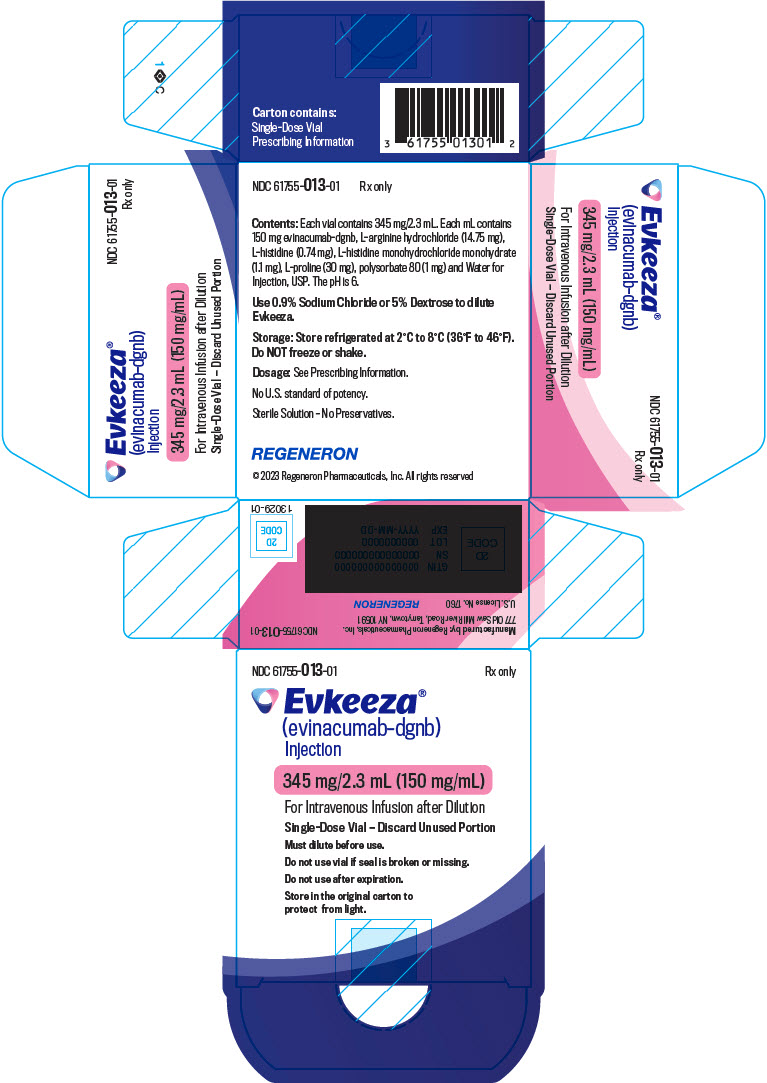
9PRINCIPAL DISPLAY PANEL - 345 mg/2.3 mL Vial Carton
NDC 61755-013-01
Evkeeza
345 mg/2.3 mL (150 mg/mL)
For Intravenous Infusion after Dilution
Single-Dose Vial – Discard Unused Portion
Must dilute before use.
Do not use vial if seal is broken or missing.
Do not use after expiration.
Store in the original carton to

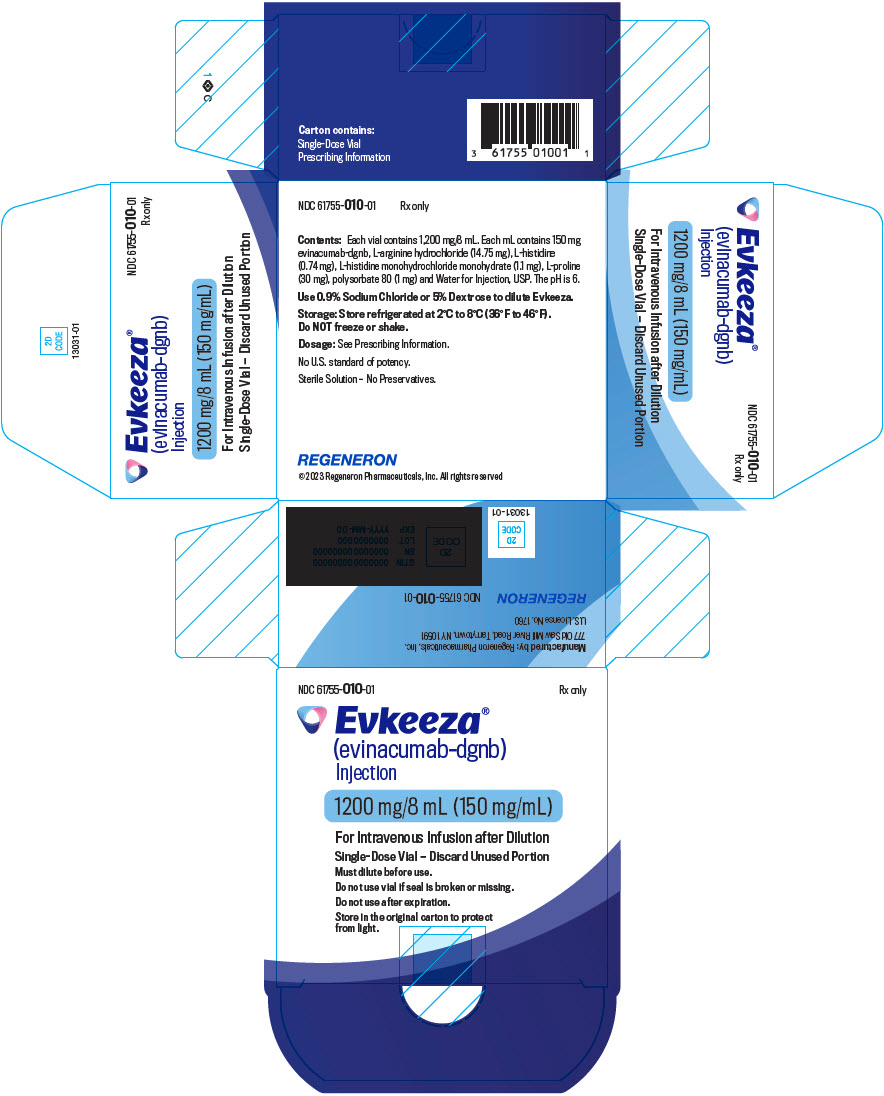
10PRINCIPAL DISPLAY PANEL - 1200 mg/8 mL Vial Carton
NDC 61755-010-01
Evkeeza
1200 mg/8 mL (150 mg/mL)
For Intravenous Infusion after Dilution
Single-Dose Vial – Discard Unused Portion
Must dilute before use.
Do not use vial if seal is broken or missing.
Do not use after expiration.
Store in the original carton to protect