Brand Name
Tivdak
Generic Name
Tisotumab Vedotin
View Brand Information FDA approval date: September 20, 2021
Form: Injection
What is Tivdak (Tisotumab Vedotin)?
TIVDAK ® is indicated for the treatment of adult patients with recurrent or metastatic cervical cancer with disease progression on or after chemotherapy. TIVDAK is a tissue factor-directed antibody and microtubule inhibitor conjugate indicated for the treatment of adult patients with recurrent or metastatic cervical cancer with disease progression on or after chemotherapy.
Approved To Treat
Top Global Experts


Save this treatment for later
Not sure about your diagnosis?
Related Clinical Trials
A PROSPECTIVE LOW-INTERVENTIONAL PHASE 4 SINGLE ARM STUDY OF OCULAR ASSESSMENTS IN PATIENTS TREATED WITH TIVDAK® IN RECURRENT OR METASTATIC CERVICAL CANCER
Summary: TIVDAK is used for the treatment of cervical cancer that has come back after chemotherapy. Chemotherapy is a treatment that uses medicines to stop the growth of cancer cells. This is done either by killing the cells or by stopping them from growing. The purpose of this study is to learn about possible side effects of TIVDAK, specially to any side effect that is related to the eye. A side effect is...
Related Latest Advances
Brand Information
TIVDAK (tisotumab vedotin)
WARNING: OCULAR TOXICITY
- TIVDAK can cause severe ocular toxicities resulting in changes in vision, including severe vision loss, and corneal ulceration.
- Conduct an ophthalmic exam, including an assessment of ocular symptoms, visual acuity, and slit lamp exam of the anterior segment of the eye prior to initiation of TIVDAK, prior to every cycle for the first nine cycles, and as clinically indicated.
- Adhere to the required premedication and eye care before, during, and after infusion.
- Withhold TIVDAK until improvement and resume, reduce the dose, or permanently discontinue, based on severity
1INDICATIONS AND USAGE
TIVDAK
2DOSAGE FORMS AND STRENGTHS
For Injection: 40 mg of tisotumab vedotin-tftv as a white to off-white lyophilized cake or powder in a single-dose vial for reconstitution.
3CONTRAINDICATIONS
None.
4ADVERSE REACTIONS
The following serious adverse reactions are described elsewhere in the labeling:
- Ocular Adverse Reactions
- Peripheral Neuropathy
- Hemorrhage
- Pneumonitis
- Severe Cutaneous Adverse Reactions
4.1Clinical Trials Experience
Because clinical trials are conducted under widely varying conditions, adverse reaction rates observed in the clinical trials of a drug cannot be directly compared to rates in the clinical trials of another drug and may not reflect the rates observed in practice.
The data in the
The data described in this section reflect exposure to TIVDAK from innovaTV 301 and innovaTV 204.
innovaTV 301
The safety of TIVDAK was evaluated in an open-label, randomized study in patients with recurrent or metastatic cervical cancer with disease progression on or after systemic therapy
Serious adverse reactions occurred in 33% of patients receiving TIVDAK. The most common (≥2%) serious adverse reactions were urinary tract infection (4.8%), small intestinal obstruction (2.4%), sepsis (2%), abdominal pain (2%), and hemorrhage (2%). Fatal adverse reactions occurred in 1.6% of patients who received TIVDAK, including acute kidney injury (0.4%), pneumonia (0.4%), sepsis (0.4%) and Stevens-Johnson syndrome (0.4%).
Adverse reactions leading to permanent discontinuation occurred in 15% of patients receiving TIVDAK; the most common (≥3%) adverse reactions leading to permanent discontinuation were peripheral neuropathy (6%) and ocular adverse reactions (6%).
Adverse reactions leading to dose interruption occurred in 39% of patients receiving TIVDAK; the most common (≥3%) adverse reactions leading to dose interruption were ocular adverse reactions (16%) and peripheral neuropathy (6%).
Adverse reactions leading to dose reduction occurred in 30% of patients receiving TIVDAK; the most common (≥3%) adverse reactions leading to dose reduction were peripheral neuropathy (10%) and ocular adverse reactions (10%). The ocular adverse reactions included conjunctival disorders (4.8%), keratopathy (4%), and dry eye (0.8%).
The most common (≥25%) adverse reactions, including laboratory abnormalities, in patients receiving TIVDAK were hemoglobin decreased, peripheral neuropathy, conjunctival adverse reactions, aspartate aminotransferase increased, nausea, alanine aminotransferase increased, fatigue, sodium decreased, epistaxis, and constipation.
Table 4 summarizes the all grade and Grade 3-4 adverse reactions from innovaTV 301.
Clinically relevant adverse reactions in <10% of patients who received TIVDAK in innovaTV 301 include periorbital adverse reactions (9%) and intestinal obstruction (4.4%, including small bowel, large bowel, and malignant gastrointestinal obstruction).
Table 5 summarizes the laboratory abnormalities in innovaTV 301.
innovaTV 204
The safety of TIVDAK was evaluated in a single arm study in patients (n=101) with recurrent or metastatic cervical cancer with disease progression on or after chemotherapy
Serious adverse reactions occurred in 43% of patients. The most common (≥3%) serious adverse reactions were ileus (6%), hemorrhage (5%), pneumonia (4%), peripheral neuropathy, sepsis, constipation, and pyrexia (each 3%). Fatal adverse reactions occurred in 4% of patients who received TIVDAK, including septic shock (1%), pneumonitis (1%), sudden death (1%), and multisystem organ failure (1%).
Adverse reactions leading to permanent discontinuation occurred in 13% of patients receiving TIVDAK; the most common (≥3%) adverse reactions leading to permanent discontinuation were peripheral neuropathy (5%) and corneal adverse reactions (4%).
Adverse reactions leading to dose interruption occurred in 47% of patients; the most (≥3%) common adverse reactions leading to dose interruption were peripheral neuropathy (8%), conjunctival adverse reactions (4%), and hemorrhage (4%).
Adverse reactions leading to dose reduction occurred in 23% of patients; the most common (≥3%) adverse reactions leading to dose reduction were conjunctival adverse reactions (9%) and corneal adverse reactions (8%).
The most common (≥25%) adverse reactions, including laboratory abnormalities, were hemoglobin decreased, fatigue, lymphocytes decreased, nausea, peripheral neuropathy, alopecia, epistaxis, conjunctival adverse reactions, hemorrhage, leukocytes decreased, creatinine increased, dry eye, prothrombin international normalized ratio increased, activated partial thromboplastin time prolonged, diarrhea, and rash.
Table 6 summarizes the all grade and Grade 3-4 adverse reactions from innovaTV 204.
Clinically relevant adverse reactions in <10% of patients who received TIVDAK in innovaTV 204 included venous thrombosis (3%), pulmonary embolism (3%), and pneumonitis (2%).
Table 7 summarizes the laboratory abnormalities in innovaTV 204.
5DESCRIPTION
Tisotumab vedotin-tftv is a Tissue Factor (TF) directed antibody drug conjugate (ADC) comprised of a human anti-TF IgG1-kappa antibody conjugated to the microtubule-disrupting agent monomethyl auristatin E (MMAE) via a protease-cleavable vc (valine-citrulline) linker. The monoclonal antibody is produced in a mammalian cell line (Chinese hamster ovary). MMAE and the linker are produced by chemical synthesis. Each monoclonal antibody molecule carries an average of 4 MMAE molecules. Tisotumab vedotin-tftv has an approximate molecular weight of 153 kDa. The chemical structure is as follows:
Figure 1. Structural Formula

TIVDAK (tisotumab vedotin-tftv) for injection, is provided as a sterile, preservative-free, white to off-white lyophilized cake or powder in a single-dose vial for infusion after dilution. Following reconstitution with 4 mL of Sterile Water for Injection, a clear to slightly opalescent, colorless to brownish-yellow solution containing 10 mg/mL tisotumab vedotin-tftv is produced
6REFERENCES
- “OSHA Hazardous Drugs.” OSHA.
7PATIENT COUNSELING INFORMATION
Advise the patient to read the FDA-approved patient labeling (Medication Guide).
Ocular Adverse Reactions
- Inform patients about the eye exam they will receive with an eye care provider before starting TIVDAK, before each of the first nine cycles and as clinically indicated
- Inform patients about the ocular signs or symptoms the eye care provider will review before each cycle
- Inform patients that ocular adverse reactions may occur during treatment with TIVDAK and to contact their healthcare provider if they experience new or worsening ocular signs and symptoms
- Instruct patients to bring their eye drops to each infusion and advise on how to administer the eye drops throughout treatment
- Inform patients to avoid wearing contact lenses during treatment unless directed by an eye care provider
Peripheral Neuropathy
- Advise patients to report to their healthcare provider any numbness and tingling of the hands or feet or muscle weakness
Hemorrhage
- Instruct patients to contact their healthcare provider to seek immediate medical attention for signs or symptoms of unusual severe bleeding or hemorrhage
Pneumonitis
- Advise patients to immediately report new or worsening respiratory symptoms
Severe Cutaneous Adverse Reactions
- Inform patients of the signs and symptoms of severe cutaneous adverse reactions, including life-threatening and potentially fatal SJS, which include target lesions, worsening skin reactions, blistering or peeling of the skin, painful sores in mouth, nose, throat, or genital area, fever or flu-like symptoms, and swollen lymph nodes
- Instruct patients to contact their healthcare provider to seek immediate medical attention for signs or symptoms of severe cutaneous adverse reactions, including SJS
Embryo-Fetal Toxicity
- Advise pregnant women and females of reproductive potential of the potential risk to the fetus. Advise patients to inform their healthcare providers of a known or suspected pregnancy
- Advise females of reproductive potential to use effective contraception during treatment and for 2 months after the last dose. Advise male patients with female partners of reproductive potential to use effective contraception during treatment and for 4 months after the last dose
Lactation
- Advise women not to breastfeed during treatment with TIVDAK and for 3 weeks after the last dose
Manufactured by:
Marketed by:
U.S. License 2257
8PRINCIPAL DISPLAY PANEL
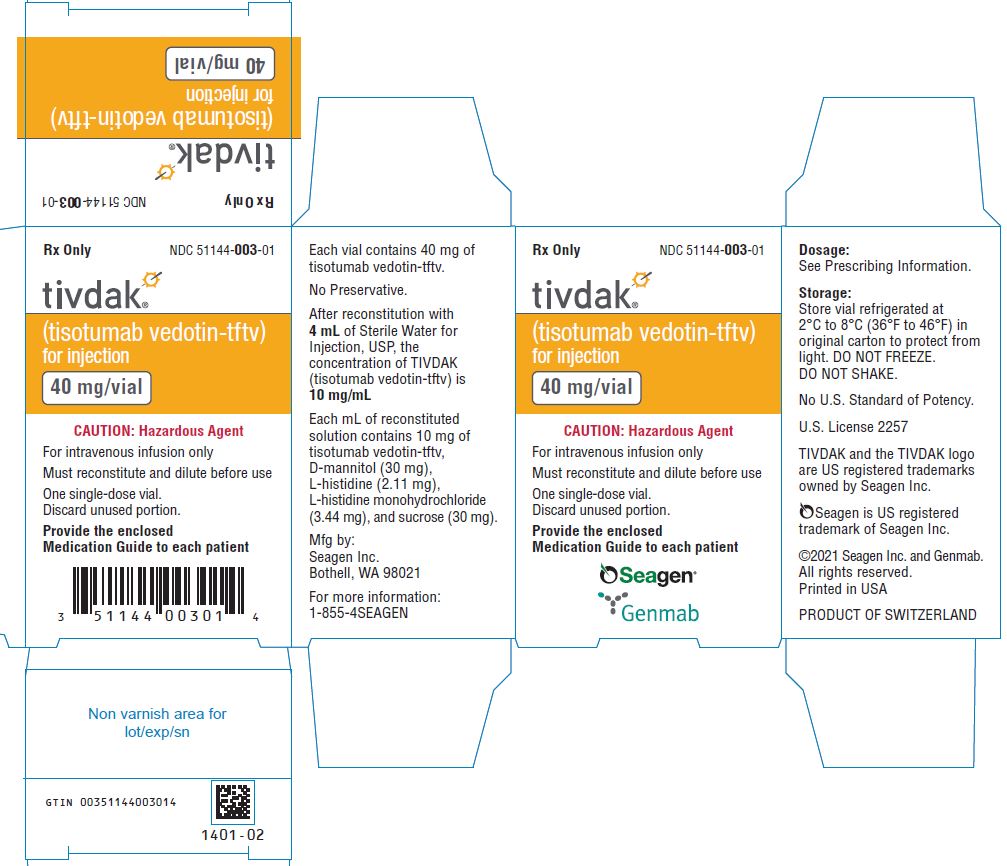
Rx Only
NDC 51144-003-01
tivdak®
(tisotumab vedotin-tftv)
for injection
40 mg/vial
CAUTION: Hazardous Agent
For intravenous infusion only
Must reconstitute and dilute before use
One single-dose vial.
Discard unused portion.
Provide the enclosed
Medication Guide to each patient
Seagen®
Genmab
Dosage:
See Prescribing Information.
Storage:
Store vial refrigerated at
2ºC to 8ºC (36ºF to 46ºF) in
original carton to protect from
light. DO NOT FREEZE.
DO NOT SHAKE.
No U.S. Standard of Potency
U.S. License 2257
TIVDAK and the TIVDAK logo
are US registered trademarks
owned by Seagen Inc.
 Seagen is US registered
trademark of Seagen Inc.
©2021 Seagen Inc. and Genmab.
All rights reserved.
Printed in USA
PRODUCT OF SWITZERLAND
Each vial contains 40 mg of
tisotumab vedotin-tftv.
No Preservative
After reconstitution with
4 mL of Sterile Water for
Injection, USP, the
concentration of TIVDAK
(tisotumab vedotin-tftv) is
10 mg/mL
Each mL of reconstituted
solution contains 10 mg of
tisotumab vedotin-tftv,
D-mannitol (30 mg),
L-histidine (2.11 mg),
L-histidine monojhydrochloride
(3.44 mg), and sucrose (30mg)
Mfg by:
Seagen Inc.
Bothell, WA 98021
For more information:
1-855-4SEAGEN
GTIN 00351144003014
1401 - 02
NDC 51144-003-01
tivdak®
(tisotumab vedotin-tftv)
for injection
40 mg/vial
CAUTION: Hazardous Agent
For intravenous infusion only
Must reconstitute and dilute before use
One single-dose vial.
Discard unused portion.
Provide the enclosed
Medication Guide to each patient
Seagen®
Genmab
Dosage:
See Prescribing Information.
Storage:
Store vial refrigerated at
2ºC to 8ºC (36ºF to 46ºF) in
original carton to protect from
light. DO NOT FREEZE.
DO NOT SHAKE.
No U.S. Standard of Potency
U.S. License 2257
TIVDAK and the TIVDAK logo
are US registered trademarks
owned by Seagen Inc.
Seagen is US registeredtrademark of Seagen Inc.
©2021 Seagen Inc. and Genmab.
All rights reserved.
Printed in USA
PRODUCT OF SWITZERLAND
Each vial contains 40 mg of
tisotumab vedotin-tftv.
No Preservative
After reconstitution with
4 mL of Sterile Water for
Injection, USP, the
concentration of TIVDAK
(tisotumab vedotin-tftv) is
10 mg/mL
Each mL of reconstituted
solution contains 10 mg of
tisotumab vedotin-tftv,
D-mannitol (30 mg),
L-histidine (2.11 mg),
L-histidine monojhydrochloride
(3.44 mg), and sucrose (30mg)
Mfg by:
Seagen Inc.
Bothell, WA 98021
For more information:
1-855-4SEAGEN
GTIN 00351144003014
1401 - 02
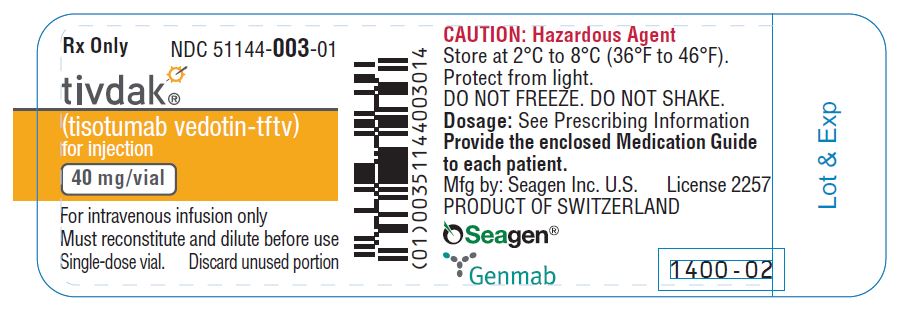
Rx Only
NDC 51144-003-01
tivdak®
(tisotumab vedotin-tftv)
for injection
40 mg/vial
For intravenous infusion only
Must reconstitute and dilute before use
Single-dose vial. Discard unused portion.
CAUTION: Hazardous Agent
Store at 2ºC to 8ºC (36ºF to 46ºF)
Protect from light.
DO NOT FREEZE. DO NOT SHAKE.
Dosage: See Prescribing Information
Provide the enclosed Medication Guide to each patient.
Mfg by: Seagen Inc. U.S. License 2257
PRODUCT OF SWITZERLAND
Seagen®
Genmab
1400-02
NDC 51144-003-01
tivdak®
(tisotumab vedotin-tftv)
for injection
40 mg/vial
For intravenous infusion only
Must reconstitute and dilute before use
Single-dose vial. Discard unused portion.
CAUTION: Hazardous Agent
Store at 2ºC to 8ºC (36ºF to 46ºF)
Protect from light.
DO NOT FREEZE. DO NOT SHAKE.
Dosage: See Prescribing Information
Provide the enclosed Medication Guide to each patient.
Mfg by: Seagen Inc. U.S. License 2257
PRODUCT OF SWITZERLAND
Seagen®
Genmab
1400-02