Brand Name
Glucotrol
Generic Name
Glipizide
View Brand Information FDA approval date: February 27, 1995
Classification: Sulfonylurea
Form: Tablet
What is Glucotrol (Glipizide)?
GLUCOTROL XL is indicated as an adjunct to diet and exercise to improve glycemic control in adults with type 2 diabetes mellitus. GLUCOTROL XL is a sulfonylurea indicated as an adjunct to diet and exercise to improve glycemic control in adults with type 2 diabetes mellitus Limitations of Use: Not for treatment of type 1 diabetes or diabetic ketoacidosis.
Approved To Treat
Top Global Experts
There are no experts for this drug
Save this treatment for later
Not sure about your diagnosis?
Related Clinical Trials
There is no clinical trials being done for this treatment
Related Latest Advances
There is no latest advances for this treatment
Brand Information
Glucotrol (glipizide)
1INDICATIONS AND USAGE
GLUCOTROL XL is indicated as an adjunct to diet and exercise to improve glycemic control in adults with type 2 diabetes mellitus.
1.1Limitations of Use
GLUCOTROL XL is not recommended for the treatment of type 1 diabetes mellitus or diabetic ketoacidosis.
2DOSAGE FORMS AND STRENGTHS
GLUCOTROL XL (glipizide) Extended Release tablets:
2.5 mg, blue and imprinted with "GLUCOTROL XL 2.5" or "GXL 2.5" on one side
5 mg, white and imprinted with "GLUCOTROL XL 5" or "GXL 5" on one side
10 mg, white and imprinted with "GLUCOTROL XL 10" or "GXL 10" on one side
3CONTRAINDICATIONS
Glipizide is contraindicated in patients with:
- Known hypersensitivity to glipizide or any of the product's ingredients.
- Hypersensitivity to sulfonamide derivatives.
4ADVERSE REACTIONS
The following serious adverse reactions are discussed in more detail below and elsewhere in the labeling:
- Hypoglycemia
- Hemolytic anemia
4.1Clinical Trials Experience
Because clinical trials are conducted under widely varying conditions, adverse reaction rates observed in the clinical trials of a drug cannot be directly compared to rates in the clinical trials of another drug and may not reflect the rates observed in practice.
In clinical trials, 580 patients from 31 to 87 years of age received GLUCOTROL XL in doses from 5 mg to 60 mg in both controlled and open trials. The dosages above 20 mg are not recommended dosages. In these trials, approximately 180 patients were treated with GLUCOTROL XL for at least 6 months.
Table 1 summarizes the incidence of adverse reactions, other than hypoglycemia, that were reported in pooled double-blind, placebo-controlled trials in ≥3% of GLUCOTROL XL-treated patients and more commonly than in patients who received placebo.
4.2Postmarketing Experience
The following adverse reactions have been identified during post approval use of GLUCOTROL XL. Because these reactions are reported voluntarily from a population of uncertain size, it is not always possible to reliably estimate their frequency or establish a causal relationship to drug exposure.
- Abdominal pain
- Cholestatic and hepatocellular forms of liver injury accompanied by jaundice
- Leukopenia, agranulocytosis, thrombocytopenia, hemolytic anemia
- Hepatic porphyria and disulfiram-like reactions
- Hyponatremia and the syndrome of inappropriate antidiuretic hormone (SIADH) secretion
- Rash
- There have been reports of gastrointestinal irritation and gastrointestinal bleeding with use of another drug with this non-dissolvable extended release formulation.
5OVERDOSAGE
Overdosage of sulfonylureas including GLUCOTROL XL can produce severe hypoglycemia. Mild hypoglycemic symptoms without loss of consciousness or neurologic findings should be treated with oral glucose. Severe hypoglycemic reactions with coma, seizure, or other neurological impairment are medical emergencies requiring immediate treatment. The patient should be treated with glucagon or intravenous glucose. Patients should be closely monitored for a minimum of 24 to 48 hours since hypoglycemia may recur after apparent clinical recovery. Clearance of glipizide from plasma may be prolonged in persons with liver disease. Because of the extensive protein binding of glipizide, dialysis is unlikely to be of benefit.
6DESCRIPTION
GLUCOTROL XL (glipizide) is an oral sulfonylurea.
The Chemical Abstracts name of glipizide is 1-cyclohexyl-3-[[p-[2-(5-methylpyrazinecarboxamido)ethyl] phenyl]sulfonyl]urea. The molecular formula is C

Glipizide is a whitish, odorless powder with a pKa of 5.9. It is insoluble in water and alcohols, but soluble in 0.1
Each tablet contains 2.75 mg glipizide to provide a 2.5 mg dose.
Each tablet contains 5.49 mg glipizide to provide a 5 mg dose.
Each tablet contains 10.98 mg glipizide to provide a 10 mg dose.
Inert ingredients in the 2.5 mg, 5 mg and 10 mg formulations are: polyethylene oxide, hypromellose, magnesium stearate, sodium chloride, red ferric oxide, cellulose acetate, polyethylene glycol, Opadry
7REFERENCES
1.
8HOW SUPPLIED/STORAGE AND HANDLING
GLUCOTROL XL (glipizide) Extended Release Tablets are supplied to provide 2.5 mg, 5 mg, and 10 mg round, biconvex tablets and imprinted with black ink as follows:
9PATIENT COUNSELING INFORMATION
Advise the patient to read the FDA-approved patient labeling (Patient Information).
Inform patients of the potential adverse reactions of GLUCOTROL XL including hypoglycemia. Explain the risks of hypoglycemia, its symptoms and treatment, and conditions that predispose to its development to patients and responsible family members. Also inform patients about the importance of adhering to dietary instructions, of a regular exercise program, and of regular testing of glycemic control.
Inform patients that GLUCOTROL XL should be swallowed whole. Inform patients that they should not chew, divide or crush tablets and they may occasionally notice in their stool something that looks like a tablet. In the GLUCOTROL XL tablet, the medication is contained within a non-dissolvable shell that has been specially designed to slowly release the drug so the body can absorb it.
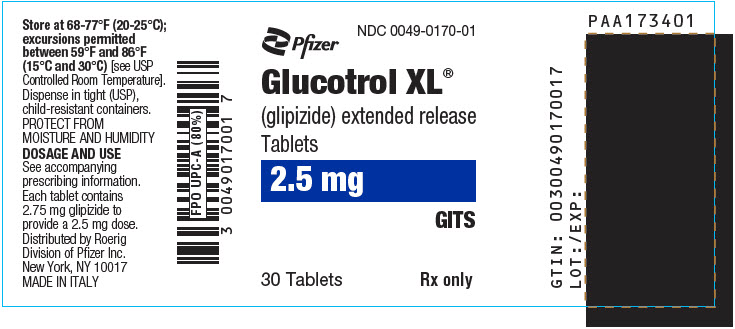
10PRINCIPAL DISPLAY PANEL - 2.5 mg Tablet Bottle Label - NDC 0049-0170
Pfizer
NDC 0049-0170-01
NDC 0049-0170-01
Glucotrol XL ®
(glipizide) extended release
Tablets
(glipizide) extended release
Tablets
2.5 mg
GITS
30 Tablets
11PRINCIPAL DISPLAY PANEL - 5 mg Tablet Bottle Label - NDC 0049-0174
Pfizer
NDC 0049-0174-02
NDC 0049-0174-02
Glucotrol XL ®
(glipizide) extended release
Tablets
(glipizide) extended release
Tablets
5 mg
GITS
100 Tablets

12PRINCIPAL DISPLAY PANEL - 10 mg Tablet Bottle Label - NDC 0049-0178
Pfizer
NDC 0049-0178-07
NDC 0049-0178-07
Glucotrol XL ®
(glipizide) extended release
Tablets
(glipizide) extended release
Tablets
10 mg
GITS
100 Tablets
