Brand Name

Verquvo

Generic Name
Vericiguat
View Brand Information
FDA approval date: February 01, 2021
Classification: Soluble Guanylate Cyclase Stimulator
Form: Tablet

What is Verquvo (Vericiguat)?

VERQUVO ® is indicated to reduce the risk of cardiovascular death and heart failure hospitalization following a hospitalization for heart failure or need for outpatient IV diuretics, in adults with symptomatic chronic HF and ejection fraction less than 45%. VERQUVO is a soluble guanylate cyclase stimulator, indicated to reduce the risk of cardiovascular death and heart failure hospitalization following a hospitalization for heart failure or need for outpatient IV diuretics, in adults with symptomatic chronic HF and ejection fraction less than 45%.

Approved To Treat

Save this treatment for later
Sign Up
Not sure about your diagnosis?
Check Your Symptoms

Related Clinical Trials

A Phase 2/3 Randomized, Placebo-Controlled, Double-blind, Clinical Study to Evaluate the Efficacy, Safety, and Pharmacokinetics of Vericiguat in Pediatric Participants With Heart Failure Due to Systemic Left Ventricular Systolic Dysfunction (VALOR)

Summary: This study aims to compare the efficacy of vericiguat versus placebo on change in n-terminal pro-brain natriuretic peptide (NTproBNP) from baseline to Week 16 of the Base Period. The primary hypothesis is that vericiguat is superior to placebo in reducing NT-proBNP at Week 16 of the Base Period.

Randomised Controlled Trial of Vericiguat in Patients With Coronary Microvascular Dysfunction Causing Stable Chest Pain (V-COM)

Summary: This is a randomised controlled trial to determine the effectiveness of Vericiguat to improve stress myocardial blood flow (MBF) and myocardial perfusion reserve as measured by cardiac magnetic resonance (CMR) imaging.

Post-marketing Surveillance Study for Verquvo (Vericiguat) in Korean Heart Failure Patients With Reduced Ejection Fraction

Summary: This is an observational study in which only data are collected from participants receiving their usual treatment. The study is done in people with chronic heart failure with reduced ejection fraction (HFrEF). HFrEF is a long-term condition in which the heart does not pump blood as well as it should. Blood and fluid may collect in the lungs, blood vessels, and tissues causing shortness of breath o...

Brand Information

VERQUVO (vericiguat)
WARNING: EMBRYO-FETAL TOXICITY
Females of reproductive potential: Exclude pregnancy before the start of treatment. To prevent pregnancy, females of reproductive potential must use effective forms of contraception during treatment and for one month after stopping treatment. Do not administer VERQUVO to a pregnant female because it may cause fetal harm
1INDICATIONS AND USAGE
VERQUVO
2DOSAGE FORMS AND STRENGTHS
  • VERQUVO 2.5 mg (vericiguat 2.5 mg) are round, biconvex, white film-coated tablets debossed with “2.5” on one side and “VC” on the other side.
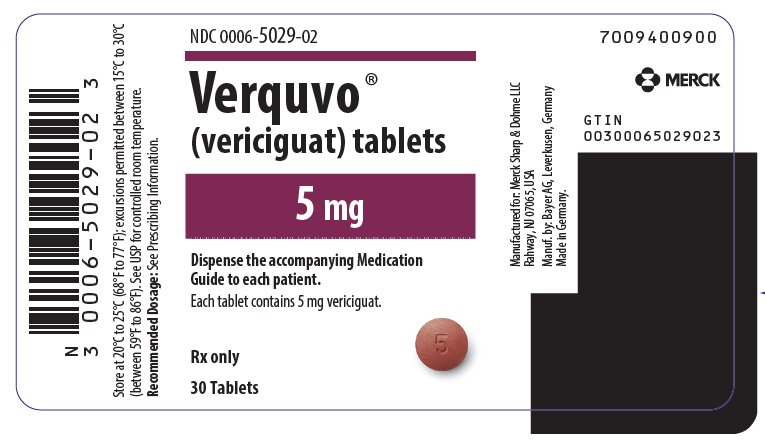
  • VERQUVO 5 mg (vericiguat 5 mg) are round, biconvex, brown-red film-coated tablets debossed with “5” on one side and “VC” on the other side.
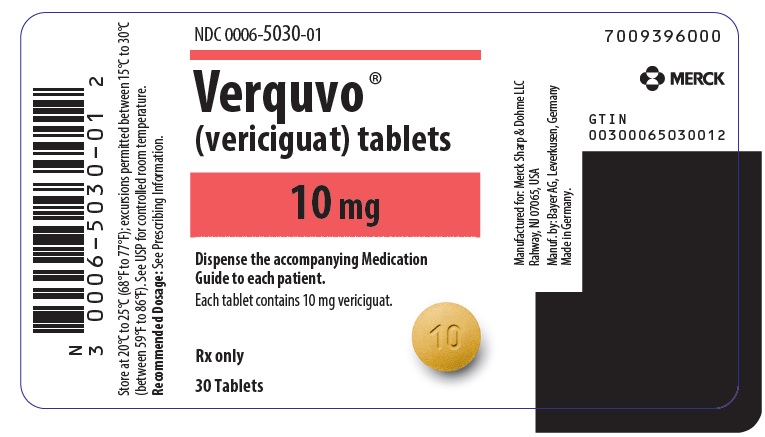
  • VERQUVO 10 mg (vericiguat 10 mg) are round, biconvex, yellow-orange film-coated tablets debossed with “10” on one side and “VC” on the other side.
3CONTRAINDICATIONS
VERQUVO is contraindicated in patients with concomitant use of other soluble guanylate cyclase (sGC) stimulators
VERQUVO is contraindicated in pregnancy
4OVERDOSAGE
Limited data are available with regard to overdosage in human patients treated with VERQUVO. In VICTORIA, doses up to 10 mg have been studied. In a study of patients with preserved ejection fraction heart failure (left ventricular ejection fraction ≥45%), multiple doses of VERQUVO 15 mg have been studied and were generally well tolerated. In the event of an overdose, hypotension may result. Symptomatic treatment should be provided. VERQUVO is unlikely to be removed by hemodialysis because of high protein binding.
5DESCRIPTION
VERQUVO tablets contains vericiguat, a soluble guanylate cyclase stimulator.
The chemical name of vericiguat is methyl {4,6-diamino-2-[5-fluoro-1-(2-fluorobenzyl)-1H-pyrazolo[3,4-b] pyridin-3-yl] pyrimidin-5-yl} carbamate. The molecular formula is C
The chemical structure is:
Vericiguat is a white to yellowish powder that is freely soluble in dimethyl sulfoxide; slightly soluble in acetone; very slightly soluble in ethanol, acetonitrile, methanol, and ethyl acetate; and practically insoluble in 2-propanol.
VERQUVO
The film coating contains hypromellose, talc and titanium dioxide. The film coating for the 5 mg of VERQUVO tablet also contains ferric oxide red. The film coating for the 10 mg of VERQUVO tablet also contains ferric oxide yellow.
6CLINICAL STUDIES
VICTORIA was a randomized, parallel-group, placebo-controlled, double-blind, event-driven, multi-center trial comparing VERQUVO and placebo in 5,050 adult patients with symptomatic chronic heart failure (New York Heart Association [NYHA] class II-IV) and left ventricular ejection fraction (LVEF) less than 45% following a worsening heart failure event. A worsening heart failure event was defined as heart failure hospitalization within 6 months before randomization or use of outpatient IV diuretics for heart failure within 3 months before randomization.
Patients were randomized to receive VERQUVO 10 mg or matching placebo. VERQUVO was initiated at 2.5 mg once daily and increased at approximately 2 week intervals to 5 mg once daily and the target dose of 10 mg once daily, as tolerated. Placebo doses were similarly adjusted. After approximately 1 year, 90% of patients in both treatment groups were treated with the 10 mg target dose.
The primary endpoint was a composite of time to first event of CV death or hospitalization for heart failure. The median follow-up for the primary endpoint was 11 months.
The population was 64% Caucasian, 22% Asian, and 5% Black. The mean age was 67 years and 76% were male. At randomization, 59% of patients were NYHA Class II, 40% were NYHA Class III, and 1% were NYHA Class IV. The mean left ventricular ejection fraction (EF) was 29%. Approximately half of all patients had an EF <30%, and 14% had an EF between 40% and 45%. The most frequently reported medical history conditions other than heart failure included hypertension (79%), coronary artery disease (58%), hyperlipidemia (57%), diabetes mellitus (47%), atrial fibrillation (45%) and myocardial infarction (42%). At randomization, the mean eGFR was 62 mL/min/1.73 m
At baseline, 93% of patients were on a beta blocker, 73% of patients were on an angiotensin-converting enzyme (ACE) inhibitor or angiotensin II receptor blocker (ARB), 70% of patients were on a mineralocorticoid receptor antagonist (MRA), 15% of patients were on a combination of an angiotensin receptor and neprilysin inhibitor (ARNI), 28% of patients had an implantable cardiac defibrillator, and 15% had a biventricular pacemaker. Ninety-one percent of patients were treated with 2 or more heart failure medications (beta blocker, any renin-angiotensin system [RAS] inhibitor or MRA) and 60% of patients were treated with all 3. At baseline, 6% of patients were on ivabradine and 3% of patients were on a sodium glucose co-transporter 2 (SGLT2) inhibitor.
In VICTORIA, VERQUVO was superior to placebo in reducing the risk of CV death or heart failure hospitalization based on a time-to-event analysis (hazard ratio [HR]: 0.90, 95% confidence interval [CI], 0.82-0.98; p=0.019). Over the course of the study, there was a 4.2% annualized absolute risk reduction (ARR) with VERQUVO compared with placebo. The treatment effect reflected a reduction in both cardiovascular death and heart failure hospitalization (see
The Kaplan-Meier curve (
A wide range of demographic characteristics, baseline disease characteristics, and baseline concomitant medications were examined for their influence on outcomes. The results of the prespecified subgroup analysis for the primary composite endpoint are shown in
As shown above in
Secondary endpoints other than the components of the primary endpoint were tested according to a hierarchical testing procedure to control the family wise type I error rate. VERQUVO was superior to placebo in reducing the risk of total (first and recurrent) events of HF hospitalization and the first occurrence of either all-cause mortality or HF hospitalization (see
7PATIENT COUNSELING INFORMATION
Advise the patient to read the FDA-approved patient labeling (
Dosing Instructions
If a dose is missed, it should be taken as soon as the patient remembers on the same day of the missed dose. Patients should not take two doses of VERQUVO on the same day.
Embryo-Fetal Toxicity
Advise pregnant women and females of reproductive potential of the potential risk to a fetus and to inform their healthcare provider of a known or suspected pregnancy. Advise females of reproductive potential to use effective contraception during treatment with VERQUVO and for one month after the final dose [see
Pregnancy
Advise women who are exposed to VERQUVO during pregnancy to report their pregnancy to their healthcare provider. Health care providers should report any prenatal exposure to VERQUVO by calling 1-877-888-4231 or at https://pregnancyreporting.verquvo-us.com. [See
Lactation
Advise women not to breastfeed during treatment with VERQUVO [see .
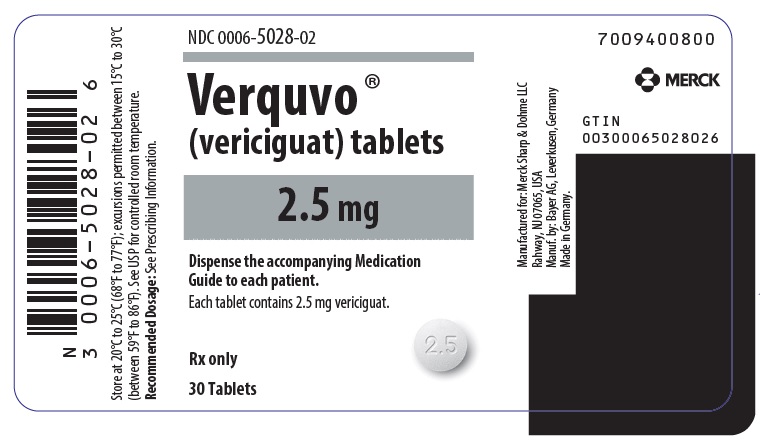
8PRINCIPAL DISPLAY PANEL - 2.5 mg Tablet Bottle Label
NDC 0006-5028-02
Verquvo ®
(vericiguat) tablets
2.5 mg
Dispense the accompanying Medication
Each tablet contains 2.5 mg vericiguat.
Rx only
30 Tablets
PRINCIPAL DISPLAY PANEL - 2.5 mg Bottle Label
9PRINCIPAL DISPLAY PANEL - 5 mg Tablet Bottle Label
NDC 0006-5029-02
Verquvo ®
(vericiguat) tablets
5 mg
Dispense the accompanying Medication
Each tablet contains 5 mg vericiguat.
Rx only
30 Tablets
PRINCIPAL DISPLAY PANEL - 5 mg Bottle Label
10PRINCIPAL DISPLAY PANEL - 10 mg Tablet Bottle Label
NDC 0006-5030-01
Verquvo ®
(vericiguat) tablets
10 mg
Dispense the accompanying Medication
Each tablet contains 10 mg vericiguat.
Rx only
30 Tablets
PRINCIPAL DISPLAY PANEL - 10 mg Bottle Label