Generic Name

Epoprostenol

Brand Names
Flolan, Veletri
FDA approval date: December 08, 1995
Classification: Prostacycline Vasodilator
Form: Injection

What is Flolan (Epoprostenol)?

Epoprostenol for injection is indicated for the treatment of pulmonary arterial hypertension to improve exercise capacity. Studies establishing effectiveness included predominantly patients with NYHA Functional Class III-IV symptoms and etiologies of idiopathic or heritable PAH or PAH associated with connective tissue diseases. Epoprostenol for injection is a prostacyclin vasodilator indicated for the treatment of pulmonary arterial hypertension to improve exercise capacity. Studies establishing effectiveness included predominantly patients with NYHA Functional Class III-IV symptoms and etiologies of idiopathic or heritable PAH or PAH associated with connective tissue diseases.

Approved To Treat

Save this treatment for later
Sign Up
Not sure about your diagnosis?
Check Your Symptoms

Related Clinical Trials

ACTION - The Impact of ERA Switching on Risk Stratification in Pulmonary Arterial Hypertension

Summary: Pulmonary arterial hypertension (PAH) is a rare, progressive, and potentially fatal disease characterized by increased pulmonary vascular resistance and right ventricular dysfunction. Among the four major molecular pathways involved in PAH pathophysiology-nitric oxide, prostacyclin, activin, and endothelin-1 (ET-1)-the endothelin pathway plays a central role. Endothelin-1 acts on ETA and ETB recep...

RECOMPENSE: Right vEntricular COMPENsation With SotatercEpt: a Prospective Single Arm Open Label Phase 4 Study to Evaluate the Effects of Sotatercept on Right Ventricular Function in Pulmonary Arterial Hypertension

Summary: Pulmonary arterial hypertension (PAH) is a progressive disease characterized by vascular remodelling resulting in elevated pressures in the pulmonary artery (PA). This elevated pressure ultimately leads to fulminant right heart failure. Current therapeutic options are limited and are centred around vasodilatory medications such as phosphodiesterase-5 inhibitors and prostacyclin. While these medica...

An Open-label Extension Study to Evaluate Safety and Tolerability of Sotatercept (MK-7962) Administered Using a Weight-banded Approach in Participants With Pulmonary Arterial Hypertension (PAH) on Standard of Care

Summary: Researchers are looking for other ways to treat pulmonary arterial hypertension (PAH). Sotatercept is a study medicine that is designed to treat PAH. A past study, MK-7962-024 (LIGHTRAY) (NCT06664801), learned about the safety and effects of sotatercept in people with PAH. One of the goals of that study was to learn about sotatercept when given at a dose (amount) based on the weight range a person...

Brand Information

    FLOLAN (epoprostenol sodium)
    1INDICATIONS AND USAGE
    FLOLAN is indicated for the treatment of pulmonary arterial hypertension (PAH) (WHO Group I) to improve exercise capacity. Trials establishing effectiveness included predominantly (97%) patients with New York Heart Association (NYHA) Functional Class III-IV symptoms and etiologies of idiopathic or heritable PAH (49%) or PAH associated with connective tissue diseases (51%).
    2DOSAGE FORMS AND STRENGTHS
    For injection: 0.5 mg or 1.5 mg of epoprostenol, freeze-dried powder in a single-dose vial for reconstitution with the supplied diluent.
    3CONTRAINDICATIONS
    FLOLAN is contraindicated in patients with heart failure caused by reduced left ventricular ejection fraction
    FLOLAN is contraindicated in patients with a hypersensitivity to the drug or any of its ingredients.
    4OVERDOSAGE
    Signs and Symptoms
    Hypoxemia, hypotension, and respiratory arrest leading to death have been reported in clinical practice following overdosage of FLOLAN.
    Excessive doses of FLOLAN were associated with flushing, headache, hypotension, tachycardia, nausea, vomiting, and diarrhea during clinical trials.
    One patient with PAH/SSD accidentally received 50 mL of an unspecified concentration of FLOLAN. The patient vomited and became unconscious with an initially unrecordable blood pressure. FLOLAN was discontinued and the patient regained consciousness within seconds.
    Single intravenous doses of FLOLAN at 10 and 50 mg/kg (2,703 and 27,027 times the recommended acute phase human dose based on body surface area) were lethal to mice and rats, respectively. Symptoms of acute toxicity were hypoactivity, ataxia, loss of righting reflex, deep slow breathing, and hypothermia.
    Treatment
    Discontinue or reduce dose of FLOLAN.
    5DESCRIPTION
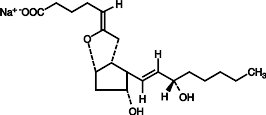
    FLOLAN (epoprostenol sodium) for injection is sterile sodium salt that is a white or off-white powder formulated for intravenous (IV) administration. Each vial of FLOLAN contains epoprostenol sodium equivalent to either 0.5 mg (500,000 ng) or 1.5 mg (1,500,000 ng) epoprostenol, 3.76 mg glycine, 50 mg mannitol, and 2.93 mg sodium chloride. Sodium hydroxide may have been added to adjust pH.
    Epoprostenol (PGI
    epoprostenol sodium chemical structure
    FLOLAN must be reconstituted with pH 12 STERILE DILUENT for FLOLAN.
    pH 12 STERILE DILUENT for FLOLAN is supplied in plastic vials each containing 50 mL of 94 mg glycine, 73.3 mg sodium chloride, sodium hydroxide (added to adjust the pH to 11.7 to 12.3), and Water for Injection. The stability of reconstituted solutions of FLOLAN is pH-dependent and is greater at higher pH.
    6PATIENT COUNSELING INFORMATION
    Advise the patient to read the FDA-approved patient labeling (Patient Information).
    Advise patients:
    • FLOLAN must be reconstituted only with pH 12 STERILE DILUENT for FLOLAN.
    • Reconstituted solutions prepared with pH 12 STERILE DILUENT for FLOLAN do NOT require use with a cold pouch.
    • FLOLAN is infused continuously through a permanent indwelling central venous catheter via a small, portable infusion pump. Thus, therapy with FLOLAN requires commitment by the patient to drug reconstitution, drug administration, and care of the permanent central venous catheter. Patients must adhere to sterile technique in preparing the drug and in the care of the catheter, and even brief interruptions in the delivery of FLOLAN may result in rapid symptomatic deterioration. A patient’s decision to receive FLOLAN should be based upon the understanding that there is a high likelihood that therapy with FLOLAN will be needed for prolonged periods, possibly years. Consider the patient's ability to accept and care for a permanent intravenous catheter and infusion pump.
    • FLOLAN prepared with pH 12 STERILE DILUENT for FLOLAN must not be used with any preparation or administration materials containing PET or PETG. Only use materials provided by a healthcare provider or pharmacist.
    • To adjust infusion rates of FLOLAN only under the direction of a physician.
    • To avoid interruptions in drug delivery, the patient should have access to a backup infusion pump and intravenous infusion sets.
    • To contact their healthcare providers if any unusual bruising or bleeding develops.
    Trademark is owned by or licensed to the GSK group of companies.
    GlaxoSmithKline
    Durham, NC 27701
    ©2023 GSK group of companies or its licensor.
    FLL:11PI