Brand Name

Izervay

Generic Name
Avacincaptad Pegol
View Brand Information
FDA approval date: August 19, 2023
Classification: Complement Inhibitor
Form: Injection

What is Izervay (Avacincaptad Pegol)?

IZERVAY ™ is indicated for the treatment of geographic atrophy secondary to age-related macular degeneration . IZERVAY is a complement inhibitor indicated for the treatment of geographic atrophy secondary to age-related macular degeneration .
Save this treatment for later
Sign Up
Not sure about your diagnosis?
Check Your Symptoms

Related Clinical Trials

A Phase 3/4, Multicenter, Single-arm Clinical Study to Assess the Safety of Intravitreal Administration of ASP3021 in Participants in Japan With Geographic Atrophy Secondary to Age-related Macular Degeneration

Summary: Age-related macular degeneration (AMD) is an eye disease which causes people to lose their vision over time. AMD damages the macula, which is in the middle of the retina - the light sensitive part at the back of the eye. In AMD, the cells in the macula die over time, usually over several years, leading to vision loss. When AMD gets worse, it can turn into either geographic atrophy (GA), neovascula...

A Non-interventional, Observational Study to Evaluate Treatment Patterns and Safety of Avacincaptad Pegol (ACP/IZERVAY™) in Routine Clinical Practice in Patients With Geographic Atrophy Secondary to Age-related Macular Degeneration

Summary: This study is for people who have geographic atrophy due to age-related macular degeneration (AMD). AMD happens when the macula, the light-sensitive layer at the back of the eye called the retina, becomes damaged and causes a person's central vision to worsen. Geographic atrophy is an advanced form of AMD where cells in the retina waste away and die. Over time this can lead to permanent loss of vi...

Brand Information

IZERVAY (avacincaptad pegol)
1INDICATIONS AND USAGE
IZERVAY
2DOSAGE FORMS AND STRENGTHS
Intravitreal solution: 20 mg/mL clear to slightly opalescent, colorless to slightly yellow solution in a single-dose vial.
3ADVERSE REACTIONS
The following potentially serious adverse reactions are described elsewhere in the labeling:
  • Ocular and periocular infections
  • Active intraocular inflammation
  • Endophthalmitis and retinal detachments
  • Neovascular AMD
  • Increase in intraocular pressure
3.1Clinical Trials Experience
Because clinical trials are conducted under widely varying conditions, adverse reaction rates observed in the clinical trials of a drug cannot be directly compared to rates in the clinical trials of another drug and may not reflect the rates observed in practice.
The safety of avacincaptad pegol was evaluated in 733 patients with AMD in two sham-controlled studies (GATHER1 and GATHER2). Of these patients, 292 were treated with intravitreal IZERVAY 2 mg (0.1 mL of 20 mg/mL solution)
Adverse reactions reported in ≥2% of patients who received treatment with IZERVAY pooled across GATHER1 and GATHER2, are listed below in
4DESCRIPTION
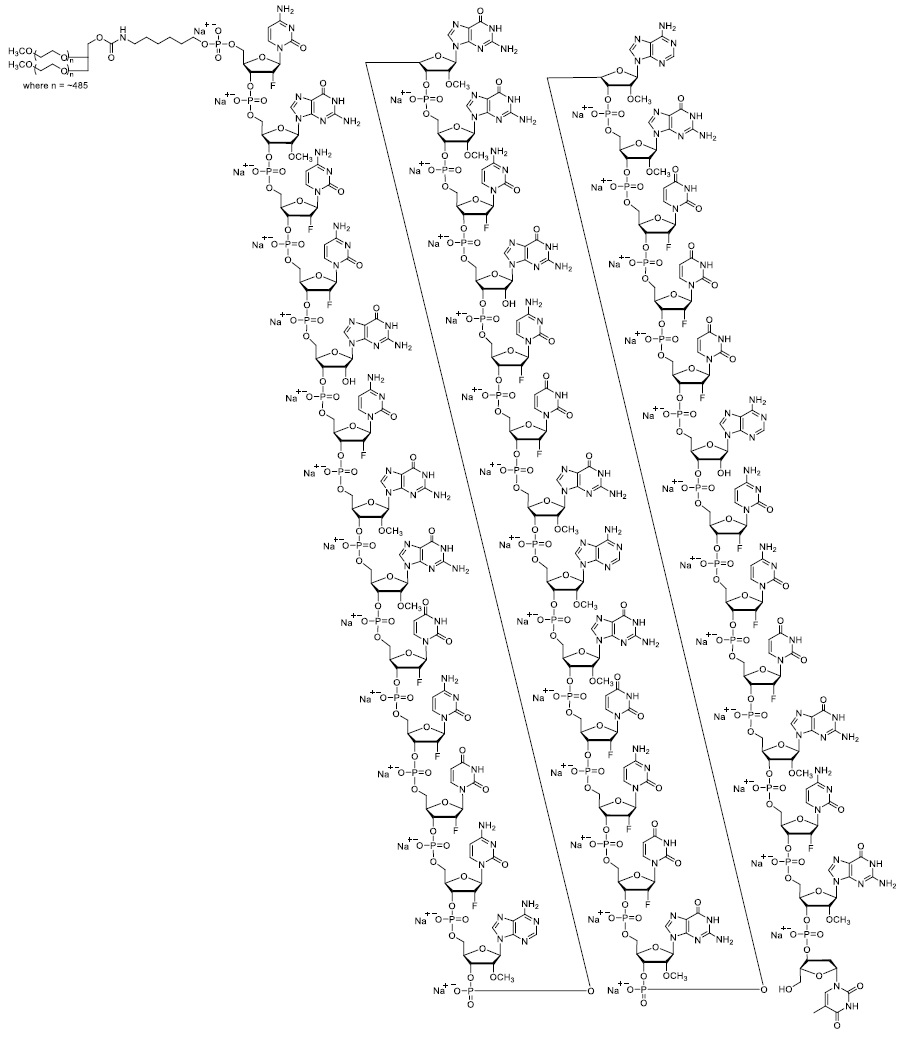
IZERVAY contains avacincaptad pegol sodium, a complement C5 inhibitor. Avacincaptad pegol is a ribonucleic acid (RNA) aptamer, covalently bound to an approximately 43-kiloDalton (kDa) branched polyethylene glycol (PEG) molecule.
The molecular formula of avacincaptad pegol (free acid form) is C
Avacincaptad_Pegol
IZERVAY (avacincaptad pegol intravitreal solution) is a sterile, clear to slightly opalescent, colorless to slightly yellowish solution in a single-dose glass vial for intravitreal administration. Each single-dose vial is designed to deliver 0.1 mL of solution containing 2 mg avacincaptad pegol (oligonucleotide basis), 0.198 mg dibasic sodium phosphate heptahydrate, 0.0256 mg monobasic sodium phosphate monohydrate, and 0.83 mg sodium chloride. IZERVAY is formulated in Water for Injection, with a target pH of 7.3. IZERVAY does not contain an anti-microbial preservative.
5CLINICAL STUDIES
The safety and efficacy of IZERVAY were demonstrated in two randomized, multi-center, double-masked, sham-controlled, 18- and 24-month studies (GATHER1-NCT02686658 and GATHER2-NCT04435366, respectively) in patients with GA due to AMD. Patient ages ranged from 51 to 97 years with a mean of 77 years. In total, 292 patients were treated with avacincaptad pegol 2 mg, and 332 patients received sham.
In GATHER1, patients were treated with either IZERVAY or sham monthly for 18 months. In the primary analysis for GATHER1, the mean rate of GA growth (slope) from baseline to Month 12, measured by Fundus Autofluorescence (FAF), was evaluated at 3 time points: baseline, Month 6, and Month 12. Over a 12-month period, there was a statistically significant reduction of the rate of GA growth (0.10 mm/year; p<0.01 with square root transformed data) in patients treated with IZERVAY compared to sham. The observed results are shown in
In the 24-month GATHER2 study, patients were treated with IZERVAY or sham monthly for the first 12 months. Patients receiving monthly IZERVAY were re-randomized at Month 12 to receive either IZERVAY monthly (EM) or every other month (EOM). Patients treated with sham in the first 12 months continued monthly sham treatment. At any time during the GATHER2 study, patients that developed choroidal neovascularization were concomitantly treated with anti-VEGF therapy.
In GATHER2 analysis, the mean rate of GA growth (slope) measured by FAF was evaluated at 5 time points: baseline, Month 6, Month 12, Month 18, and Month 24. Over a 12-month period, there was a statistically significant reduction of the rate of GA growth (0.05 mm/year; p<0.01 with square root transformed data) in patients treated with IZERVAY EM compared to sham. The annualized rate of GA growth over 24 months in the monthly arm was 2.23 mm
In both studies, treatment effects in all pre-specified subgroups (e.g., age, gender, baseline GA disc area) were consistent with the results in the overall population.
EM: monthly
6PATIENT COUNSELING INFORMATION
Advise patients that following IZERVAY administration, patients are at risk of developing neovascular AMD, endophthalmitis, elevated intraocular pressure and retinal detachments. If the eye becomes red, sensitive to light, painful, or if a patient develops a change in vision, instruct the patient to seek immediate care from an ophthalmologist
Patients may experience temporary visual disturbances and blurring after an intravitreal injection with IZERVAY and the associated eye examinations
IZERVAY
Distributed by:
Astellas Pharma US, Inc.
Northbrook, IL 60062
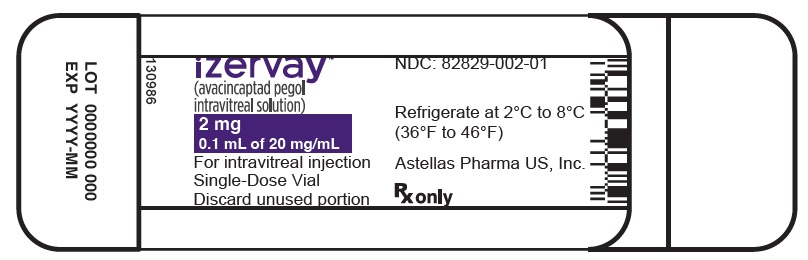
7PRINCIPAL DISPLAY PANEL
NDC: 82829-002-01
izervay
(avacincaptad pegol
intravitreal solution)
2 mg
0.1 mL of 20 mg/mL
For intravitreal injection
Single-Dose Vial
Discard unused portion
Refrigerate at 2°C to 8°C
Astellas Pharma US, Inc.
Rx only
Figure
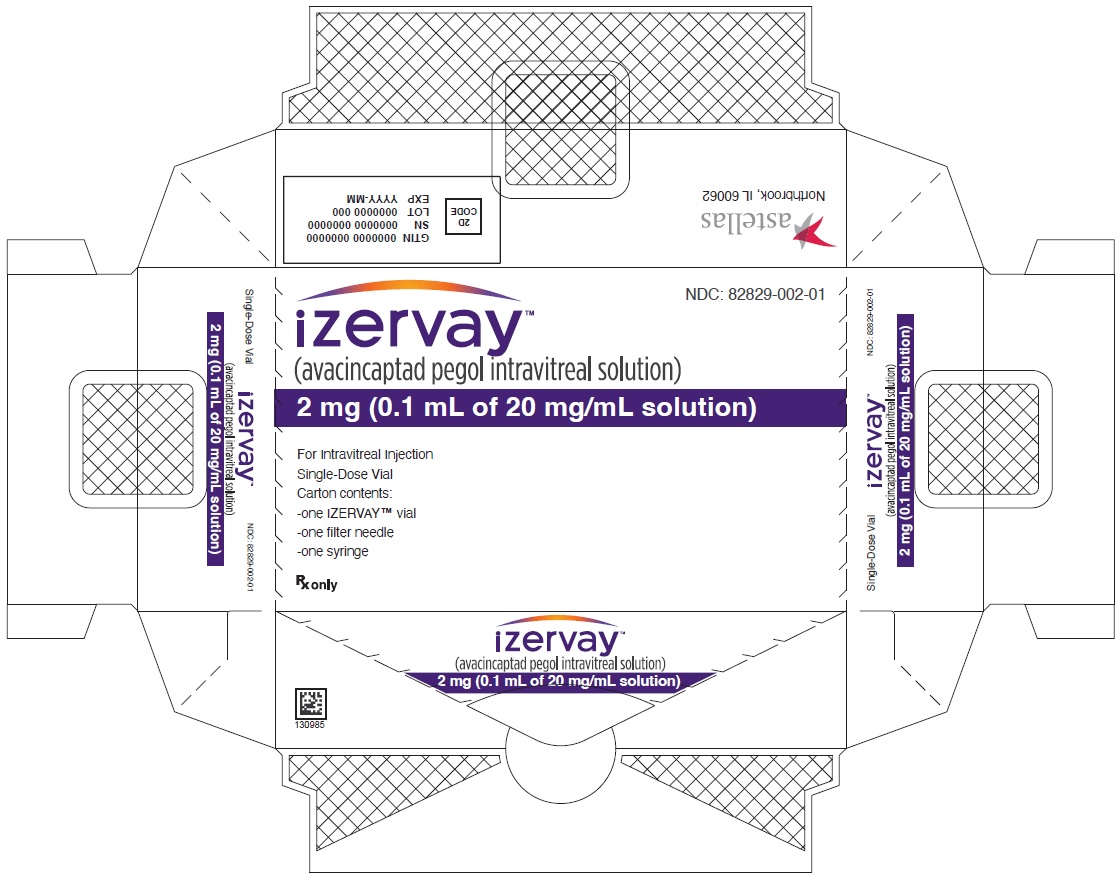
8PRINCIPAL DISPLAY PANEL
NDC: 82829-002-01
izervay
(avacincaptad pegol intravitreal solution)
2 mg (0.1 mL of 20 mg/mL solution)
For Intravitreal Injection
Single-Dose Vial
Carton contents:
-one IZERVAY
-one filter needle
-one syringe
Rx only
Figure
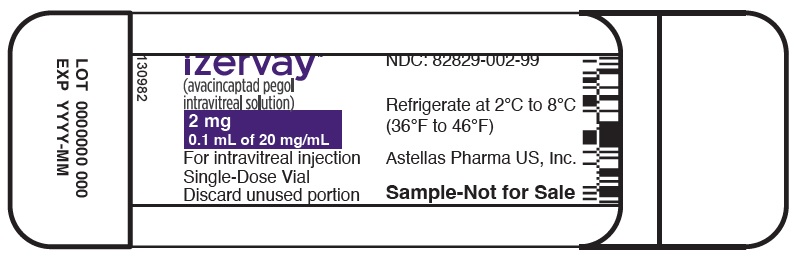
9PRINCIPAL DISPLAY PANEL
NDC: 82829-002-99
izervay
(avacincaptad pegol
intravitreal solution)
2 mg
0.1 mL of 20 mg/mL
For intravitreal injection
Single-Dose Vial
Discard unused portion
Refrigerate at 2°C to 8°C
Astellas Pharma US, Inc.
Sample-Not for Sale
Figure
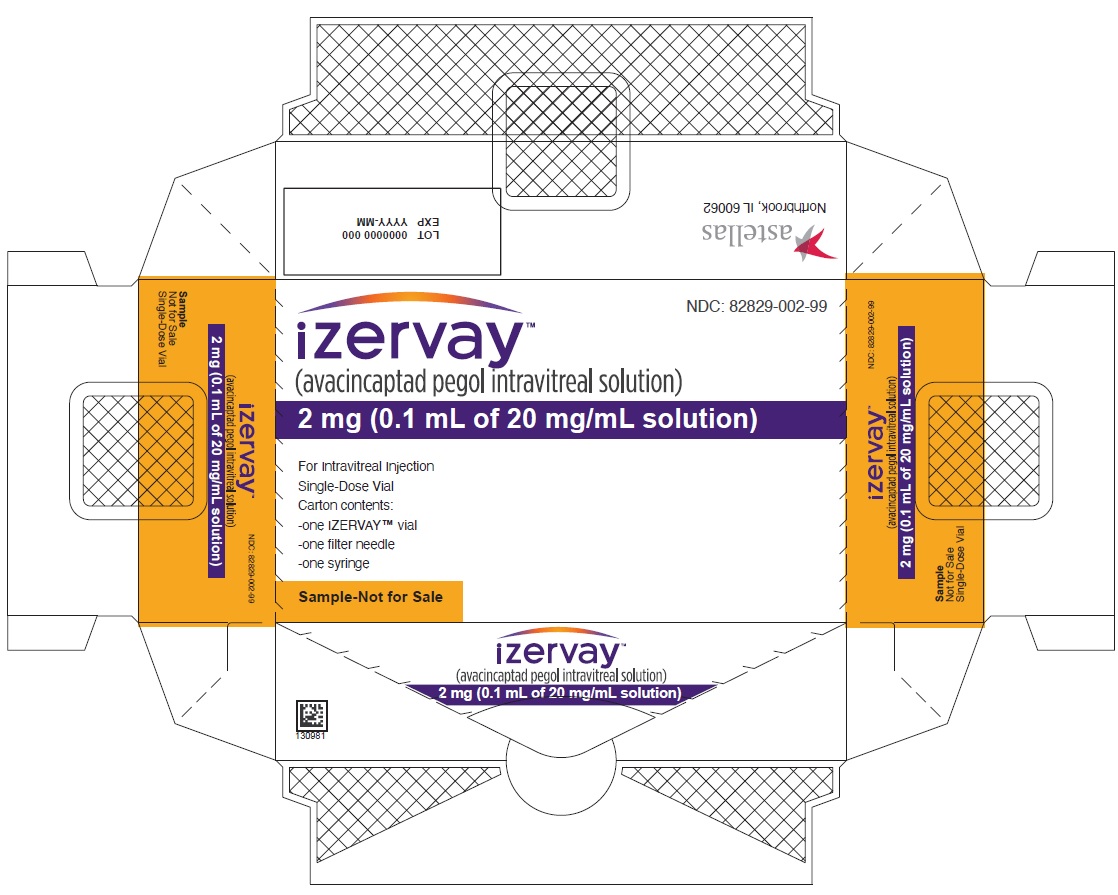
10PRINCIPAL DISPLAY PANEL
NDC: 82829-002-99
izervay
(avacincaptad pegol intravitreal solution)
2 mg (0.1 mL of 20 mg/mL solution)
For Intravitreal Injection
Single-Dose Vial
Carton contents:
-one IZERVAY
-one filter needle
-one syringe
Sample-Not for Sale
Figure