Brand Name

Scemblix

Generic Name
Asciminib
View Brand Information
FDA approval date: October 29, 2021
Form: Tablet

What is Scemblix (Asciminib)?

For many people living with chronic myeloid leukemia (CML), managing the disease means long-term treatment, frequent monitoring, and adapting to therapies that can lose effectiveness over time. Scemblix (asciminib) represents a newer and more targeted approach for patients whose cancer has not responded to earlier treatments. It brings hope to individuals who have struggled with resistance or intolerance to other medications, offering another chance at remission and stability in daily life. 

Scemblix is a tyrosine kinase inhibitor (TKI) specifically approved for adults with Philadelphia chromosome–positive chronic myeloid leukemia (Ph+ CML) in the chronic phase. Developed by Novartis, it belongs to a unique subclass known as a STAMP inhibitor, short for Specifically Targeting the ABL Myristoyl Pocket. Unlike traditional TKIs, Scemblix works in a novel way to control cancer growth, making it a valuable treatment for patients who have already received other TKIs such as imatinib, dasatinib, or nilotinib. 

As one of the first drugs of its kind, Scemblix expands treatment options for people living with CML and reflects significant progress in personalized cancer therapy. 

What does Scemblix do? 

Scemblix is prescribed to treat adults with chronic myeloid leukemia (CML) in the chronic phase who have previously been treated with two or more other tyrosine kinase inhibitors. It is also approved for use in patients whose leukemia cells carry the T315I mutation, a genetic change that makes many other TKIs ineffective. 

CML is a type of blood cancer that starts in the bone marrow and causes the body to produce too many white blood cells. This overproduction can crowd out healthy blood cells, leading to fatigue, infections, and other health problems. 

By targeting the abnormal protein responsible for driving this uncontrolled growth, Scemblix helps reduce the number of leukemia cells and restore healthy blood cell balance. In clinical trials, many patients achieved major molecular responses meaning a significant reduction in cancer-related genetic material in their blood often with fewer side effects compared to older TKIs (FDA, 2021). 

For patients who have exhausted other treatment options, Scemblix offers a renewed sense of control and hope for long-term disease management. 

How does Scemblix work? 

Unlike traditional CML medications that block the active site of the BCR-ABL1 protein, Scemblix works differently. It binds to a unique site on the BCR-ABL1 enzyme, called the myristoyl pocket, rather than the usual ATP-binding site targeted by older TKIs. 

This distinctive mechanism allows Scemblix to shut down the activity of the abnormal protein more precisely. By doing so, it prevents leukemia cells from multiplying while sparing many normal cells. 

The clinical significance of this is substantial: Scemblix can still work even when mutations like T315I make other TKIs ineffective. This means patients whose disease has become resistant to standard treatments have an alternative that directly attacks the resistant cancer pathway. 

In simpler terms, Scemblix helps “turn off” the molecular switch that keeps leukemia cells growing uncontrollably offering a smarter and often better-tolerated way to control the disease. 

Scemblix side effects 

As with all cancer therapies, Scemblix can cause side effects, although not everyone experiences them. Many are manageable and lessen as the body adjusts to treatment. 

Common side effects may include: 

  • Fatigue or weakness[Text Wrapping Break] 
  • Headache[Text Wrapping Break] 
  • Muscle or joint pain[Text Wrapping Break] 
  • Nausea or stomach discomfort[Text Wrapping Break] 
  • Rash or mild skin reactions[Text Wrapping Break] 
  • Upper respiratory infections 

Serious side effects, though less common, can include: 

  • Low blood cell counts (anemia, neutropenia, or thrombocytopenia)[Text Wrapping Break] 
  • Elevated liver enzyme levels[Text Wrapping Break] 
  • High blood pressure[Text Wrapping Break] 
  • Pancreatitis (inflammation of the pancreas)[Text Wrapping Break] 
  • Allergic reactions such as swelling, rash, or difficulty breathing 

Contact a doctor if you experience severe fatigue, fever, unusual bleeding, or shortness of breath. Inform your doctor about all medications and supplements to prevent harmful interactions.  

Scemblix is not for those with severe liver issues, or who are pregnant or breastfeeding. Women of childbearing potential need contraception during and after treatment. 

Scemblix dosage 

Scemblix is an oral tablet taken once or twice daily, with or without food, swallowed whole. Dosing is determined by the doctor based on prior treatments, response, and overall health. 

Regular medical monitoring is crucial. Physicians conduct blood tests (for cell counts, platelets), liver function tests (for medication safety), and molecular tests (for BCR-ABL1 levels and treatment effectiveness).  

Older adults or those with liver disease may require closer monitoring. Side effects may necessitate dosage adjustments or treatment pauses. 

Does Scemblix have a generic version? 

As of 2025, Scemblix (asciminib) does not have a generic version available. It is currently a patented brand-name medication manufactured by Novartis and approved by the U.S. Food and Drug Administration (FDA) in 2021. However, international versions may exist in other markets. 

Scemblix, a new targeted therapy, won’t have generics until patent expiration. Once available, generics will offer comparable safety and efficacy. Patients can explore financial assistance or insurance for cost management. 

Conclusion 

Scemblix (asciminib) represents a major step forward in the treatment of chronic myeloid leukemia, especially for patients who have struggled with resistance to older medications. By targeting a new molecular site, it provides a fresh way to control CML with precision and potentially fewer side effects. 

While treatment with Scemblix requires ongoing monitoring and commitment, it offers hope for long-term disease control and improved quality of life. Every patient’s journey is different, but with guidance from a skilled healthcare provider and consistent follow-up care, Scemblix can be a powerful ally in managing CML and helping patients move forward with greater confidence and stability. 

References 

  1. U.S. Food and Drug Administration (FDA). (2021). FDA approves asciminib for Philadelphia chromosome-positive chronic myeloid leukemia. Retrieved from https://www.fda.gov[Text Wrapping Break] 
  1. Mayo Clinic. (2024). Asciminib (oral route): Drug information and side effects. Retrieved from https://www.mayoclinic.org[Text Wrapping Break] 
  1. MedlinePlus. (2024). Asciminib – Medication guide. National Library of Medicine. Retrieved from https://medlineplus.gov[Text Wrapping Break] 
  1. National Cancer Institute (NCI). (2024). Chronic myeloid leukemia treatment (PDQ®)–Patient version. Retrieved from https://www.cancer.gov[Text Wrapping Break] 

Save this treatment for later
Sign Up
Not sure about your diagnosis?
Check Your Symptoms

Related Clinical Trials

Phase I/II Study of the Combination of Blinatumomab and Asciminib in Patients With Philadelphia Chromosome-Positive Acute Lymphoblastic Leukemia

Summary: To learn if the combination of blinatumomab and asciminib can help to control Ph+ ALL.

Phase II Study Assessing Efficacy and Safety of Asciminib in Patients With Newly Diagnosed Chronic Myeloid Leukemia in Chronic Phase.

Summary: To learn if asciminib can help to control CML. The safety and effects of this drug will also be studied.

Phase II Study of Asciminib for Second-line Treatment of Chronic Phase Chronic Myeloid Leukemia

Summary: This is an open label, phase 2 study investigating asciminib in patients previously treated with one line of TKI therapy.

Brand Information

SCEMBLIX (asciminib)
1INDICATIONS AND USAGE
SCEMBLIX is indicated for the treatment of adult patients with:
  • Newly diagnosed Philadelphia chromosome-positive chronic myeloid leukemia (Ph+ CML) in chronic phase (CP).
  • Previously treated Ph+ CML in CP.
  • Ph+ CML in CP with the T315I mutation.
2DOSAGE FORMS AND STRENGTHS
  • 20 mg asciminib film-coated tablets: pale yellow, unscored, round, biconvex, with beveled edges, film-coated tablet debossed with “20” on one side and the “Novartis” logo on the other side.
  • 40 mg asciminib film-coated tablets: violet white, unscored, round, biconvex, with beveled edges, film-coated tablet debossed with “40” on one side and the “Novartis” logo on the other side.
  • 100 mg asciminib film-coated tablets: light red, unscored, round, biconvex, with beveled edges, film-coated tablet debossed with “100” on one side and the “Novartis” logo on the other side.
3CONTRAINDICATIONS
None.
4ADVERSE REACTIONS
The following clinically significant adverse reactions can occur with SCEMBLIX and are discussed in greater detail in other sections of the labeling:
  • Myelosuppression
  • Pancreatic Toxicity
  • Hypertension
  • Hypersensitivity
  • Cardiovascular Toxicity
4.1Clinical Trials Experience
Because clinical trials are conducted under widely varying conditions, adverse reaction rates observed in the clinical trials of a drug cannot be directly compared to rates in the clinical trials of another drug and may not reflect the rates observed in practice.
The pooled safety population described in the WARNINGS AND PRECAUTIONS reflect exposure to SCEMBLIX at 10 mg to 200 mg orally twice daily (between 0.25 to 5 times the recommended dosage for the 80 mg daily dosage and between 0.05 times and up to the recommended dosage for the 200 mg twice daily dosage) in 556 patients enrolled in one of three clinical trials, including patients with Ph+ CML in CP receiving SCEMBLIX as monotherapy: study CABL001J12301 (ASC4FIRST), study CABL001A2301 (ASCEMBL) and study CABL001X2101
The most common (≥ 20%) adverse reactions in patients who received SCEMBLIX were musculoskeletal pain, rash, fatigue, upper respiratory tract infection, headache, abdominal pain, arthralgia, and diarrhea.
Adverse Reactions in Patients with Newly Diagnosed Ph+ CML-CP
The ASC4FIRST clinical trial randomized 405 patients with newly diagnosed Ph+ CML-CP to receive SCEMBLIX 80 mg once daily or investigator selected tyrosine kinase inhibitors (IS-TKIs). IS-TKIs included imatinib (400 mg once daily), nilotinib (300 mg twice daily), dasatinib (100 mg once daily), or bosutinib (400 mg once daily)
Serious adverse reactions occurred in 15% of patients who received SCEMBLIX. Serious adverse reactions in ≥ 1% included pancreatitis (1%), musculoskeletal pain (1%), and peripheral neuropathy (1%).
Permanent discontinuation due to an adverse reaction occurred in 5% of patients receiving SCEMBLIX. Adverse reactions which resulted in permanent discontinuation of SCEMBLIX in ≥ 1% of patients included pancreatic enzymes increased (1.5%), cardiovascular toxicity (1%), and thrombocytopenia (1%).
Dosage interruptions of SCEMBLIX due to an adverse reaction occurred in 33% of patients. Adverse reactions which required dosage interruption in > 5% of patients included thrombocytopenia (13%) and neutropenia (10%).
Dose reductions of SCEMBLIX due to an adverse reaction occurred in 6% of patients. Adverse reactions which required dose reductions in > 1% of patients included thrombocytopenia (2.5%) and neutropenia (1.5%).
The most common (≥ 20%) adverse reactions in patients who received SCEMBLIX were musculoskeletal pain and rash.
The most common select laboratory abnormalities that worsened from baseline in ≥ 20% of patients who received SCEMBLIX were lymphocyte count decreased, leukocyte count decreased, platelet count decreased, neutrophil count decreased, calcium corrected decreased, lipase increased, cholesterol increased, uric acid increased, alanine aminotransferase (ALT) increased, alkaline phosphatase (ALP) increased, hemoglobin decreased, and triglycerides increased.
Table 3 summarizes the adverse reactions in ASC4FIRST.
Clinically relevant adverse reactions in < 10% of patients treated with SCEMBLIX in ASC4FIRST included: nausea, cough, pruritus, dry eye, pyrexia, vomiting, dizziness, edema, lower respiratory tract infection, decreased appetite, hypothyroidism, urticaria, arrhythmia, influenza, neuropathy peripheral, hemorrhage, urinary tract infection, pneumonia, dyspnea, pancreatitis, vision blurred, febrile neutropenia, and palpitations.
Table 4 summarizes the laboratory abnormalities in ASC4FIRST.
Adverse Reactions in Patients with Ph+ CML-CP, Previously Treated with Two or More TKIs
The clinical trial randomized and treated 232 patients with Ph+ CML-CP, previously treated with two or more TKIs to receive SCEMBLIX 40 mg twice daily or bosutinib 500 mg once daily (ASCEMBL)
Serious adverse reactions occurred in 18% of patients who received SCEMBLIX. Serious adverse reactions in ≥ 1% included cardiac failure congestive (1.9%), pyrexia (1.9%), urinary tract infection (1.9%), headache (1.3%), and thrombocytopenia (1.3%). Two patients (1.3%) had a fatal adverse reaction, one each for mesenteric artery thrombosis and ischemic stroke.
Permanent discontinuation of SCEMBLIX due to an adverse reaction occurred in 8% of patients. Adverse reactions which resulted in permanent discontinuation of SCEMBLIX in > 2% of patients included thrombocytopenia (3.2%) and neutropenia (2.6%).
Dosage interruptions of SCEMBLIX due to an adverse reaction occurred in 41% of patients. Adverse reactions which required dosage interruption in > 5% of patients included thrombocytopenia (19%) and neutropenia (18%).
Dose reductions of SCEMBLIX due to an adverse reaction occurred in 6% of patients. Adverse reactions which required dose reductions in > 1% of patients included thrombocytopenia (4.5%) and neutropenia (1.3%).
The most common (≥ 20%) adverse reactions in patients who received SCEMBLIX were upper respiratory tract infections, musculoskeletal pain, headache, and fatigue.
The most common select laboratory abnormalities that worsened from baseline in ≥ 20% of patients who received SCEMBLIX were platelet count decreased, triglycerides increased, neutrophil count decreased, hemoglobin decreased, creatine kinase increased, alanine aminotransferase (ALT) increased, aspartate aminotransferase (AST) increased, uric acid increased, and lymphocyte count decreased.
Table 5 summarizes the adverse reactions in ASCEMBL.
Clinically relevant adverse reactions in < 10% of patients treated with SCEMBLIX in ASCEMBL included: cough, dyspnea, pleural effusion, dizziness, neuropathy peripheral, edema, pyrexia, vomiting, constipation, dyslipidemia, decreased appetite, pruritus, urticaria, lower respiratory tract infection, influenza, urinary tract infection, pneumonia, hemorrhage, arrhythmia (including electrocardiogram QT prolonged), palpitations, cardiac failure congestive, vision blurred, dry eye, hypothyroidism, and febrile neutropenia.
Table 6 summarizes the laboratory abnormalities in ASCEMBL.
Adverse Reactions in Patients with Ph+ CML-CP with the T315I Mutation
The single-arm clinical trial enrolled patients with Ph+ CML-CP with the T315I mutation
Serious adverse reactions occurred in 23% of patients who received SCEMBLIX. Serious adverse reactions in > 1% included abdominal pain (4.2%), vomiting (4.2%), pneumonia (4.2%), musculoskeletal pain (2.1%), headache (2.1%), hemorrhage (2.1%), constipation (2.1%), arrhythmia (2.1%), and pleural effusion (2.1%).
Permanent discontinuation of SCEMBLIX due to an adverse reaction occurred in 10% of patients. Adverse reactions which resulted in permanent discontinuation of SCEMBLIX in > 2% of patients included pancreatic enzymes increased (2.1%).
Dosage interruptions of SCEMBLIX due to an adverse reaction occurred in 31% of patients. Adverse reactions which required dosage interruption in > 5% of patients included pancreatic enzymes increased (17%) and thrombocytopenia (8%).
Dose reductions of SCEMBLIX due to an adverse reaction occurred in 23% of patients. Adverse reactions which required dose reductions in > 1% of patients included pancreatic enzymes increased (10%), abdominal pain (4.2%), anemia (2.1%), blood bilirubin increased (2.1%), dizziness (2.1%), fatigue (2.1%), hepatic enzymes increased (2.1%), musculoskeletal pain (2.1%), nausea (2.1%), neutropenia (2.1%), pruritus (2.1%), and thrombocytopenia (2.1%).
The most common (≥ 20%) adverse reactions in patients who received SCEMBLIX were musculoskeletal pain, fatigue, nausea, rash, and diarrhea.
The most common select laboratory abnormalities that worsened from baseline in ≥ 20% of patients who received SCEMBLIX were alanine aminotransferase (ALT) increased, lipase increased, triglycerides increased, hemoglobin decreased, neutrophil count decreased, lymphocyte count decreased, phosphate decreased, aspartate aminotransferase (AST) increased, amylase increased, platelet count decreased, and bilirubin increased.
Table 7 summarizes adverse reactions in study X2101.
Clinically relevant adverse reactions in < 10% of patients treated with SCEMBLIX in X2101 included: constipation, pancreatitis, pyrexia, dizziness, neuropathy peripheral, pneumonia, lower respiratory tract infection, dyspnea, pleural effusion, dry eye, vision blurred, arrhythmia, palpitations, cardiac failure congestive, decreased appetite, dyslipidemia, hypersensitivity, and urticaria.
Table 8 summarizes laboratory abnormalities in X2101.
5DESCRIPTION
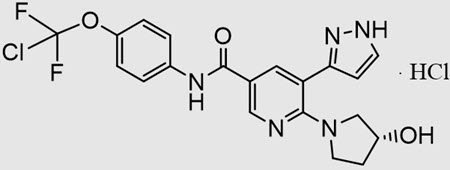
SCEMBLIX (asciminib) is a kinase inhibitor. The chemical name of the drug substance is
chemical structure of asciminib hydrochloride
SCEMBLIX film-coated tablets are supplied for oral use with three strengths that contain 20 mg, 40 mg and 100 mg of asciminib (equivalent to 21.62 mg, 43.24 mg and 108.10 mg, respectively, of asciminib hydrochloride). The tablets contain colloidal silicon dioxide, croscarmellose sodium, ferric oxide, hydroxypropyl cellulose, lactose monohydrate, lecithin, magnesium stearate, microcrystalline cellulose, polyvinyl alcohol, talc, titanium dioxide, and xanthan gum. The 20 mg tablets contain ferric oxide, yellow and ferric oxide, red. The 40 mg and 100 mg tablets contain ferrosoferric oxide and ferric oxide, red.
6HOW SUPPLIED/STORAGE AND HANDLING
SCEMBLIX tablets are available as:
  • SCEMBLIX (asciminib) 20 mg film-coated tablets are supplied as pale yellow, unscored, round, biconvex, with beveled edges, film-coated tablets containing 20 mg of asciminib. Each tablet is debossed with “20” on one side and the “Novartis” logo on the other side.
  • SCEMBLIX (asciminib) 40 mg film-coated tablets are supplied as violet white, unscored, round, biconvex, with beveled edges, film-coated tablets containing 40 mg of asciminib. Each tablet is debossed with “40” on one side and the “Novartis” logo on the other side.
  • SCEMBLIX (asciminib) 100 mg film-coated tablets are supplied as light red, unscored, round, biconvex, with beveled edges, film-coated tablets containing 100 mg of asciminib. Each tablet is debossed with “100” on one side and the “Novartis” logo on the other side.
Store at 20°C to 25°C (68°F to 77°F); excursions permitted between 15°C and 30°C (59°F and 86°F) [see USP Controlled Room Temperature]. Dispense and store in the original container in order to protect from moisture.
7PATIENT COUNSELING INFORMATION
Advise the patient to read the FDA-approved patient labeling (Patient Information).
Myelosuppression
Inform patients of the possibility of developing low blood cell counts. Advise patients to immediately report fever, any suggestion of infection, or signs or symptoms suggestive of bleeding or easy bruising
Pancreatic Toxicity
Inform patients of the possibility of developing pancreatitis that may be accompanied by nausea, vomiting, severe abdominal pain, or abdominal discomfort, and to promptly report these symptoms
Hypertension
Inform patients of the possibility of developing hypertension. Advise patients to contact their healthcare provider for elevated blood pressure or if symptoms of hypertension occur, including confusion, headache, dizziness, chest pain, or shortness of breath
Hypersensitivity
Advise the patient to discontinue SCEMBLIX and seek immediate medical attention if any signs or symptoms of a hypersensitivity reaction, such as rash, edema, or bronchospasm occur
Cardiovascular Toxicity
Inform patients of the possibility of the occurrence of cardiovascular toxicity, especially those with a history of cardiovascular risk factors. Advise patients to immediately contact their healthcare provider or get medical help if they develop cardiovascular signs and symptoms
Embryo-Fetal Toxicity
Advise females to inform their healthcare provider if they are pregnant or become pregnant. Inform female patients of the potential risk to a fetus
Advise females of reproductive potential to use effective contraception during treatment and for 1 week after receiving the last dose of SCEMBLIX
Lactation
Advise women not to breastfeed during treatment with SCEMBLIX and for 1 week after the last dose
Infertility
Advise females of reproductive potential of the potential for impaired fertility from SCEMBLIX
Drug Interactions
Advise patients that SCEMBLIX and certain other medicines, including over-the-counter medications or herbal supplements, can interact with each other and may alter the effects of SCEMBLIX
Instructions for Taking SCEMBLIX
Advise patients to take SCEMBLIX exactly as prescribed and not to change their dose or schedule or to stop taking SCEMBLIX unless they are told to do so by their healthcare provider.
Advise patients to take SCEMBLIX orally without food. Advise patients to avoid food for at least 2 hours before and 1 hour after taking SCEMBLIX. SCEMBLIX tablets should be swallowed whole. Patients should not break, crush, or chew the tablets
Advise patients that if they take SCEMBLIX once daily and miss a dose by more than 12 hours to skip the missed dose. Advise patients that if they take SCEMBLIX twice daily and miss a dose by more than 6 hours to skip the missed dose. Advise patients to take the next dose as scheduled
Distributed by:
© Novartis
T2025-68
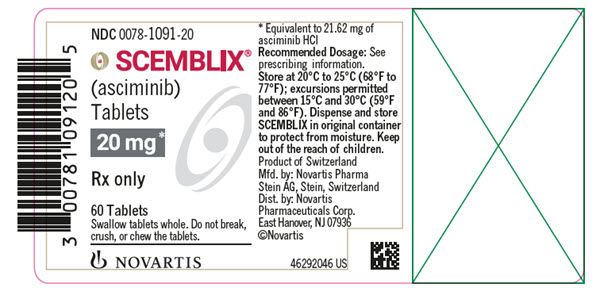
8PRINCIPAL DISPLAY PANEL
NDC 0078-1091-20
SCEMBLIX
(asciminib)
20 mg
Rx only
60 Tablets
Swallow tablets whole. Do not break,
NOVARTIS
PRINCIPAL DISPLAY PANEL
								NDC 0078-1091-20
								SCEMBLIX®
								(capmatinib) Tablets
								20 mg*
								Rx only
								60 Tablets
								Swallow tablets whole. Do not break, crush, or chew the tablets.
								NOVARTIS
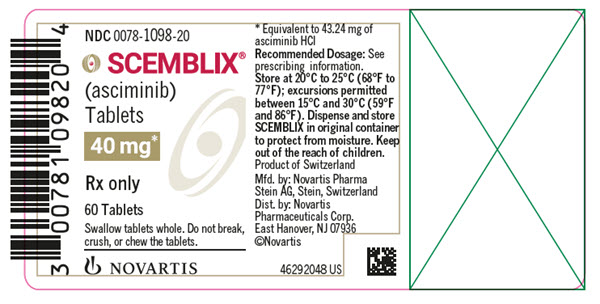
9PRINCIPAL DISPLAY PANEL
NDC 0078-1098-20
SCEMBLIX
(asciminib)
40 mg
Rx only
60 Tablets
Swallow tablets whole. Do not break,
NOVARTIS
PRINCIPAL DISPLAY PANEL
								NDC 0078-1098-20
								SCEMBLIX®
								(asciminib) Tablets
								40 mg*
								Rx only
								60 Tablets
								Swallow tablets whole. Do not break, crush, or chew the tablets.
								NOVARTIS
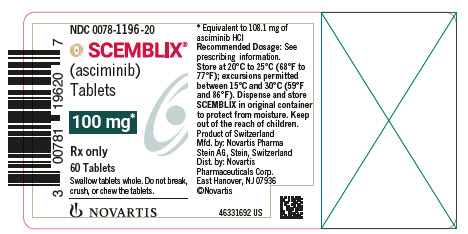
10PRINCIPAL DISPLAY PANEL
NDC 0078-1196-20
SCEMBLIX
(asciminib)
100 mg
Rx only
60 Tablets
Swallow tablets whole. Do not break,
NOVARTIS
PRINCIPAL DISPLAY PANEL
								NDC 0078-1196-20
								SCEMBLIX®
								(asciminib) Tablets
								100 mg*
								Rx only
								60 Tablets
								Swallow tablets whole. Do not break, crush, or chew the tablets.
								NOVARTIS