Brand Name

Ojemda

Generic Name
Tovorafenib
View Brand Information
FDA approval date: April 30, 2024
Classification: Kinase Inhibitor
Form: Tablet, Kit

What is Ojemda (Tovorafenib)?

OJEMDA is indicated for the treatment of patients 6 months of age and older with relapsed or refractory pediatric low-grade glioma harboring a BRAF fusion or rearrangement, or BRAF V600 mutation. This indication is approved under accelerated approval based on response rate and duration of response. Continued approval for this indication may be contingent upon verification and description of clinical benefit in a confirmatory trial. OJEMDA is a kinase inhibitor indicated for the treatment of patients 6 months of age and older with relapsed or refractory pediatric low-grade glioma harboring a BRAF fusion or rearrangement, or BRAF V600 mutation. This indication is approved under accelerated approval based on response rate and duration of response. Continued approval for this indication may be contingent upon verification and description of clinical benefit in a confirmatory trial.

Approved To Treat

Save this treatment for later
Sign Up
Not sure about your diagnosis?
Check Your Symptoms

Related Clinical Trials

A Phase 1 Study of Combination Tovorafenib (DAY101) and Rituximab Treatment in Relapsed or Refractory Classical Hairy Cell Leukemia and Phase 2 Randomized Study Comparing Tovorafenib (DAY101) and Rituximab With Cladribine and Rituximab for Front-Line Treatment of Classical Hairy Cell Leukemia

Summary: This phase I/II trial tests the safety, side effects, and effectiveness of tovorafenib in combination with rituximab in patients with classical hairy cell leukemia (cHCL) that has come back after a period of improvement (recurrent) or that has not responded to previous treatment (refractory) and compares the effect of tovorafenib and rituximab to current standard treatment of cladribine and rituxi...

Phase 2 Study of Tovorafenib (DAY101) in Relapsed and Refractory Langerhans Cell Histiocytosis

Summary: This phase II trial tests the safety, side effects, best dose and activity of tovorafenib (DAY101) in treating patients with Langerhans cell histiocytosis that is growing, spreading, or getting worse (progressive), has come back (relapsed) after previous treatment, or does not respond to therapy (refractory). Langerhans cell histiocytosis is a type of disease that occurs when the body makes too ma...

LOGGIC/FIREFLY-2: A Phase 3, Randomized, International Multicenter Trial of DAY101 Monotherapy Versus Standard of Care Chemotherapy in Patients With Pediatric Low-Grade Glioma Harboring an Activating RAF Alteration Requiring First-Line Systemic Therapy

Summary: This is a 2-arm, randomized, open-label, multicenter, global, Phase 3 trial to evaluate the efficacy, safety, and tolerability of tovorafenib monotherapy versus standard of care (SoC) chemotherapy in participants with pediatric low-grade glioma (LGG) harboring an activating rapidly accelerated fibrosarcoma (RAF) alteration requiring first-line systemic therapy.

Brand Information

OJEMDA (tovorafenib)
1INDICATIONS AND USAGE
OJEMDA is indicated for the treatment of patients 6 months of age and older with relapsed or refractory pediatric low-grade glioma (LGG) harboring a
This indication is approved under accelerated approval based on response rate and duration of response
2DOSAGE FORMS AND STRENGTHS
Tablets:
  • 100 mg: orange, film-coated, oval tablets debossed with "100"; on one side and "D101" on the opposite side. Each tablet contains 100 mg of tovorafenib.
For Oral Suspension:
  • 25 mg/mL: white to off white powder. After reconstitution, each mL of strawberry flavored tovorafenib suspension contains 25 mg of tovorafenib. Each bottle delivers 300 mg of tovorafenib in 12 mL.
3CONTRAINDICATIONS
None
4ADVERSE REACTIONS
The following clinically significant adverse reactions are described elsewhere in the labeling:
  • Hemorrhage
  • Skin Toxicity Including Photosensitivity
  • Hepatotoxicity
  • Effect on Growth
4.1Clinical Trials Experience
Because clinical trials are conducted under widely varying conditions, adverse reaction rates observed in the clinical trials of a drug cannot be directly compared to rates in the clinical trials of another drug and may not reflect the rates observed in practice.
The safety population described in WARNINGS AND PRECAUTIONS reflects exposure to OJEMDA taken orally once weekly at a dose based on body surface area
5DESCRIPTION
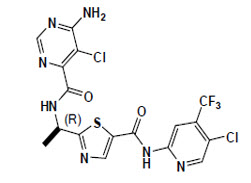
OJEMDA contains tovorafenib, a kinase inhibitor. Tovorafenib has the molecular formula C
Chemical Structure
It is a white to off-white powder. The solubility of tovorafenib at 37ºC is ≤ 3 micrograms/mL from pH 1.2 to 8 in aqueous media.
OJEMDA (tovorafenib) tablets are supplied as 100 mg strength tablets for oral administration. Each tablet contains 100 mg tovorafenib and the following inactive ingredients: copovidone, colloidal silicon dioxide, croscarmellose sodium, magnesium stearate, microcrystalline cellulose, and orange film coating (hypromellose, polyethylene glycol 8000, titanium dioxide, ferric oxide yellow, ferric oxide red).
OJEMDA (tovorafenib) for oral suspension is a white to off white powder which produces a white suspension when reconstituted with water. Each mL of reconstituted tovorafenib suspension contains 25 mg of tovorafenib and the following inactive ingredients: artificial strawberry flavor, colloidal silicon dioxide, copovidone, maltodextrin, mannitol, microcrystalline cellulose, simethicone, sodium lauryl sulfate, and sucralose.
6CLINICAL STUDIES
The efficacy of OJEMDA was evaluated in a multicenter, open-label, single-arm clinical trial (FIREFLY-1; NCT04775485). Eligible patients (N=76) were required to have a relapsed or refractory pediatric low-grade glioma (LGG) harboring an activating
Patients received OJEMDA approximately 420 mg/m
Tumor assessments were performed every 12 weeks.
The major efficacy outcome measure was overall response rate (ORR), defined as the proportion of patients with complete response (CR), partial response (PR), or minor response (MR) by blinded independent central review based on RAPNO-LGG (Response Assessment in Pediatric Neuro-Oncology) criteria. Additional efficacy outcome measures were duration of response, time to response, and ORR by independent review based on RANO-LGG (2011) criteria.
The efficacy population included 76 patients who had measurable disease at baseline and who received OJEMDA. The median age was 8.5 years (range 2 to 21 years); 53% were male; 61% White, 7% Asian, 2.6% Black or African American, 3.9% multiple races, 8% other race, 18% where race was not reported; 3.9% were Hispanic or Latino, and 93% had Karnofsky/Lansky performance status of 80 to 100. Patients received a median of 3 prior systemic regimens (range: 1 to 9). Forty-five patients (59%) received prior treatment with a MAP kinase pathway inhibitor. The most common tumor locations were the optic pathway (51%), deep midline structures (12%), brain stem (8%), cerebellum (7%), and cerebral hemisphere (5%). Fifty-six patients (74%) had a
Among responders, the median time to response was 5.4 months (range 1.6, 17.5). In exploratory analyses of
Based on RANO-LGG (2011) criteria (n=76), the ORR was 54% [95% CI: (42, 65)], including 23 patients with PR and 18 patients with MR.
7PATIENT COUNSELING INFORMATION
Advise the patient to read the FDA-approved patient labeling (Patient Information and Instructions for Use).
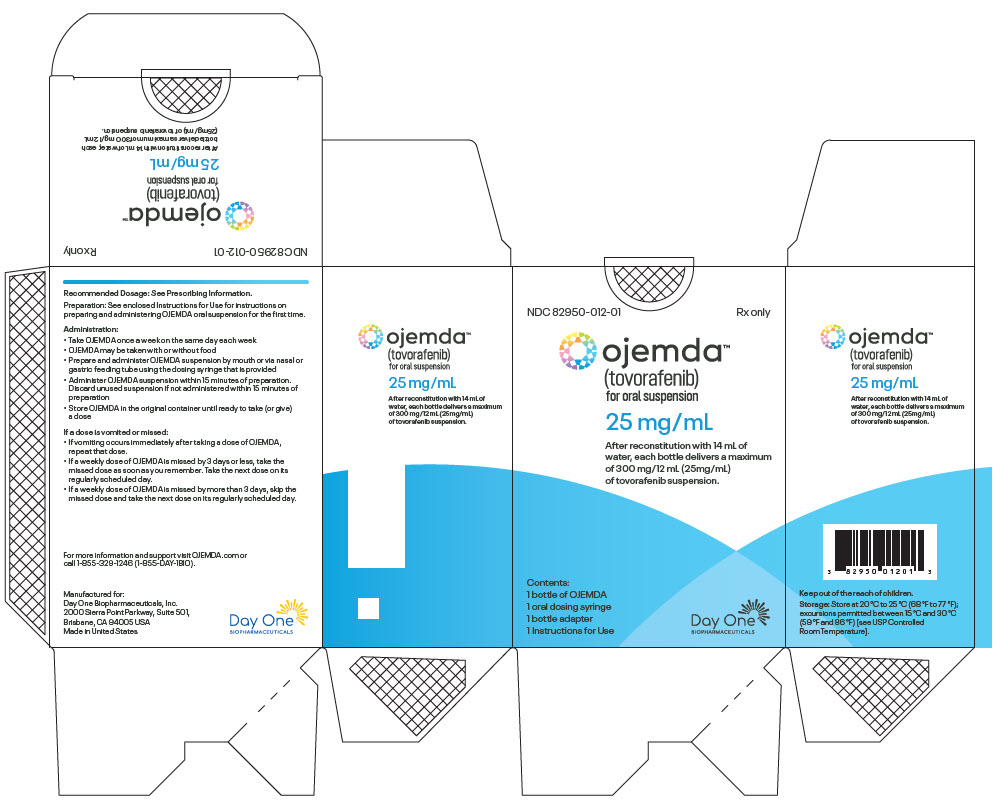
8PRINCIPAL DISPLAY PANEL - Kit Carton
NDC 82950-012-01
ojemda™
25 mg/mL
After reconstitution with 14 mL of
Contents:
Day One
PRINCIPAL DISPLAY PANEL - Kit Carton
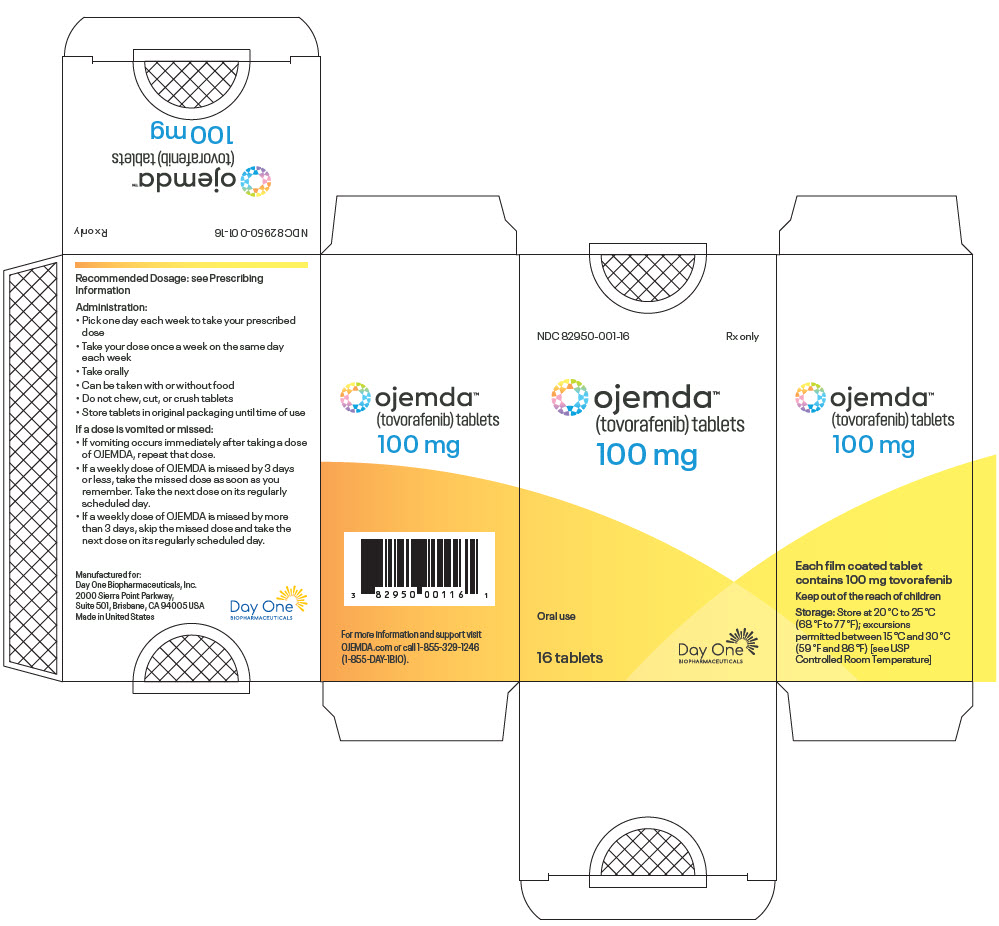
9PRINCIPAL DISPLAY PANEL - 100 mg Tablet Blister Pack Carton
NDC 82950-001-16
ojemda™
400 mg Once Weekly Dose
Oral use
Contains 4 individual weekly
Each blister card contains four
16 tablets
Day One
PRINCIPAL DISPLAY PANEL - 100 mg Tablet Blister Pack Carton