The clinical development program for DUAKLIR PRESSAIR included two placebo-controlled [Trial 1 (NCT 01462942) and Trial 2 (NCT 01437397)] and one active-controlled [Trial 3 (NCT 02796677)] randomized, double-blind, parallel-group 24-week trials in subjects with moderate to very severe COPD, including chronic bronchitis and emphysema, designed to evaluate the efficacy of DUAKLIR PRESSAIR on lung function. The 24-week trials included 4,977 subjects >40 years of age that had a clinical diagnosis of COPD, with a smoking history greater than or equal to 10 pack-years, a post-albuterol FEV
Trials 1, 2, and 3 evaluated DUAKLIR PRESSAIR (aclidinium/formoterol fumarate) 400 mcg/12 mcg, aclidinium 400 mcg, and formoterol fumarate 12 mcg. Trials 1 and 2 included a placebo arm, and Trial 3 included an active, blinded, control arm.
The co-primary endpoints were change from baseline in trough FEV
In the three trials, DUAKLIR PRESSAIR demonstrated a statistically significant increase in mean change from baseline in trough FEV
With the limited data available, there were consistent improvements in trough FEV
In Trial 3, serial spirometric evaluations were performed throughout the 24-hour dosing interval in a subset of subjects (n=563) at Day 1 and Week 24. Results from Trial 3 are shown in Figures 1 and 2.
Figure 1: FEV
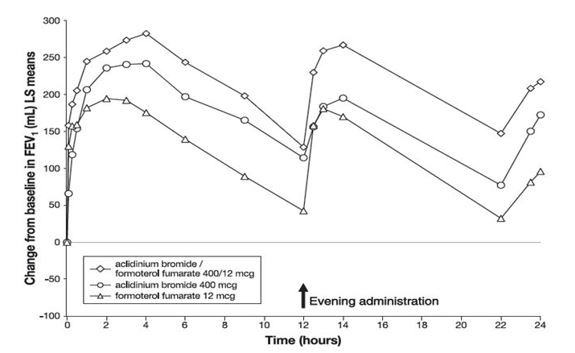
Figure 2: FEV
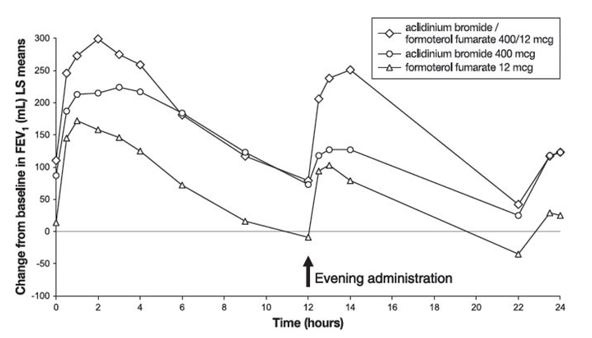
In Trials 1 and 2, DUAKLIR PRESSAIR displayed an increase in FEV
In Trials 1 and 2, patients treated with DUAKLIR PRESSAIR used less rescue medication compared to patients treated with placebo.
The St. George’s Respiratory Questionnaire (SGRQ) was assessed in Trials 1, 2, and 3. In Trial 1, the SGRQ responder rate (defined as an improvement in score of 4 or more as threshold) was 55.3%, 53.5%, 52.1%, and 53.2% for DUAKLIR PRESSAIR, aclidinium, formoterol fumarate, and placebo, respectively, with odds ratios of 1.12 (95% CI: 0.76, 1.67) for DUAKLIR PRESSAIR vs. aclidinium, 1.16 (95% CI: 0.78, 1.73) for DUAKLIR PRESSAIR vs. formoterol fumarate, and 1.12 (95% CI: 0.68, 1.84) for DUAKLIR PRESSAIR vs. placebo. In Trial 2, the SGRQ responder rate was 58.2%, 54.5%, 52.4%, and 38.7% for DUAKLIR PRESSAIR, aclidinium, formoterol fumarate, and placebo, respectively, with odds ratios of 1.03 (95% CI: 0.66, 1.62), 1.21 (95% CI: 0.77, 1.90), and 2.26 (95% CI: 1.41, 3.61), for DUAKLIR PRESSAIR vs. aclidinium, DUAKLIR PRESSAIR vs. formoterol fumarate, and DUAKLIR PRESSAIR vs. placebo, respectively. In Trial 3, the odds ratios were 0.96 (95% CI: 0.61, 1.51) and 0.97 (95% CI: 0.59, 1.58), for DUAKLIR PRESSAIR vs. aclidinium, DUAKLIR PRESSAIR vs. formoterol fumarate, respectively.
Exacerbations
A randomized, double-blind, placebo-controlled study of up to 36 months evaluated the efficacy of aclidinium bromide 400 mcg on COPD exacerbations in patients with moderate to very severe COPD with and without a history of exacerbations. The trial enrolled 3630 COPD patients, aged between 40 and 91 years, 58.7% were male and 90.6% were Caucasian, with a mean post-bronchodilator FEV
The primary efficacy endpoint was the rate of moderate to severe exacerbations during the first year of treatment, defined as worsening of COPD symptoms (dyspnea, cough, sputum) for at least 2 consecutive days that required treatment with antibiotics and/or systemic corticosteroids or resulted in hospitalization or lead to death. Aclidinium bromide demonstrated a statistically significant reduction in the rate of on-study moderate to severe COPD exacerbations by 17% compared to placebo (rate ratio [RR] 0.83; 95% CI 0.73 to 0.94; p=0.003).