Cyclobenzaprine
What is AMRIX (Cyclobenzaprine)?
Muscle pain and stiffness can make even simple movements like turning your head or getting out of bed feel like a challenge. Whether caused by an injury, strain, or overuse, these painful spasms can disrupt daily life and sleep. Amrix (cyclobenzaprine) is a medication that helps the muscles relax, allowing patients to recover more comfortably and move more freely.
Amrix is a muscle relaxant that works on the central nervous system (CNS) to relieve muscle spasms associated with acute musculoskeletal conditions. It is not a painkiller but rather a supportive therapy that helps muscles stop tightening involuntarily. Approved by the U.S. Food and Drug Administration (FDA), Amrix is a long-acting formulation of cyclobenzaprine, designed to be taken once daily. It is often used alongside rest and physical therapy as part of a short-term treatment plan for muscle injuries or strains.
What does Amrix do?
Amrix is prescribed to relieve muscle spasms and stiffness caused by acute musculoskeletal conditions, such as back pain, neck strain, or muscle injuries. When muscles are strained or injured, they can contract uncontrollably, leading to sharp pain and reduced mobility. Amrix helps ease these spasms, making it easier for patients to move, stretch, and heal.
The medication is typically used for short-term relief usually for a few weeks as most muscle injuries improve with rest, therapy, and time. It does not directly heal the injury but helps by reducing pain and discomfort, so patients can participate more comfortably in rehabilitation exercises or daily activities.
Clinical studies have shown that cyclobenzaprine significantly reduces muscle spasm intensity and improves range of motion compared to placebo, with noticeable relief often within a few days of use (Mayo Clinic, 2024). Patients often report better sleep and overall function when taking Amrix as part of a comprehensive recovery plan.
How does Amrix work?
Amrix works by acting on the central nervous system, specifically the brainstem, to reduce the nerve signals that cause muscle spasms. It doesn’t act directly on the muscles themselves. Instead, it interferes with the communication between nerves in the spinal cord and brain that trigger involuntary muscle contractions.
Cyclobenzaprine, the active ingredient in Amrix, is chemically similar to certain antidepressants known as tricyclic compounds, but its primary action is muscle relaxation rather than mood regulation. By calming these overactive nerve signals, Amrix helps muscles return to a more normal, relaxed state.
Clinically, this mechanism matters because it allows patients to move without triggering pain or tension, promoting faster physical recovery. The extended-release formulation in Amrix provides steady relief over 24 hours, offering the convenience of once-daily dosing and reducing the need for multiple doses throughout the day.
Amrix side effects
Like all medications, Amrix can cause side effects, though many are mild and temporary. Most patients tolerate the drug well when taken as prescribed.
Common side effects include:
- Drowsiness or fatigue
- Dry mouth
- Dizziness or lightheadedness
- Constipation
- Blurred vision
Less common but more serious side effects may include:
- Rapid or irregular heartbeat
- Confusion or hallucinations (especially in older adults)
- Difficulty urinating
- Allergic reactions such as rash, itching, or swelling
Amrix often causes drowsiness; avoid driving, operating machinery, or alcohol until you know its effects. Do not use Amrix if taking Monoamine oxidase inhibitors (MAOIs). Use cautiously with heart disease, hyperthyroidism, or liver impairment.
Seek immediate medical attention for severe dizziness, irregular heartbeat, chest pain, or allergic reactions. Consult a doctor before combining Amrix with other sedating medications.
Amrix dosage
Amrix extended-release capsules are for once-daily oral use, providing 24-hour muscle relaxation. Take at the same time daily, with or without food, swallowing the capsule whole. Do not crush or chew. Typically, short-term treatment lasts two to three weeks; longer use requires medical guidance.
Doctors should monitor liver function, especially in patients with existing liver disease or those on long-term treatment. Older adults need close supervision due to increased sensitivity to sedative effects, which can cause falls or confusion. Do not double up on missed doses; take the next scheduled dose. Patients should not stop the medication abruptly without consulting their doctor.
Does Amrix have a generic version?
Yes. Cyclobenzaprine, the active ingredient in Amrix, is available as a generic medication. The generic form is FDA-approved and offers the same active ingredient, strength, safety, and effectiveness as the brand-name product.
Cyclobenzaprine comes in immediate-release tablets (formerly Flexeril) and extended-release capsules (like Amrix). Generic options are usually cheaper and offer the same benefits; choice depends on insurance, cost, and patient preference.
Conclusion
Amrix (cyclobenzaprine) is a trusted muscle relaxant used to relieve short-term muscle spasms and stiffness caused by strains, sprains, or other musculoskeletal injuries. By calming nerve signals in the brain and spinal cord, it helps the body relax and recover more comfortably.
When used correctly with rest, physical therapy, and medical guidance, Amrix can significantly reduce pain and improve mobility. While mild, temporary side effects like drowsiness are common, most tolerate it well. Open communication with a healthcare provider is crucial for safe and effective treatment, helping patients regain comfort, flexibility, and confident movement.
References
- U.S. Food and Drug Administration (FDA). (2024). Amrix (cyclobenzaprine hydrochloride) prescribing information. Retrieved from https://www.accessdata.fda.gov
- Mayo Clinic. (2024). Cyclobenzaprine (oral route) drug information. Retrieved from https://www.mayoclinic.org
- MedlinePlus. (2024). Cyclobenzaprine: Uses, side effects, and precautions. National Library of Medicine. Retrieved from https://medlineplus.gov
- National Institutes of Health (NIH). (2024). Skeletal muscle relaxants for acute pain and spasm. Retrieved from https://www.nih.gov
Approved To Treat
Top Global Experts
There are no experts for this drug
Related Clinical Trials
There is no clinical trials being done for this treatment
Related Latest Advances
There is no latest advances for this treatment
Brand Information
- AMRIX should be used only for short periods (up to two or three weeks) because adequate evidence of effectiveness for more prolonged use is not available and because muscle spasm associated with acute, painful musculoskeletal conditions is generally of short duration and specific therapy for longer periods is seldom warranted.
- AMRIX has not been found effective in the treatment of spasticity associated with cerebral or spinal cord disease or in children with cerebral palsy.
- It is recommended that doses be taken at approximately the same time each day.
- Use of AMRIX for periods longer than two or three weeks is not recommended
- Sprinkle the contents of the capsule onto a tablespoon of applesauce and consume immediately without chewing.
- Rinse the mouth to ensure all of the contents have been swallowed.
- Discard any unused portion of the AMRIX capsules after the contents have been sprinkled on applesauce.
- 15 mg: Capsules are orange/orange and are embossed in blue ink with “15 mg” on the body, and Cephalon “C” logo, “Cephalon,” and a dashed band on the cap.
- 30 mg: Capsules are blue/red and are embossed in white ink with “30 mg” on the body, and Cephalon “C” logo, “Cephalon,” and a dashed band on the cap.
- Hypersensitivity to any component of this product. Adverse reactions may include anaphylactic reaction, urticaria, facial and/or tongue swelling, or pruritus. Discontinue AMRIX if a hypersensitivity reaction is suspected.
- Concomitant use of monoamine oxidase (MAO) inhibitors or within 14 days after their discontinuation. Hyperpyretic crisis seizures and deaths have occurred in patients receiving cyclobenzaprine (or structurally similar tricyclic antidepressants) concomitantly with MAO inhibitor drugs.
- During the acute recovery phase of myocardial infarction, and in patients with arrhythmias, heart block or conduction disturbances, or congestive heart failure.
- Hyperthyroidism.
- Serotonin Syndrome
- Adverse Cardiovascular Effects [see Warnings and Precautions (

- Instruct patients to swallow AMRIX capsules intact or to sprinkle capsule contents on a tablespoon of applesauce and swallow immediately without chewing.
- Advise patients to stop taking AMRIX and to notify their physician right away if they experience symptoms of an allergic reaction, such as difficulty breathing, hives, swelling of face or tongue, or itching.
- Advise patients that AMRIX should not be taken with MAO inhibitors or within 14 days after their discontinuation.
- Caution patients about the risk of serotonin syndrome with concomitant use of AMRIX and other drugs, such as SSRIs, SNRIs, TCAs, tramadol, bupropion, meperidine, verapamil, or MAO inhibitors. Advise patients of the signs and symptoms of serotonin syndrome
- Advise patients to stop taking AMRIX and to notify their physician right away if they experience arrhythmias or tachycardia.
- Advise patients that AMRIX may enhance the impairment effects of alcohol. These effects may also be seen if AMRIX is taken with other CNS depressants.
- Caution patients about operating an automobile or other hazardous machinery until it is reasonably certain that AMRIX therapy will not adversely affect their ability to engage in such activities.
- Advise patients to take AMRIX at approximately the same time each day.
- Do not chew AMRIX capsules or the granules that are in the capsules.
- The capsule sprinkle method for mixing the contents of AMRIX with applesauce may be used for adults who cannot swallow capsules.
- paper towels
- tablespoon
- applesauce
- cup of water
- Store AMRIX capsules at room temperature between 68°F to 77°F (20°C to 25°C).
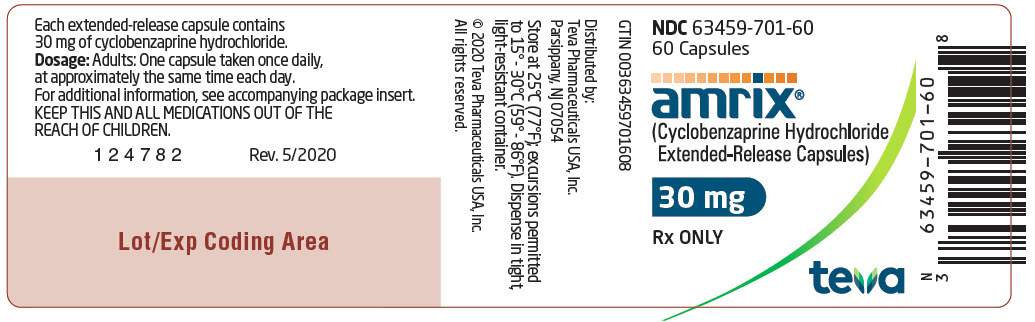
60 Capsules
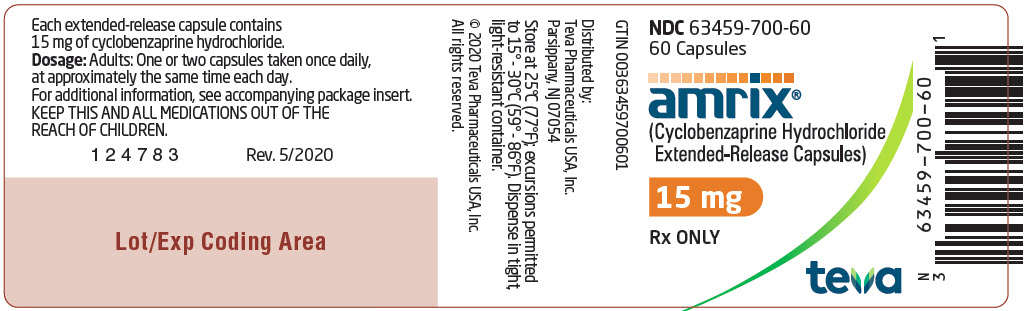
60 Capsules