Brand Name
Compro
Generic Name
Prochlorperazine
View Brand Information FDA approval date: November 30, 1993
Classification: Phenothiazine
Form: Suppository, Tablet
What is Compro (Prochlorperazine)?
For control of severe nausea and vomiting. For the treatment of schizophrenia. Prochlorperazine is effective for the short-term treatment of generalized non-psychotic anxiety. However, prochlorperazine is not the first drug to be used in therapy for most patients with non-psychotic anxiety, because certain risks associated with its use are not shared by common alternative treatments . When used in the treatment of non-psychotic anxiety, prochlorperazine should not be administered at doses of more than 20 mg per day or for longer than 12 weeks, because the use of prochlorperazine at higher doses or for longer intervals may cause persistent tardive dyskinesia that may prove irreversible. The effectiveness of prochlorperazine as treatment for non-psychotic anxiety was established in 4-week clinical studies of outpatients with generalized anxiety disorder. This evidence does not predict that prochlorperazine will be useful in patients with other non-psychotic conditions in which anxiety, or signs that mimic anxiety, are found . Prochlorperazine has not been shown effective in the management of behavioral complications in patients with mental retardation.
Top Global Experts
There are no experts for this drug
Save this treatment for later
Not sure about your diagnosis?
Related Clinical Trials
There is no clinical trials being done for this treatment
Related Latest Advances
There is no latest advances for this treatment
Brand Information
Compro (PROCHLORPERAZINE)
1DESCRIPTION
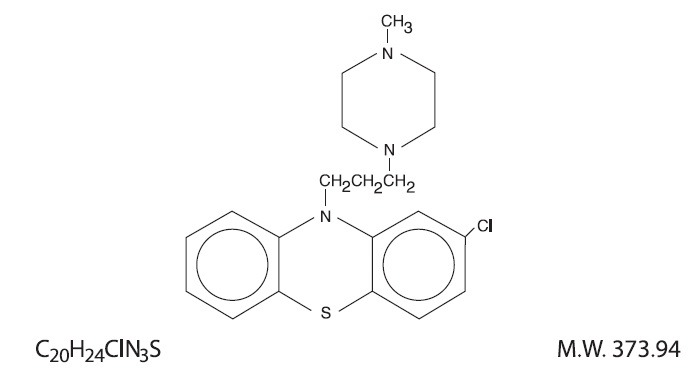
Prochlorperazine, a phenothiazine derivative, is designated chemically as 2-Chloro -10-[3-(4-methyl-1-piperazinyl)propyl]phenothiazine with the following structural formula:

Each suppository, for rectal administration, contains 25 mg of prochlorperazine; with glycerin, glyceryl monopalmitate, glyceryl monostearate, hydrogenated coconut oil fatty acids and hydrogenated palm kernel oil fatty acids.
2CLINICAL PHARMACOLOGY
Prochlorperazine is a propylpiperazine derivative of phenothiazine. Like other phenothiazines, it exerts an antiemetic effect through a depressant action on the chemoreceptor trigger zone.
3INDICATIONS AND USAGE
Prochlorperazine 25 mg suppositories are indicated in the control of severe nausea and vomiting in adults.
4CONTRAINDICATIONS
Do not use in comatose states or in the presence of large amounts of central nervous system depressants (alcohol, barbiturates, narcotics, etc.).
Do not use in pediatric surgery.
Do not use in children under 2 years of age or under 20 lbs. Do not use in children for conditions for which dosage has not been established.
5ADVERSE REACTIONS
Drowsiness, dizziness, amenorrhea, blurred vision, skin reactions and hypotension may occur.
Cholestatic jaundice has occurred. If fever with grippe-like symptoms occurs, appropriate liver studies should be conducted. If tests indicate an abnormality, stop treatment. There have been a few observations of fatty changes in the livers of patients who have died while receiving the drug. No causal relationship has been established.
Leukopenia and agranulocytosis have occurred. Warn patients to report the sudden appearance of sore throat or other signs of infection. If white blood cell and differential counts indicate leukocyte depression, stop treatment and start antibiotic and other suitable therapy.
5.1Neuromuscular (Extrapyramidal) Reactions
These symptoms are seen in a significant number of hospitalized mental patients. They may be characterized by motor restlessness, be of the dystonic type, or they may resemble parkinsonism.
Depending on the severity of symptoms, dosage should be reduced or discontinued. If therapy is reinstituted, it should be at a lower dosage. Should these symptoms occur in children or pregnant patients, the drug should be stopped and not reinstituted. In most cases barbiturates by suitable route of administration will suffice. (Or, injectable diphenhydramine may be useful.) In more severe cases, the administration of an anti-parkinsonism agent, except levodopa (see
5.1.1Motor Restlessness:
Symptoms may include agitation or jitteriness and sometimes insomnia. These symptoms often disappear spontaneously. At times these symptoms may be similar to the original neurotic or psychotic symptoms. Dosage should not be increased until these side effects have subsided.
If these symptoms become too troublesome, they can usually be controlled by a reduction of dosage or change of drug. Treatment with anti-parkinsonian agents, benzodiazepines or propranolol may be helpful.
5.1.2Pseudo-parkinsonism:
Symptoms may include: mask-like facies; drooling; tremors; pillrolling motion; cogwheel rigidity; and shuffling gait. Reassurance and sedation are important. In most cases these symptoms are readily controlled when an anti-parkinsonism agent is administered concomitantly. Anti-parkinsonism agents should be used only when required. Generally, therapy of a few weeks to 2 or 3 months will suffice. After this time patients should be evaluated to determine their need for continued treatment. (Note: Levodopa has not been found effective in pseudo-parkinsonism.) Occasionally it is necessary to lower the dosage of prochlorperazine or to discontinue the drug.
5.1.3Tardive Dyskinesia:
As with all antipsychotic agents, tardive dyskinesia may appear in some patients on long-term therapy or may appear after drug therapy has been discontinued. The syndrome can also develop, although much less frequently, after relatively brief treatment periods at low doses. This syndrome appears in all age groups. Although its prevalence appears to be highest among elderly patients, especially elderly women, it is impossible to rely upon prevalence estimates to predict at the inception of neuroleptic treatment which patients are likely to develop the syndrome. The symptoms are persistent and in some patients appear to be irreversible. The syndrome is characterized by rhythmical involuntary movements of the tongue, face, mouth or jaw (e.g., protrusion of tongue, puffing of cheeks, puckering of mouth, chewing movements). Sometimes these may be accompanied by involuntary movements of extremities. In rare instances, these involuntary movements of the extremities are the only manifestations of tardive dyskinesia. A variant of tardive dyskinesia, tardive dystonia, has also been described.
There is no known effective treatment for tardive dyskinesia; anti-parkinsonism agents do not alleviate the symptoms of this syndrome. It is suggested that all antipsychotic agents be discontinued if these symptoms appear.
Should it be necessary to reinstitute treatment, or increase the dosage of the agent, or switch to a different antipsychotic agent, the syndrome may be masked.
It has been reported that fine vermicular movements of the tongue may be an early sign of the syndrome and if the medication is stopped at that time the syndrome may not develop.
5.2Adverse Reactions Reported with Prochlorperazine or Other Phenothiazine Derivatives:
Adverse reactions with different phenothiazines vary in type, frequency and mechanism of occurrence, i.e., some are dose-related, while others involve individual patient sensitivity. Some adverse reactions may be more likely to occur, or occur with greater intensity, in patients with special medical problems, e.g., patients with mitral insufficiency or pheochromocytoma have experienced severe hypotension following recommended doses of certain phenothiazines.
Not all of the following adverse reactions have been observed with every phenothiazine derivative, but they have been reported with 1 or more and should be borne in mind when drugs of this class are administered: extrapyramidal symptoms (opisthotonos, oculogyric crisis, hyperreflexia, dystonia, akathisia, dyskinesia, parkinsonism) some of which have lasted months and even years- particularly in elderly patients with previous brain damage; grand mal and petit mal convulsions, particularly in patients with EEG abnormalities or history of such disorders; altered cerebrospinal fluid proteins; cerebral edema; intensification and prolongation of the action of central nervous system depressants (opiates, analgesics, antihistamines, barbiturates, alcohol), atropine, heat, organophosphorus insecticides; autonomic reactions (dryness of the mouth, nasal congestion, headache, nausea, constipation, obstipation, adynamic ileus, ejaculatory disorders/impotence, priapism, atonic colon, urinary retention, miosis and mydriasis); reactivation of psychotic processes, catatonic-like states; hypotension (sometimes fatal); cardiac arrest; blood dyscrasias (pancytopenia, thrombocytopenic purpura, leukopenia, agranulocytosis, eosinophilia, hemolytic anemia, aplastic anemia); liver damage (jaundice, biliary stasis); endocrine disturbances (hyperglycemia, hypoglycemia, glycosuria, lactation, galactorrhea, gynecomastia, menstrual irregularities, false-positive pregnancy tests); skin disorders (photosensitivity, itching, erythema, urticaria, eczema up to exfoliative dermatitis); other allergic reactions (asthma, laryngeal edema, angioneurotic edema, anaphylactoid reactions); peripheral edema; reversed epinephrine effect; hyperpyrexia; mild fever after large I.M. doses; increased appetite; increased weight; a systemic lupus erythematosus-like syndrome; pigmentary retinopathy; with prolonged administration of substantial doses, skin pigmentation, epithelial keratopathy, and lenticular and corneal deposits.
EKG changes-particularly nonspecific, usually reversible Q and T wave distortions-have been observed in some patients receiving phenothiazine tranquilizers.
Although phenothiazines cause neither psychic nor physical dependence, sudden discontinuance in long-term psychiatric patients may cause temporary symptoms, e.g., nausea and vomiting, dizziness, tremulousness.
Note:There have been occasional reports of sudden death in patients receiving phenothiazines. In some cases, the cause appeared to be cardiac arrest or asphyxia due to failure of the cough reflex.
6OVERDOSAGE
(See also
7HOW SUPPLIED
Compro
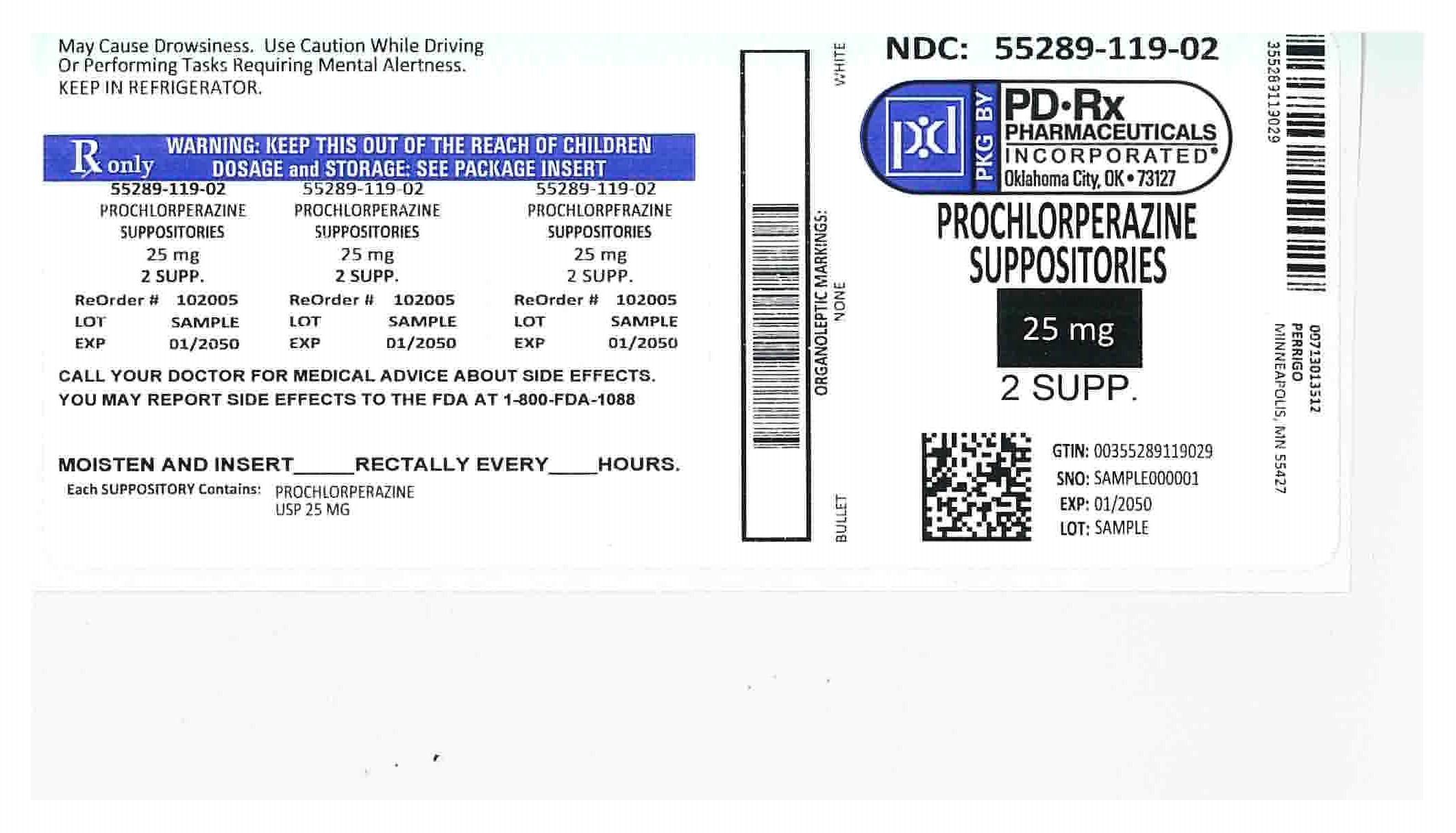
2's - NDC 55289-119-02, 6's NDC 55289-119-06
8Package/Label Display Panel
Rx Only
Prochlorperazine Suppositories, USP
25 mg
FOR RECTAL USE ONLY
ADULT SIZE
NOT FOR USE IN CHILDREN

The following image is a placeholder representing the product identifier that is either affixed or imprinted on the drug package label during the packaging operation.