Corlanor
What is Corlanor (Ivabradine)?
For people living with chronic heart failure, every breath and heartbeat can feel like hard work. Fatigue, shortness of breath, and limits on physical activity often become part of daily life. Corlanor (ivabradine) is a medication designed to help patients with certain types of heart failure manage these symptoms, reduce hospitalizations, and improve their overall quality of life.
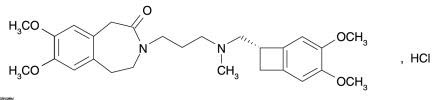
Corlanor is a heart rate–lowering medication that belongs to a class of drugs known as hyperpolarization-activated cyclic nucleotide-gated (HCN) channel blockers, sometimes called If channel inhibitors. Unlike traditional beta-blockers, which affect several aspects of heart function, Corlanor specifically targets the natural pacemaker of the heart to slow its rhythm without reducing the strength of each heartbeat.
Approved by the U.S. Food and Drug Administration (FDA) in 2015, Corlanor is a relatively new addition to the tools cardiologists use to manage chronic heart failure with reduced ejection fraction (HFrEF). It’s often prescribed alongside standard therapies such as beta-blockers, ACE inhibitors, or ARBs to provide additional heart rate control and symptom relief.
What does Corlanor do?
Corlanor is used to treat adults with chronic heart failure who have a stable heart rhythm (sinus rhythm) and a resting heart rate of 70 beats per minute or higher, despite being on maximum tolerated beta-blocker therapy. It helps the heart work more efficiently by slowing down its rate, giving it more time to fill with blood before pumping it out to the body.
By improving the timing and efficiency of each heartbeat, Corlanor can reduce symptoms like fatigue, dizziness, and shortness of breath. It also helps lower the risk of hospitalization due to worsening heart failure (FDA, 2024).
In clinical trials, such as the SHIFT study, patients taking ivabradine in addition to standard heart failure treatments experienced a significant reduction in hospitalizations and disease progression compared with those receiving placebo. This means Corlanor doesn’t just improve day-to-day comfort, it may also help people live longer and stay healthier.
How does Corlanor work?
Corlanor works by selectively blocking the “funny” current (If current) in the sinoatrial (SA) node, the part of the heart that controls its natural rhythm. This electrical current regulates how quickly the heart beats. By slowing this current, Corlanor reduces the heart rate without affecting the heart’s ability to contract or the blood pressure.
In simpler terms, Corlanor helps the heart beat more slowly and efficiently. When the heart rate is lowered, the heart muscle has more time to fill with blood before each contraction. This increases oxygen delivery to the body while reducing the workload on the heart.
This mechanism is especially useful for patients with chronic heart failure because a persistently fast heart rate can strain an already weakened heart. By controlling heart rhythm, Corlanor supports better long-term heart function and symptom management.
Corlanor side effects
Most patients tolerate Corlanor well, but as with any prescription medication, side effects can occur. These are generally mild and may improve over time.
Common side effects include:
- Slow heartbeat (bradycardia)
- High blood pressure
- Temporary visual disturbances (bright spots or flashing lights, called phosphenes)
- Fatigue or dizziness
Serious side effects (less common):
- Fainting or very slow heart rate
- Irregular heartbeats (atrial fibrillation)
- Severe dizziness or shortness of breath
- Signs of an allergic reaction (rash, swelling, or difficulty breathing)
Visual effects, such as seeing brief flashes of light, are unique to Corlanor and usually occur within the first two months of treatment. These are caused by ivabradine’s mild effects on the retina but are typically temporary and reversible.
Corlanor is unsuitable for patients with severe liver disease, very low blood pressure, slow resting heart rate, or certain unstable irregular heart rhythms (like atrial fibrillation). Immediately contact a doctor for chest pain, fainting, or worsening heart failure symptoms (e.g., swelling, breathlessness).
Corlanor dosage
Corlanor is taken by mouth in tablet form, usually twice daily with meals. The medication works best when taken consistently at the same times each day. Doctors determine and adjust your dose based on your resting heart rate and health, aiming for 50-60 bpm.
Regular heart rate monitoring (via checkups or ECGs) is crucial during treatment to ensure effectiveness and prevent a dangerously low heart rate. Patients with liver problems or light sensitivity may require dose adjustments or extra precautions.
While generally safe for older adults, closer monitoring may be needed due to age-related changes in heart rhythm or metabolism.
Does Corlanor have a generic version?
Yes. As of 2022, the FDA has approved a generic version of Corlanor, available under the generic name ivabradine. The generic medication is therapeutically equivalent to the brand-name version, meaning it contains the same active ingredient and provides the same clinical benefits and safety profile.
Corlanor and generic ivabradine are available as tablets and oral solutions. Generic ivabradine offers a cost-effective and equally effective alternative for managing heart failure.
Conclusion
Corlanor (ivabradine) is a valuable treatment for adults with chronic heart failure who need additional heart rate control beyond standard medications. By slowing the heart’s rhythm without lowering blood pressure or heart strength, it helps the heart pump more efficiently and reduces the risk of hospitalizations.
Most people tolerate Corlanor well, and side effects are typically mild and manageable. Regular monitoring with your healthcare team ensures safe and effective treatment. While not a cure, Corlanor significantly helps heart failure patients live longer, feel better, and stay active. Following your doctor’s guidance and treatment plan is key to better heart health.
References
- U.S. Food and Drug Administration (FDA). (2024). Corlanor (ivabradine) prescribing information. Retrieved from https://www.accessdata.fda.gov
- Mayo Clinic. (2024). Ivabradine (oral route) drug information. Retrieved from https://www.mayoclinic.org
- MedlinePlus. (2024). Ivabradine: Uses, dosage, and side effects. National Library of Medicine. Retrieved from https://medlineplus.gov
- National Institutes of Health (NIH). (2024). Heart failure treatment: Beta-blockers, ACE inhibitors, and ivabradine. Retrieved from https://www.nih.gov
Approved To Treat
Top Global Experts


Related Clinical Trials
Summary: The present study will recruit 50 symptomatic non-ischemic cardiomyopathy (NICM) patients with left ventricular ejection fraction (LVEF) below 35% and complete left bundle branch block (CLBBB), who have not received complete guideline-directed medical therapy (GDMT). Each patient was randomized to 2 groups, GDMT or left bundle branch pacing combined with GDMT (LBBP+GDMT) as initial therapy and was...
Summary: Clozapine is the only drug approved for Treatment Resistant Schizophrenia. However, it has been associated with many adverse drug reactions including agranulocytosis, myocarditis, sialorrhea, constipation, orthostasis, tachycardia. There are many factors that have impacted the use of clozapine in TRS patients including physician hesitation, patient denial, stopping of drug due to Adverse drug reac...
Summary: Septic shock is a major health problem, with several million cases annually worldwide and a mortality approaching 45%. Tachycardia is associated with excess mortality during septic shock. This pejorative effect could be related to the increase in cardiac metabolic demand, impaired cardiac diastolic function, and/or poorer tolerance of administered exogenous catecholamines. Recent studies suggest t...
Related Latest Advances
Brand Information
- Atrial Fibrillation
- Bradycardia and Conduction Disturbances
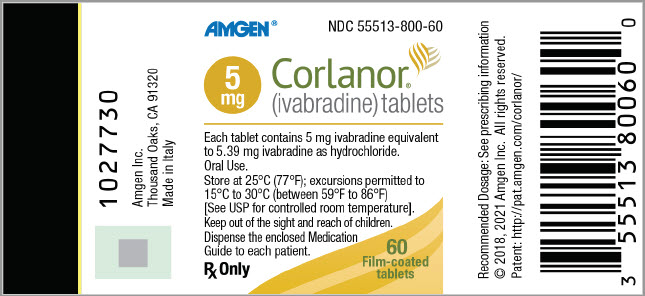
- Bottles of 60 tablets with child-resistant closure (NDC 55513-800-60)
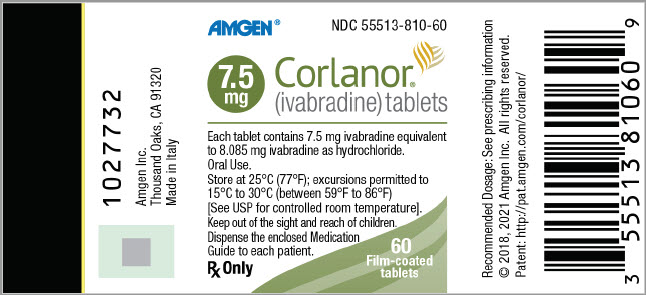
- Bottles of 60 tablets with child-resistant closure (NDC 55513-810-60)
- Fetal Toxicity
Advise pregnant women of the potential risks to a fetus.
Advise females of reproductive potential to use effective contraception and to notify their healthcare provider with a known or suspected pregnancy [see Warnings and Precautions (5.1) and Use in Specific Populations (8.1), (8.3)]. - Low Heart Rate
Advise patients to report significant decreases in heart rate or symptoms such as dizziness, fatigue, or hypotension [see Warnings and Precautions (5.3)]. - Atrial Fibrillation
Advise patients to report symptoms of atrial fibrillation, such as heart palpitations or racing, chest pressure, or worsened shortness of breath [see Warnings and Precautions (5.2)]. - Phosphenes
Advise patients about the possible occurrence of luminous phenomena (phosphenes). Advise patients to use caution if they are driving or using machines in situations where sudden changes in light intensity may occur, especially when driving at night. Advise patients that phosphenes may subside spontaneously during continued treatment with Corlanor [see Adverse Reactions (6.1)]. - Drug Interactions
Advise patients to avoid ingestion of grapefruit juice and St. John’s wort [see Drug Interactions(7.1)]. - Intake with Food
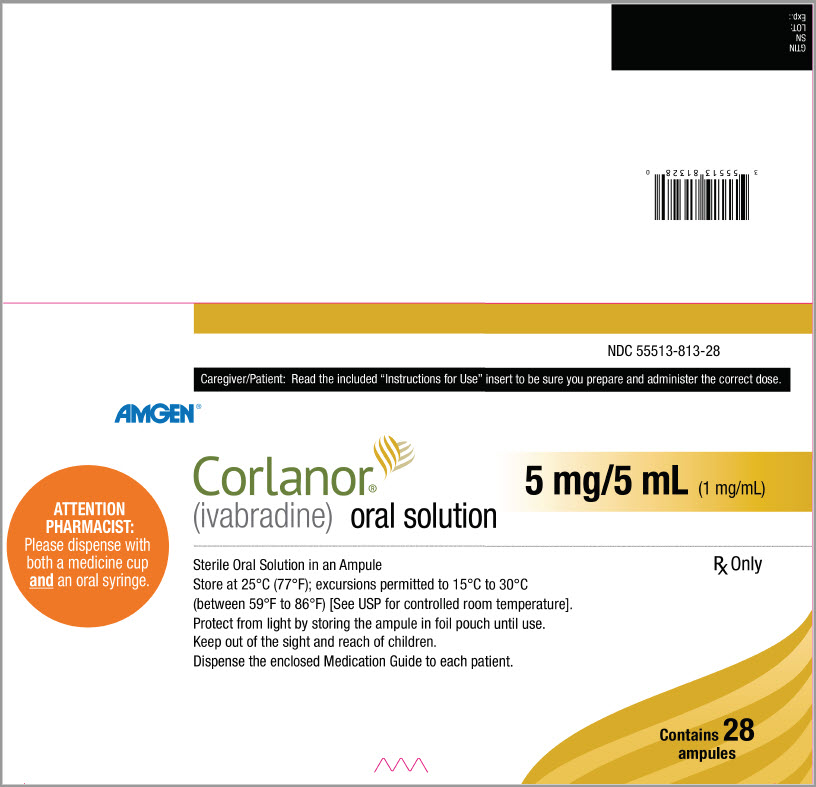
Advise patients to take Corlanor twice daily with food [see Dosage and Administration (2)]. - Oral Solution
Advise parents/caregivers on preparation and administration instructions including the use of a calibrated oral syringe and a medicine cup (provided by the pharmacy) to avoid dosing errors [see Dosage and Administration (2.2)].
Advise parents/caregivers that the oral solution should not be administered by the child.
Advise parents/caregivers to not double up doses (e.g., if patient spits out the drug or caregiver forgets to give the drug at the prescribed time).
Advise parents/caregivers to throw away the unused product remaining in the cup immediately after drawing up the prescribed dose in the syringe.
Amgen Inc.
One Amgen Center Drive
Thousand Oaks, California 91320-1799