Brand Name
Bystolic
Generic Name
Nebivolol
View Brand Information FDA approval date: January 22, 2008
Classification: beta-Adrenergic Blocker
Form: Tablet
What is Bystolic (Nebivolol)?
Nebivolol Tablets are a beta-adrenergic blocking agent indicated for the treatment of hypertension, to lower blood pressure. Lowering blood pressure reduces the risk of fatal and nonfatal cardiovascular events, primarily strokes and myocardial infarctions.
Approved To Treat
Top Global Experts
There are no experts for this drug
Save this treatment for later
Not sure about your diagnosis?
Related Clinical Trials
There is no clinical trials being done for this treatment
Related Latest Advances
There is no latest advances for this treatment
Brand Information
Bystolic (nebivolol hydrochloride)
1DOSAGE FORMS AND STRENGTHS
BYSTOLIC is available as tablets for oral administration containing nebivolol hydrochloride equivalent to 2.5, 5, 10, and 20 mg of nebivolol.
BYSTOLIC tablets are triangular-shaped, biconvex, unscored, differentiated by color and are engraved with “
2CONTRAINDICATIONS
BYSTOLIC is contraindicated in the following conditions:
- Severe bradycardia
- Heart block greater than first degree
- Patients with cardiogenic shock
- Decompensated cardiac failure
- Sick sinus syndrome (unless a permanent pacemaker is in place)
- Patients with severe hepatic impairment (Child-Pugh >B)
- Patients who are hypersensitive to any component of this product.
3OVERDOSAGE
In clinical trials and worldwide postmarketing experience there were reports of BYSTOLIC overdose. The most common signs and symptoms associated with BYSTOLIC overdosage are bradycardia and hypotension. Other important adverse reactions reported with BYSTOLIC overdose include cardiac failure, dizziness, hypoglycemia, fatigue and vomiting. Other adverse reactions associated with β-blocker overdose include bronchospasm and heart block.
The largest known ingestion of BYSTOLIC worldwide involved a patient who ingested up to 500 mg of BYSTOLIC along with several 100 mg tablets of acetylsalicylic acid in a suicide attempt. The patient experienced hyperhydrosis, pallor, depressed level of consciousness, hypokinesia, hypotension, sinus bradycardia, hypoglycemia, hypokalemia, respiratory failure and vomiting. The patient recovered.
Because of extensive drug binding to plasma proteins, hemodialysis is not expected to enhance nebivolol clearance.
If overdose occurs, provide general supportive and specific symptomatic treatment. Based on expected pharmacologic actions and recommendations for other β-blockers, consider the following general measures, including stopping BYSTOLIC, when clinically warranted:
Bradycardia: Administer IV atropine. If the response is inadequate, isoproterenol or another agent with positive chronotropic properties may be given cautiously. Under some circumstances, transthoracic or transvenous pacemaker placement may be necessary.
Hypotension:Administer IV fluids and vasopressors. Intravenous glucagon may be useful.
Heart Block (second or third degree):Monitor and treat with isoproterenol infusion. Under some circumstances, transthoracic or transvenous pacemaker placement may be necessary.
Congestive Heart Failure: Initiate therapy with digitalis glycoside and diuretics. In certain cases, consider the use of inotropic and vasodilating agents.
Bronchospasm: Administer bronchodilator therapy such as a short acting inhaled β2-agonist and/or aminophylline.
Hypoglycemia: Administer IV glucose. Repeated doses of IV glucose or possibly glucagon may be required.
Supportive measures should continue until clinical stability is achieved. The half-life of low doses of nebivolol is 12-19 hours.
Call the National Poison Control Center (800-222-1222) for the most current information on β-blocker overdose treatment.
4DESCRIPTION
The chemical name for the active ingredient in BYSTOLIC (nebivolol) tablets is (1RS,1’RS)-1,1’-[(2RS,2’SR)-bis(6-fluoro-3,4-dihydro-2H-1-benzopyran-2-yl)]- 2,2’-iminodiethanol hydrochloride. Nebivolol is a racemate composed of d-Nebivolol and l-Nebivolol with the stereochemical designations of [SRRR]-nebivolol and [RSSS]-nebivolol, respectively. Nebivolol’s molecular formula is (C
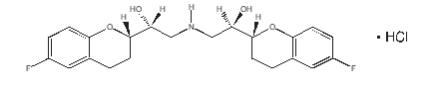
SRRR - or d-nebivolol hydrochloride
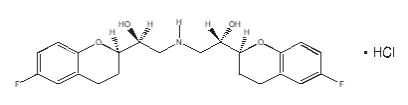
RSSS - or l-nebivolol hydrochloride
MW: 441.90 g/mol
Nebivolol hydrochloride is a white to almost white powder that is soluble in methanol, dimethylsulfoxide, and N,N-dimethylformamide, sparingly soluble in ethanol, propylene glycol, and polyethylene glycol, and very slightly soluble in hexane, dichloromethane, and methylbenzene.
BYSTOLIC as tablets for oral administration contains nebivolol hydrochloride equivalent to 2.5, 5, 10, and 20 mg of nebivolol base. In addition, BYSTOLIC contains the following inactive ingredients: colloidal silicon dioxide, croscarmellose sodium, D&C Red #27 Lake, FD&C Blue #2 Lake, FD&C Yellow #6 Lake, hypromellose, lactose monohydrate, magnesium stearate, microcrystalline cellulose, pregelatinized starch, polysorbate 80, and sodium lauryl sulfate.
5CLINICAL PHARMACOLOGY
Nebivolol is a β-adrenergic receptor blocking agent. In extensive metabolizers (most of the population) and at doses less than or equal to 10 mg, nebivolol is preferentially β
5.1Mechanism of Action
The mechanism of action of the antihypertensive response of BYSTOLIC has not been definitively established. Possible factors that may be involved include: (1) decreased heart rate, (2) decreased myocardial contractility, (3) diminution of tonic sympathetic outflow to the periphery from cerebral vasomotor centers, (4) suppression of renin activity and (5) vasodilation and decreased peripheral vascular resistance.
5.2Pharmacokinetics
Nebivolol is metabolized by a number of routes, including glucuronidation and hydroxylation by CYP2D6. The active isomer (d-nebivolol) has an effective half-life of about 12 hours in CYP2D6 extensive metabolizers (most people), and 19 hours in poor metabolizers and exposure to d-nebivolol is substantially increased in poor metabolizers. This has less importance than usual, however, because the metabolites, including the hydroxyl metabolite and glucuronides (the predominant circulating metabolites), contribute to β-blocking activity.
Plasma levels of d–nebivolol increase in proportion to dose in EMs and PMs for doses up to 20mg. Exposure to l-nebivolol is higher than to d-nebivolol but l-nebivolol contributes little to the drug’s activity as d-nebivolol’s beta receptor affinity is > 1000-fold higher than l-nebivolol. For the same dose, PMs attain a 5-fold higher Cmax and 10-fold higher AUC of d-nebivolol than do EMs. d-Nebivolol accumulates about 1.5-fold with repeated once-daily dosing in EMs.
Absorption
Absorption of BYSTOLIC is similar to an oral solution. The absolute bioavailability has not been determined.
Mean peak plasma nebivolol concentrations occur approximately 1.5 to 4 hours post-dosing in EMs and PMs.
Food does not alter the pharmacokinetics of nebivolol. Under fed conditions, nebivolol glucuronides are slightly reduced. BYSTOLIC may be administered without regard to meals.
Distribution
The in vitro human plasma protein binding of nebivolol is approximately 98%, mostly to albumin, and is independent of nebivolol concentrations.
Metabolism
Nebivolol is predominantly metabolized via direct glucuronidation of parent and to a lesser extent via N-dealkylation and oxidation via cytochrome P450 2D6. Its stereospecific metabolites contribute to the pharmacologic activity
Elimination
After a single oral administration of 14C-nebivolol, 38% of the dose was recovered in urine and 44% in feces for EMs and 67% in urine and 13% in feces for PMs. Essentially all nebivolol was excreted as multiple oxidative metabolites or their corresponding glucuronide conjugates.
5.3Pharmacokinetics in Special Populations
Hepatic Disease
d-Nebivolol peak plasma concentration increased 3-fold, exposure (AUC) increased 10-fold, and the apparent clearance decreased by 86% in patients with moderate hepatic impairment (Child-Pugh Class B). No formal studies have been performed in patients with severe hepatic impairment and nebivolol should be contraindicated for these patients
Renal Disease
The apparent clearance of nebivolol was unchanged following a single 5 mg dose of BYSTOLIC in patients with mild renal impairment (ClCr 50 to 80 mL/min, n=7), and it was reduced negligibly in patients with moderate (ClCr 30 to 50 mL/min, n=9), but clearance was reduced by 53% in patients with severe renal impairment (ClCr <30 mL/min, n=5). No studies have been conducted in patients on dialysis
5.4Drug-Drug Interactions
Drugs that inhibit CYP2D6 can be expected to increase plasma levels of nebivolol. When BYSTOLIC is co-administered with an inhibitor or an inducer of this enzyme, monitor patients closely and adjust the nebivolol dose according to blood pressure response.
Digoxin:Concomitant administration of BYSTOLIC (10 mg once daily) and digoxin (0.25 mg once daily) for 10 days in 14 healthy adult individuals resulted in no significant changes in the pharmacokinetics of digoxin or nebivolol [see Drug Interactions (7)].
Warfarin:Administration of BYSTOLIC (10 mg once daily for 10 days) led to no significant changes in the pharmacokinetics of nebivolol or R- or S-warfarin following a single 10 mg dose of warfarin. Similarly, nebivolol has no significant effects on the anticoagulant activity of warfarin, as assessed by Prothrombin time and INR profiles from 0 to 144 hours after a single 10 mg warfarin dose in 12 healthy adult volunteers.
Diuretics:No pharmacokinetic interactions were observed in healthy adults between nebivolol (10 mg daily for 10 days) and furosemide (40 mg single dose), hydrochlorothiazide (25 mg once daily for 10 days), or spironolactone (25 mg once daily for 10 days).
Ramipril: Concomitant administration of BYSTOLIC (10 mg once daily) and ramipril (5 mg once daily) for 10 days in 15 healthy adult volunteers produced no pharmacokinetic interactions.
Losartan:Concomitant administration of BYSTOLIC (10 mg single dose) and losartan (50 mg single dose) in 20 healthy adult volunteers did not result in pharmacokinetic interactions.
Fluoxetine:Fluoxetine, a CYP2D6 inhibitor, administered at 20 mg per day for 21 days prior to a single 10 mg dose of nebivolol to 10 healthy adults, led to an 8-fold increase in the AUC and 3-fold increase in Cmax for d-nebivolol [see Drug Interactions (7)].
Histamine-2 Receptor Antagonists:The pharmacokinetics of nebivolol (5 mg single dose) were not affected by the co-administration of ranitidine (150 mg twice daily). Cimetidine (400 mg twice daily) causes a 23% increase in the plasma levels of d-nebivolol.
Charcoal:The pharmacokinetics of nebivolol (10 mg single dose) were not affected by repeated co-administration (4, 8, 12, 16, 22, 28, 36, and 48 hours after nebivolol administration) of activated charcoal (Actidose®-Aqua).
Sildenafil:The co-administration of nebivolol and sildenafil decreased AUC and Cmax of sildenafil by 21 and 23% respectively. The effect on the Cmax and AUC for d-nebivolol was also small (< 20%). The effect on vital signs (e.g., pulse and blood pressure) was approximately the sum of the effects of sildenafil and nebivolol.
Other Concomitant Medications:Utilizing population pharmacokinetic analyses, derived from hypertensive patients, the following drugs were observed not to have an effect on the pharmacokinetics of nebivolol: acetaminophen, acetylsalicylic acid, atorvastatin, esomeprazole, ibuprofen, levothyroxine sodium, metformin, sildenafil, simvastatin, or tocopherol.
Protein Binding:No meaningful changes in the extent of in vitro binding of nebivolol to human plasma proteins were noted in the presence of high concentrations of diazepam, digoxin, diphenylhydantoin, enalapril, hydrochlorothiazide, imipramine, indomethacin, propranolol, sulfamethazine, tolbutamide, or warfarin. Additionally, nebivolol did not significantly alter the protein binding of the following drugs: diazepam, digoxin, diphenylhydantoin, hydrochlorothiazide, imipramine, or warfarin at their therapeutic concentrations.
6HOW SUPPLIED/STORAGE AND HANDLING
BYSTOLIC is available as tablets for oral administration containing nebivolol hydrochloride equivalent to 2.5, 5, 10, and 20 mg of nebivolol.
BYSTOLIC tablets are triangular-shaped, biconvex, unscored, differentiated by color and are engraved with “
Store at 20° to 25°C (68° to 77°F) [see USP for Controlled Room Temperature].
Dispense in a tight, light-resistant container as defined in the USP using a child-resistant closure.
7PATIENT COUNSELING INFORMATION
- Patient Advice
Advise patients to take BYSTOLIC regularly and continuously, as directed. BYSTOLIC can be taken with or without food. If a dose is missed, take the next scheduled dose only (without doubling it). Do not interrupt or discontinue BYSTOLIC without consulting the physician.
Patients should know how they react to this medicine before they operate automobiles, use machinery, or engage in other tasks requiring alertness.
Advise patients to consult a physician if any difficulty in breathing occurs, or if they develop signs or symptoms of worsening congestive heart failure such as weight gain or increasing shortness of breath, or excessive bradycardia.
Caution patients subject to spontaneous hypoglycemia, or diabetic patients receiving insulin or oral hypoglycemic agents, that β-blockers may mask some of the manifestations of hypoglycemia, particularly tachycardia.
Inform patients or caregivers that there is a risk of hypoglycemia when BYSTOLIC is given to patients who are fasting or who are vomiting. Instruct patients or caregivers how to monitor for signs of hypoglycemia
Distributed by:
Licensed from Mylan Laboratories, Inc.
Under license from Janssen Pharmaceutica N.V., Beerse, Belgium
Actidose
BYSTOLIC and its design are trademarks of Allergan Sales, LLC, an AbbVie company.
© 2024 AbbVie. All rights reserved.
8PATIENT INFORMATION
BYSTOLIC®(bi-STOL-ik)
(nebivolol) Tablets
Read the Patient Information that comes with BYSTOLIC before you start taking it and each time you get a refill. There may be new information. This information does not take the place of talking with your doctor about your medical condition or your treatment. If you have any questions about BYSTOLIC, ask your doctor or pharmacist.
WHAT IS BYSTOLIC?
BYSTOLIC is a kind of prescription medicine called a “beta-blocker”. BYSTOLIC treats:
- High blood pressure (hypertension)
BYSTOLIC can lower blood pressure when used by itself and with other medicines.
BYSTOLIC is not approved for children less than 18 years of age.
WHO SHOULD NOT TAKE BYSTOLIC?
Do not take BYSTOLIC if you:
- Have heart failure and are in the ICU or need medicines to keep up your blood circulation
- Have a slow heartbeat or your heart skips beats (irregular heartbeat)
- Have severe liver damage
- Are allergic to any ingredient in BYSTOLIC. The active ingredient is nebivolol. See the end of this leaflet for a list of ingredients.
WHAT SHOULD I TELL MY DOCTOR BEFORE TAKING BYSTOLIC?
Tell your doctor about all of your medical problems, including if you:
- Have asthma or other lung problems (such as bronchitis or emphysema)
- Have problems with blood flow in your feet and legs (peripheral vascular disease) BYSTOLIC can make symptoms of blood flow problems worse.
- Have diabetes and take medicine to control blood sugar
- Have thyroid problems
- Have liver or kidney problems
- Had allergic reactions to medications or have allergies
- Have a condition called pheochromocytoma
- Are pregnant or trying to become pregnant. It is not known if BYSTOLIC is safe for your unborn baby. Talk with your doctor about the best way to treat high blood pressure while you are pregnant.
- Are breastfeeding. It is not known if BYSTOLIC passes into your breast milk. You should not breastfeed while using BYSTOLIC.
- Are scheduled for surgery and will be given anesthetic agents
Tell your doctor about all the medicines you take. Include prescription and non-prescription medicines, vitamins, and herbal products. BYSTOLIC and certain other medicines can affect each other and cause serious side effects.
Keep a list of all the medicines you take. Show this list to your doctor and pharmacist before you start a new medicine.
HOW SHOULD I TAKE BYSTOLIC?
- Do not suddenly stop taking BYSTOLIC. You could have chest pain or a heart attack. If your doctor decides to stop BYSTOLIC, your doctor may slowly lower your dose over time before stopping it completely.
- Take BYSTOLIC every day exactly as your doctor tells you. Your doctor will tell you how much BYSTOLIC to take and how often. Your doctor may start with a low dose and raise it over time.
- Do not stop taking BYSTOLIC or change your dose without talking with your doctor.
- Take BYSTOLIC with or without food.
- If you miss a dose, take your dose as soon as you remember, unless it is close to the time to take your next dose. Do not take 2 doses at the same time. Take your next dose at the usual time.
- If you take too much BYSTOLIC, call your doctor or poison control center right away.
WHAT ARE POSSIBLE SIDE EFFECTS OF BYSTOLIC?
- Low blood pressure and feeling dizzy. If you feel dizzy, sit or lie down and tell your doctor right away.
- Tiredness
- Slow heartbeat
- Headache
- Leg swelling due to fluid retention (edema). Tell your doctor if you gain weight or have trouble breathing while taking BYSTOLIC.
- If you are diabetic or take medicine for high blood sugar or if you have a tendency to have low blood sugar, Bystolic can mask/cover some of the signs and symptoms that would tell you that your blood sugar may be low, like heart palpitations or rapid heart beating. Ask your doctor for other signs that may alert you when having low blood sugar.
Tell your doctor if you have any side effects that bother you or don’t go away.
HOW SHOULD I STORE BYSTOLIC?
- Store BYSTOLIC between 68° to 77°F (20° - 25°C).
- Safely throw away BYSTOLIC that is out of date or no longer needed.
- Keep BYSTOLIC and all medicines out of the reach of children.
GENERAL INFORMATION ABOUT BYSTOLIC
Doctors sometimes prescribe medicines for conditions not included in the patient information leaflets.
- Only use BYSTOLIC for the medical problem it was prescribed for.
- Do not give BYSTOLIC to other people, even if they have the same symptoms. It may harm them.
This leaflet summarizes the most important information about BYSTOLIC. For more information:
- Talk with your doctor.
- Ask your doctor or pharmacist for information about BYSTOLIC that is written for healthcare professionals.
- Visit www.BYSTOLIC.com on the web or call 1-800-678-1605.
WHAT IS IN BYSTOLIC?
Active Ingredient: Nebivolol
Inactive Ingredients: colloidal silicon dioxide, croscarmellose sodium, D&C Red #27 Lake, FD&C Blue #2 Lake, FD&C Yellow #6 Lake, hypromellose, lactose monohydrate, magnesium stearate, microcrystalline cellulose, pregelatinized starch, polysorbate 80, and sodium lauryl sulfate
WHAT IS HIGH BLOOD PRESSURE (HYPERTENSION)?
Blood pressure is the force in your blood vessels when your heart beats and when your heart rests. You have high blood pressure when the force is too great.
High blood pressure makes the heart work harder to pump blood through the body and causes damage to the blood vessels. BYSTOLIC tablets can help your blood vessels relax so your blood pressure is lower.
Medicines that lower your blood pressure lower your chance of having a stroke or heart attack.
Rev. 06 2023
Distributed by:
Licensed from Mylan Laboratories, Inc.
Under license from Janssen Pharmaceutica N.V., Beerse, Belgium
Actidose
BYSTOLIC and its design are trademarks of Allergan Sales, LLC, an AbbVie company.
© 2024 AbbVie. All rights reserved.
V3.1PPI1402
9PRINCIPAL DISPLAY PANEL
NDC 0456-1402-30
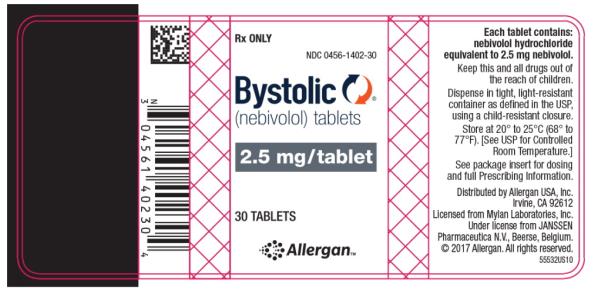
10PRINCIPAL DISPLAY PANEL
NDC 0456-1405-90
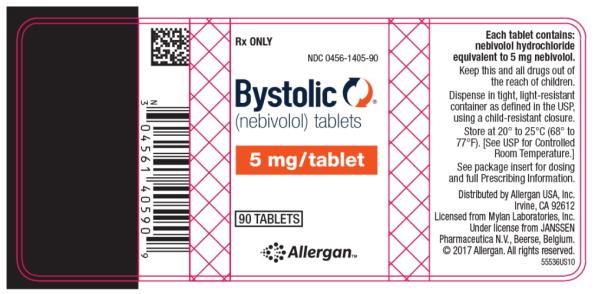
11PRINCIPAL DISPLAY PANEL
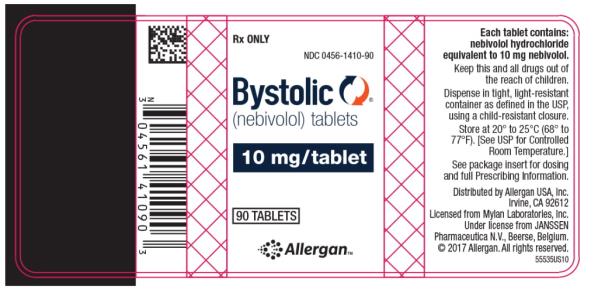
NDC 0456-1410-90
12PRINCIPAL DISPLAY PANEL
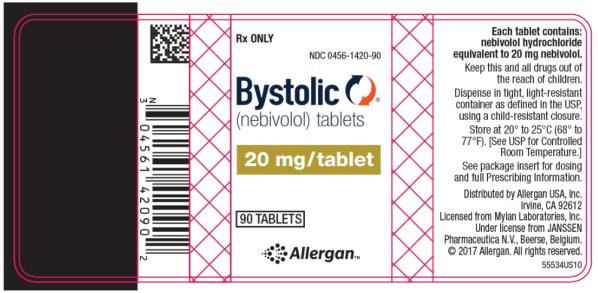
NDC 0456-1420-90