Brand Name

Latuda

Generic Name
Lurasidone
View Brand Information
FDA approval date: October 28, 2010
Classification: Atypical Antipsychotic
Form: Tablet

What is Latuda (Lurasidone)?

Lurasidone hydrochloride tablets are indicated for: Treatment of adult and adolescent patients with schizophrenia [see Clinical Studies (1.
Save this treatment for later
Sign Up
Not sure about your diagnosis?
Check Your Symptoms

Related Clinical Trials

Sequential Multiple Assignment Randomized Trial for Bipolar Depression

Summary: This is a sequential multiple assignment randomized trial for adults (ages \> 18) with a bipolar disorder type 1 diagnosis currently experiencing a depressive episode. It is a randomized pragmatic trial that will compare four commonly prescribed treatments for bipolar depression, which includes three FDA-approved medications (Cariprazine, Quetiapine and Lurasidone) and one antipsychotic/antidepres...

Chinese Longitudinal and Systematic Study of Bioplar Disorder

Summary: Affective disorders (mainly including major depressive disorder and bipolar disorder) are common, chronic and highly disabling mental disorders, which lack of objective biological markers. It is believed that genetic and environmental factors are involved in the development of affective disorders. Gut microbes can affect the function of brain neural circuits by mediating metabolic, immune, endocri...

Brand Information

Latuda (lurasidone hydrochloride)
1INDICATIONS AND USAGE
LATUDA is indicated for:
  • Treatment of adult and adolescent patients (13 to 17 years) with schizophrenia
  • Monotherapy treatment of adult and pediatric patients (10 to 17 years) with major depressive episode associated with bipolar I disorder (bipolar depression)
  • Adjunctive treatment with lithium or valproate in adult patients with major depressive episode associated with bipolar I disorder (bipolar depression)
2DOSAGE FORMS AND STRENGTHS
LATUDA tablets are available in the following shape and color (
3CONTRAINDICATIONS
  • Known hypersensitivity to lurasidone HCl or any components in the formulation. Angioedema has been observed with lurasidone
  • Strong CYP3A4 inhibitors (e.g., ketoconazole, clarithromycin, ritonavir, voriconazole, mibefradil, etc.)
  • Strong CYP3A4 inducers (e.g., rifampin, avasimibe, St. John's wort, phenytoin, carbamazepine, etc.)
4ADVERSE REACTIONS
The following adverse reactions are discussed in more detail in other sections of the labeling:
  • Increased Mortality in Elderly Patients with Dementia-Related Psychosis
  • Suicidal Thoughts and Behaviors
  • Cerebrovascular Adverse Reactions, Including Stroke, in Elderly Patients with Dementia-related Psychosis
  • Neuroleptic Malignant Syndrome
  • Tardive Dyskinesia
  • Metabolic Changes
  • Hyperprolactinemia
  • Leukopenia, Neutropenia, and Agranulocytosis
  • Orthostatic Hypotension and Syncope
  • Falls
  • Seizures
  • Potential for Cognitive and Motor Impairment
  • Body Temperature Dysregulation
  • Activation of Mania/Hypomania
  • Dysphagia
  • Neurological Adverse Reactions in Patients with Parkinson's Disease or Dementia with Lewy Bodies
4.1Clinical Trials Experience
Because clinical trials are conducted under widely varying conditions, adverse reaction rates observed in clinical trials of a drug cannot be directly compared to rates in the clinical trials of another drug and may not reflect the rates observed in clinical practice.
4.2Postmarketing Experience
The following adverse reactions have been identified during postapproval use of LATUDA. Because these reactions are reported voluntarily from a population of uncertain size, it is not always possible to reliably estimate their frequency or establish a causal relationship to drug exposure.
Hypersensitivity Reactions:  Urticaria, throat swelling, tongue swelling, dyspnea, and rash.
Metabolism and Nutrition Disorders: Hyponatremia
5DESCRIPTION
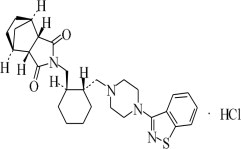
LATUDA is an atypical antipsychotic belonging to the chemical class of benzisothiazol derivatives.
Its chemical name is (3a
The chemical structure is:
Chemical Structure
Lurasidone hydrochloride is a white to off-white powder. It is very slightly soluble in water, practically insoluble or insoluble in 0.1 N HCl, slightly soluble in ethanol, sparingly soluble in methanol, practically insoluble or insoluble in toluene and very slightly soluble in acetone.
LATUDA tablets are intended for oral administration only. Each tablet contains 20 mg, 40 mg, 60 mg, 80 mg, or 120 mg of lurasidone hydrochloride.
Inactive ingredients are mannitol, pregelatinized starch, croscarmellose sodium, hypromellose, magnesium stearate, Opadry
6HOW SUPPLIED/STORAGE AND HANDLING
LATUDA tablets are white to off-white, round (20 mg or 40 mg), white to off-white, oblong (60 mg), pale green, oval (80 mg) or white to off-white, oval (120 mg) and identified with strength-specific one-sided debossing, “L20” (20 mg), “L40” (40 mg), “L80” (80 mg) or “L120” (120 mg). Tablets are supplied in the following strengths and package configurations (
7PATIENT COUNSELING INFORMATION
Advise the patient to read the FDA-approved patient labeling (