Chlorthalidone
What is Edarbyclor (Chlorthalidone)?
Approved To Treat
Top Global Experts


Related Clinical Trials
Summary: Almost 15% of Americans have chronic kidney disease (CKD), with an even higher rate in Veterans due to common risk factors such as high blood pressure and diabetes. People with CKD have a high risk of cardiovascular (CV) diseases, such as heart attacks, heart failure, and strokes. Extra fluid in the body, called volume overload, may lead to CV disease in people with CKD. It is unknown if volume ov...
Summary: The prevalence of hypertension is greater in older women than men, while the blood pressure (BP) control rate is lower in older women in US. Uncontrolled hypertension is a major risk factor for cardiovascular morbidity/mortality. Despite standard therapy and adherence to optimal drug regimens, \>50% of older hypertensive women still have inadequate BP control, and the control rate is further reduc...
Summary: Hypertension is a common and treatable disorder that remains the leading preventable cause of heart disease. Blood pressure treatment relies mainly on upper arm blood pressure readings and ignores blood vessel physiology and underlying individual genetic information. Older Veterans with hypertension are less likely to be treated to goal blood pressure because there are conflicting recommendations ...
Related Latest Advances
Brand Information
- When pregnancy is detected, discontinue Edarbyclor as soon as possible
- Drugs that act directly on the renin-angiotensin system can cause injury and death to the developing fetus
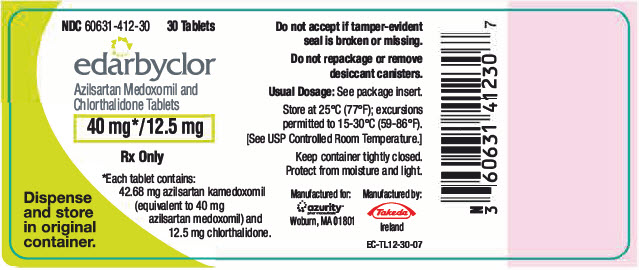
- 40/12.5 mg: pale red, round, biconvex, film-coated tablets, approximately 9.7 mm in diameter, with "A/C" and "40/12.5" imprinted on one side. Each tablet contains 40 mg of azilsartan medoxomil and 12.5 mg of chlorthalidone.
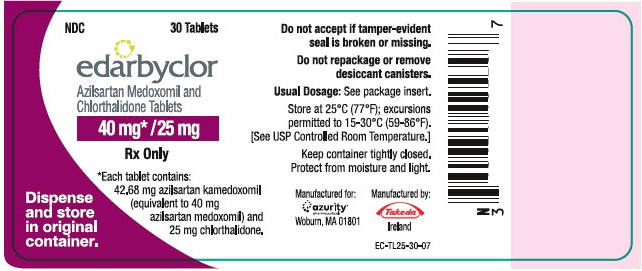
- 40/25 mg: light red, round, biconvex, film-coated tablets, approximately 9.7 mm in diameter, with "A/C" and "40/25" imprinted on one side. Each tablet contains 40 mg of azilsartan medoxomil and 25 mg of chlorthalidone.
- Edarbyclor is contraindicated in patients with anuria
- Do not coadminister aliskiren-containing products with Edarbyclor in patients with diabetes
- Fetal toxicity
- Hypotension in Volume- or Salt-Depleted Patients
- Impaired Renal Function
- Hypokalemia
- Hyperuricemia
- Loss of consciousness
- Pruritus
- Angioedema
- Edarbyclor can cause harm or death to your unborn baby.
- Talk to your doctor about other ways to lower your blood pressure if you plan to become pregnant.
- If you become pregnant while taking Edarbyclor, tell your doctor right away. Your doctor may switch you to a different medicine to treat your high blood pressure.
- when one medicine to lower your high blood pressure is not enough
- as the first medicine to lower your high blood pressure if your doctor decides you are likely to need more than one medicine.
- make less urine because of kidney problems
- have been told that you have abnormal body salt (electrolytes) levels in your blood
- have liver or kidney problems
- have heart problems or stroke
- are vomiting or have diarrhea
- have gout
- are pregnant or plan to become pregnant. See "
- are breastfeeding or plan to breastfeed. It is not known if Edarbyclor passes into your breast milk. You and your doctor should decide if you will take Edarbyclor or breastfeed. You should not do both. Talk with your doctor about the best way to feed your baby if you take Edarbyclor.
- other medicines used to treat your high blood pressure or heart problem
- water pills (diuretics)
- lithium carbonate (Lithobid), lithium citrate
- digoxin (Lanoxin)
- Take Edarbyclor exactly as your doctor tells you to.
- Your doctor will tell you how much Edarbyclor to take and when to take it.
- Your doctor may prescribe other medicines for you to take along with Edarbyclor to treat your high blood pressure.
- Edarbyclor can be taken with or without food.
- If you miss a dose, take it later in the same day. Do not take more than 1 dose of Edarbyclor in a day.
- If you take too much Edarbyclor and have symptoms of low blood pressure (hypotension) and dizziness, call your doctor for advice. See "
- See" What is the most important information I should know about Edarbyclor?"
- Low blood pressure (hypotension) and dizzinessis most likely to happen if you also:
- take water pills (diuretics)
- are on a low-salt diet
- take other medicines that affect your blood pressure
- sweat a lot
- get sick with vomiting or diarrhea
- do not drink enough fluids
- Kidney problems.Kidney problems may become worse in people that already have kidney disease. Some people have changes in blood tests for kidney function and may need a lower dose of Edarbyclor or may need to stop treatment with Edarbyclor. During treatment with Edarbyclor, certain people who have severe heart failure, narrowing of the artery to the kidney, or who lose too much body fluid such as with nausea, vomiting, bleeding, or trauma, may develop sudden kidney failure and in rare instances, death.
- Fluid and body salt (electrolyte) problems.Tell your doctor if you get any of the following symptoms:
- dry mouth
- thirst
- lack of energy (lethargic)
- weakness
- drowsiness
- confusion
- seizures
- muscle pain or cramps
- restlessness
- muscle tiredness (fatigue)
- passing very little urine or passing large amounts of urine
- fast or abnormal heartbeat
- nausea and vomiting
- constipation
- Increased uric acid levels in the blood.People who have increased levels of uric acid in the blood may develop gout. If you already have gout, tell your doctor about worsening of your gout symptoms.
- dizziness, and
- tiredness
- Store Edarbyclor at room temperature between 68°F to 77°F (20°C to 25°C).
- Store Edarbyclor in the original container that you received from your pharmacist or doctor. Do not put Edarbyclor into a different container.
- Keep the container closed tightly, and keep Edarbyclor out of the light.