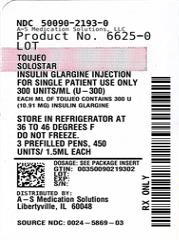
Glargine
What is Toujeo (Glargine)?
Approved To Treat
Top Global Experts


Related Clinical Trials
Summary: The goal of this clinical trial is to see if diabetes in pregnancy can be treated with once daily dosing of insulin instead of once daily dosing plus insulin with meals. The main question this study aims to answer is: 1. Can a once daily dose of long-acting insulin control blood sugars as well as long-acting insulin plus meal-time insulin? 2. Do babies born to mothers who take one dose of long-act...
Summary: This study compares insulin icodec, taken once a week, with other basal insulins, taken once a day, in people with type 2 diabetes.The purpose of this study is to see how well the approved injectable weekly insulin icodec maintains blood sugar levels when compared to approved and available daily injectable basal insulins in people with type 2 diabetes. The participants will either be prescribed we...
Summary: This study compares insulin icodec, an insulin taken once a week to insulin glargine, an insulin taken once a day. The study medicine will be investigated in participants with type 1 diabetes. The study will look at how well insulin icodec taken weekly controls blood sugar compared to insulin glargine taken daily. The study will last for about 8.5 months.
Related Latest Advances
Brand Information
- 1.5 mL TOUJEO SoloStar single-patient-use prefilled pen (450 units per 1.5 mL pen)
- 3 mL TOUJEO Max SoloStar single-patient-use prefilled pen (900 units per 3 mL pen)
- During episodes of hypoglycemia
- In patients with hypersensitivity to insulin glargine or any excipients in TOUJEO
- Hypoglycemia
- Hypoglycemia due to medication errors
- Hypersensitivity reactions
- Hypokalemia
- Do not re-use needles. If you do, you might not get your dose (underdosing) or get too much (overdosing) as the needle could block.
- Do not use a syringe to remove insulin from your pen. If you do, you will get too much insulin. The scale on most syringes is made for U-100 (non-concentrated) insulin only.
- The dose selector of your TOUJEO SoloStar pen dials by 1 unit.
- Do not use your pen if it is damaged or if you are not sure that it is working properly.
- Always perform a safety test (see
- Always carry a spare pen and spare needles in case they are lost or stop working.
- Change (rotate) your injection sites within the area you choose for each dose (see
- Talk with your healthcare provider about how to inject, before using your pen.
- Read all of these instructions before using your pen. If you do not follow all of these instructions, you may get too much or too little insulin.
- a new sterile needle (not included with the pen) (see
- an alcohol swab.
- a puncture-resistant container for used needles and pens (see
- Inject your insulin exactly as your healthcare provider has shown you.
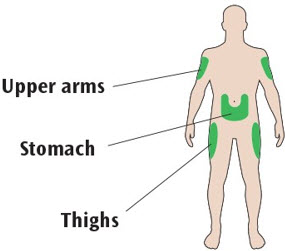
- Inject your insulin under the skin (subcutaneously) of your upper legs (thighs), upper arms, or stomach area (abdomen).
- Change (rotate) your injection sites within the area you choose for each dose to reduce your risk of getting pits or thickening of the skin (lipodystrophy) and lumps in the skin (localized cutaneous amyloidosis) at the injection sites.
- Do not inject where the skin has pits, is thickened, or has lumps.
- Do not inject where the skin is tender, bruised, scaly or hard, or into scars or damaged skin.
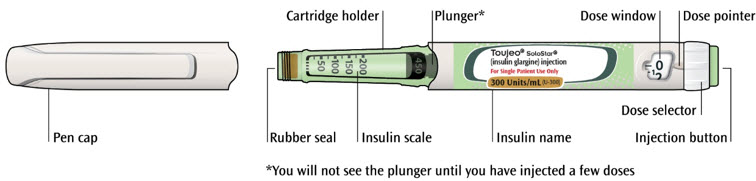
- Check the name and expiration date on the label of your pen.
- Make sure you have the correct insulin.
- Do not use your pen after the expiration date printed on the label.
- Make sure you have the correct insulin.
- Pull off the pen cap.
- Check that the insulin is clear.
- Do not use the pen if the insulin looks cloudy, colored or contains particles.
- Do not use the pen if the insulin looks cloudy, colored or contains particles.
- Wipe the rubber seal with an alcohol swab.
- Making sure you have the correct medicine is especially important if you have other injector pens.
- Do not re-use needles. Always use a new sterile needle for each injection. This helps stop blocked needles, contamination and infection.
- Always use needles
- Take a new needle and peel off the protective seal.
- Keep the needle straight and screw it onto the pen until fixed. Do not over-tighten.
- Pull off the outer needle cap. Keep this for later.
- Pull off the inner needle cap and throw away.
- Be careful when you are handling needles to help prevent accidental needle-stick injury. You may give other people a serious infection, or get a serious infection from them.
- check your pen and the needle to make sure they are working properly.
- make sure that you get the correct insulin dose.
- Select 3 units by turning the dose selector until the dose pointer is at the mark between 2 and 4.
- Press the injection button all the way in.
- When insulin comes out of the needle tip, your pen is working correctly.
- You may need to repeat this step up to 3 times before seeing insulin.
- If no insulin comes out after the third time, the needle may be blocked. If this happens:
- Do not use your pen if there is still no insulin coming out of the needle tip. Use a new pen.
- Do not use a syringe to remove insulin from your pen.
- You may see air bubbles in the insulin. This is normal, they will not harm you.
- Do not select a dose or press the injection button without a needle attached. This may damage your pen.
- TOUJEO SoloStar is made to deliver the number of insulin units that your healthcare provider prescribed. You
- The dose selector of your TOUJEO SoloStar pen dials by 1 unit.
- Make sure a needle is attached and the dose is set to "0."
- Turn the dose selector until the dose pointer lines up with your dose.
- Set the dose by turning the dose selector to a line in the dose window. Each line equals 1 unit.
- The dose selector clicks as you turn it.
- Always check the number in the dose window to make sure you dialed the correct dose.
- Do not dial your dose by counting the clicks. You may dial the wrong dose. This may lead to you getting too much insulin or not enough insulin.
- If you turn past your dose, you can turn back down.
- If there are not enough units left in your pen for your dose, the dose selector will stop at the number of units left.
- If you cannot select your full prescribed dose, split the dose into
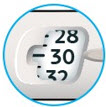
30 units selected
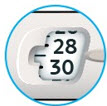
29 units selected
- Your pen contains a total of
- You can see roughly how many units of insulin are left by looking at where the plunger is on the insulin scale.
- Choose a place to inject as shown in the picture labeled "Places to inject."
- The site you choose for the injection should be clean and dry.
- If your skin is dirty, clean it as instructed by your healthcare provider.
- Push the needle into your skin as shown by your healthcare provider.
- Do not touch the injection button yet.
- Do not touch the injection button yet.
- Place your thumb on the injection button. Then press all the way in and hold.
- Do not press at an angle. Your thumb could block the dose selector from turning.
- Do not press at an angle. Your thumb could block the dose selector from turning.
- Keep the injection button held in and when you see "0" in the dose window, slowly count to 5.
- This will make sure you get your full dose.
- After holding and slowly counting to 5, release the injection button. Then remove the needle from your skin.
- Change the needle (see
- If you still find it hard to press in, get a new pen.
- Do not use a syringe to remove insulin from your pen.
- Take care when handling needles to prevent needle injury and cross-infection.
- Do not put the inner needle cap back on.
- Grip the widest part of the outer needle cap. Keep the needle straight and guide it into the outer needle cap.
- The needle can puncture the cap if it is recapped at an angle.
- Grip and squeeze the widest part of the outer needle cap. Turn your pen several times with your other hand to remove the needle.
- Try again if the needle does not come off the first time.
- Throw away the used needle in a puncture-resistant container (see " at the end of this Instructions for Use).
- Put the pen cap back on.
- Do not put the pen back in the refrigerator.
- Do not put the pen back in the refrigerator.
- Only use your pen for up to
- Keep new pens in the refrigerator between
- Do not freeze. Throw away your pen if it has been frozen (See "Throwing your pen away").
- Keep your pen at room temperature
- Protect your pen from direct heat and light.
- Do not put your pen back in the refrigerator.
- Do not store your pen with the needle attached.
- Store your pen with the pen cap on.
- Keep TOUJEO SoloStar pens and needles out of the reach of children.
- Do not drop your pen or knock it against hard surfaces.
- If you think that your pen may be damaged,
- You can clean the outside of your pen by wiping it with a damp cloth (water only).
- The used TOUJEO SoloStar pen may be thrown away in your household trash after you have removed the needle.
- Put the used needle in a FDA-cleared sharps disposal container right away after use.
- If you do not have a FDA-cleared sharps disposal container, you may use a household container that is:
- When your sharps disposal container is almost full, you will need to follow your community guidelines for the right way to dispose of your sharps disposal container. There may be state or local laws about how you should throw away used needles and syringes. For more information about safe sharps disposal, and for specific information about sharps disposal in the state that you live in, go to the FDA's website at: http://www.fda.gov/safesharpsdisposal.
- Do not dispose of your used sharps disposal container in your household trash unless your community guidelines permit this. Do not recycle your used sharps disposal container.
- Do not re-use needles. If you do, you might not get your dose (underdosing) or get too much (overdosing) as the needle could block.
- Do not use a syringe to remove insulin from your pen. If you do, you will get too much insulin. The scale on most syringes is made for U-100 (non-concentrated) insulin only.
- The dose selector of your TOUJEO Max SoloStar pen dials by
- Do not use your pen if it is damaged or if you are not sure that it is working properly.
- Always perform a safety test (see
- Always carry a spare pen and spare needles in case they are lost or stop working.
- Change (rotate) your injection sites within the area you choose for each dose (see
- Talk with your healthcare provider about how to inject, before using your pen.
- Read all of these instructions before using your pen. If you do not follow all of these instructions, you may get too much or too little insulin.
- a new sterile needle (not included with the pen) (see
- an alcohol swab.
- a puncture-resistant container for used needles and pens (see
- Inject your insulin exactly as your healthcare provider has shown you.
- Inject your insulin under the skin (subcutaneously) of your upper legs (thighs), upper arms, or stomach area (abdomen).
- Change (rotate) your injection sites within the area you choose for each dose to reduce your risk of getting pits or thickening of the skin (lipodystrophy) and lumps in the skin (localized cutaneous amyloidosis) at the injection sites.
- Do not inject where the skin has pits, is thickened, or has lumps.
- Do not inject where the skin is tender, bruised, scaly or hard, or into scars or damaged skin.
- Do not inject where the skin is tender, bruised, scaly or hard, or into scars or damaged skin.
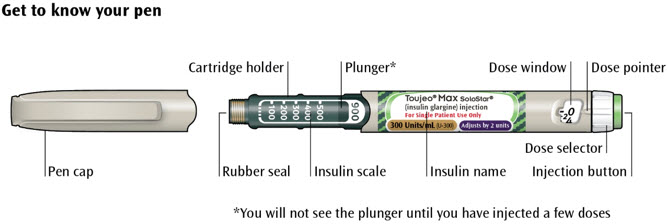
- Check the name and expiration date on the label of your pen.
- Make sure you have the correct insulin.
- Do not use your pen after the expiration date printed on the label.
- Make sure you have the correct insulin.
- Pull off the pen cap.
- Check that the insulin is clear.
- Do not use the pen if the insulin looks cloudy, colored or contains particles.
- Do not use the pen if the insulin looks cloudy, colored or contains particles.
- Wipe the rubber seal with an alcohol swab.
- Making sure you have the correct medicine is especially important if you have other injector pens.
- Do not re-use needles. Always use a new sterile needle for each injection. This helps stop blocked needles, contamination and infection.
- Always use needles
- Take a new needle and peel off the protective seal.
- Keep the needle straight and screw it onto the pen until fixed. Do not over-tighten.
- Pull off the outer needle cap. Keep this for later.
- Pull off the inner needle cap and throw away.
- Be careful when you are handling needles to help prevent accidental needle-stick injury. You may give other people a serious infection, or get a serious infection from them.
- check your pen and the needle to make sure they are working properly.
- make sure that you get the correct insulin dose.
- Select 4 units by turning the dose selector until the dose pointer is at the 4 mark.
- Press the injection button all the way in.
- When insulin comes out of the needle tip, your pen is working correctly.
- You may need to repeat this step up to 6 times before seeing insulin.
- If no insulin comes out after the sixth time, the needle may be blocked. If this happens:
- Do not use your pen if there is still no insulin coming out of the needle tip. Use a new pen.
- Do not use a syringe to remove insulin from your pen.
- You may see air bubbles in the insulin. This is normal, they will not harm you.
- Do not select a dose or press the injection button without a needle attached. This may damage your pen.
- TOUJEO Max SoloStar is made to deliver the number of insulin units that your healthcare provider prescribed. You
- The dose selector of your TOUJEO Max SoloStar pen dials by 2 units and can only dial even doses of insulin.
- Make sure a needle is attached and the dose is set to "0."
- Turn the dose selector until the dose pointer lines up with your dose.
- Set the dose by turning the dose selector to a line in the dose window. Each line equals 2 units.
- The dose selector clicks as you turn it.
- Always check the number in the dose window to make sure you dialed the correct dose.
- Do not dial your dose by counting the clicks. You may dial the wrong dose. This may lead to you getting too much insulin or not enough insulin.
- If you turn past your dose, you can turn back down.
- If there are not enough units left in your pen for your dose, the dose selector will stop at the number of units left.
- If you cannot select your full prescribed dose, split the dose into
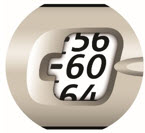
60 units selected
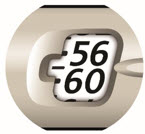
58 units selected
- Your pen contains a total of
- You can see roughly how many units of insulin are left by looking at where the plunger is on the insulin scale.
- Choose a place to inject as shown in the picture labeled "Places to inject."
- The site you choose for the injection should be clean and dry.
- If your skin is dirty, clean it as instructed by your healthcare provider.
- Push the needle into your skin as shown by your healthcare provider.
- Do not touch the injection button yet.
- Do not touch the injection button yet.
- Place your thumb on the injection button. Then press all the way in and hold.
- Do not press at an angle. Your thumb could block the dose selector from turning.
- Do not press at an angle. Your thumb could block the dose selector from turning.
- Keep the injection button held in and when you see "0" in the dose window, slowly count to 5.
- This will make sure you get your full dose.
- After holding and slowly counting to 5, release the injection button. Then remove the needle from your skin.
- Change the needle (see
- If you still find it hard to press in, get a new pen.
- Do not use a syringe to remove insulin from your pen.
- Take care when handling needles to prevent needle injury and cross-infection.
- Do not put the inner needle cap back on.
- Grip the widest part of the outer needle cap. Keep the needle straight and guide it into the outer needle cap.
- The needle can puncture the cap if it is recapped at an angle.
- Grip and squeeze the widest part of the outer needle cap. Turn your pen several times with your other hand to remove the needle.
- Try again if the needle does not come off the first time.
- Throw away the used needle in a puncture-resistant container (see " at the end of this Instructions for Use).
- Put the pen cap back on.
- Do not put the pen back in the refrigerator.
- Do not put the pen back in the refrigerator.
- Only use your pen for up to
- Keep new pens in the refrigerator between
- Do not freeze. Throw away your pen if it has been frozen (see ").
- Keep your pen at room temperature
- Protect your pen from direct heat and light.
- Do not put your pen back in the refrigerator.
- Do not store your pen with the needle attached.
- Store your pen with the pen cap on.
- Keep TOUJEO Max SoloStar pens and needles out of the reach of children.
- Do not drop your pen or knock it against hard surfaces.
- If you think that your pen may be damaged,
- You can clean the outside of your pen by wiping it with a damp cloth (water only).
- The used TOUJEO Max SoloStar pen may be thrown away in your household trash after you have removed the needle.
- Put the used needle in a FDA-cleared sharps disposal container right away after use.
- If you do not have a FDA-cleared sharps disposal container, you may use a household container that is:
- When your sharps disposal container is almost full, you will need to follow your community guidelines for the right way to dispose of your sharps disposal container. There may be state or local laws about how you should throw away used needles and syringes. For more information about safe sharps disposal, and for specific information about sharps disposal in the state that you live in, go to the FDA's website at:
- Do not dispose of your used sharps disposal container in your household trash unless your community guidelines permit this. Do not recycle your used sharps disposal container.