Generic Name

Ursodiol

Brand Names
Reltone, Urso, Urso 250, Ursolign
FDA approval date: December 31, 1987
Classification: Bile Acid
Form: Tablet, Capsule

What is Reltone (Ursodiol)?

1. Reltone™ is indicated for patients with radiolucent, noncalcified gallbladder stones < 20 mm in greatest diameter in whom elective cholecystectomy would be undertaken except for the presence of increased surgical risk due to systemic disease, advanced age, idiosyncratic reaction to general anesthesia, or for those patients who refuse surgery. Safety of use of Reltone™ beyond 24 months is not established. 2. Reltone™ is indicated for the prevention of gallstone formation in obese patients experiencing rapid weight loss.
Save this treatment for later
Sign Up
Not sure about your diagnosis?
Check Your Symptoms

Related Clinical Trials

Transabdominal and Laparoscopic Ultrasound in a Bariatric Setting: Utility and Diagnostic Accuracy

Summary: Every year, many patients undergo weight-loss (bariatric) surgery. While this surgery leads to significant and intended weight loss, it also increases the risk of developing gallstones or other gallbladder problems. Approximately one in five patients later requires a second operation to remove the gallbladder. This type of surgery carries a higher risk of complications and reoperations compared wi...

Preventive Effect of Prophylactic Oral Antibiotics Against Cholangitis After Kasai Portoenterostomy in Biliary Atresia: a Randomized Controlled Trial

Summary: This study is non-inferiority trial design. This study aimed to investigate the effect of prophylactic oral antibiotics on preventing cholangitis in biliary atresia (BA) patients after Kasai portoenterostomy (KP) by comparing the cholangitis rate in BA patients who received prophylactic oral antibiotics and those who did not. The patients were followed up for 2 years after KP.

A Prospective Open-label Randomized Controlled Trial , Evaluating the Efficacy of Ursodeoxycholic Acid (UDCA) as an Adjuvant to Phototherapy in Neonates With Indirect Hyperbilirubinemia

Summary: This is a prospective, open-label, randomized controlled trial conducted at Lattakia University Hospital (Tishreen University), aiming to evaluate the efficacy of Ursodeoxycholic Acid (UDCA) as an adjuvant to triple phototherapy in the management of indirect hyperbilirubinemia in neonates ≥34 weeks of gestation. Eligible neonates will be randomly assigned to one of two groups: Group A: continuous ...

Brand Information

    Reltone 200 mg (Ursodiol)
    1DESCRIPTION
    Reltone™ is a bile acid available as 200 mg and 400 mg capsules suitable for oral administration.
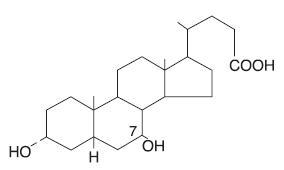
    Ursodiol (ursodesoxycholic acid) is a naturally occurring bile acid found in small quantities in normal human bile and in the bile of certain other mammals. It is a bitter-tasting, white powder freely soluble in ethanol, methanol, and glacial acetic acid; sparingly soluble in chloroform; slightly soluble in ether; and insoluble in water. The chemical name for ursodiol is 3α,7β-Dihydroxy-5β-cholan-24-oic acid (C
    Ursodioil Structural Formula
    Inactive Ingredients: Silicon dioxide, magnesium stearate, and corn starch. Gelatin capsules contain gelatin and titanium dioxide and are printed with edible black ink; additionally, the 400 mg capsule also contains FD&C Yellow #6 and D&C Yellow #10.
    2CLINICAL PHARMACOLOGY
    About 90% of a therapeutic dose of Reltone™ is absorbed in the small bowel after oral administration. After absorption, ursodiol enters the portal vein and undergoes efficient extraction from portal blood by the liver (i.e., there is a large “first-pass” effect) where it is conjugated with either glycine or taurine and is then secreted into the hepatic bile ducts. Ursodiol in bile is concentrated in the gallbladder and expelled into the duodenum in gallbladder bile via the cystic and common ducts by gallbladder contractions provoked by physiologic responses to eating. Only small quantities of ursodiol appear in the systemic circulation and very small amounts are excreted into urine. The sites of the drug’s therapeutic actions are in the liver, bile, and gut lumen.
    Beyond conjugation, ursodiol is not altered or catabolized appreciably by the liver or intestinal mucosa. A small proportion of orally administered drug undergoes bacterial degradation with each cycle of enterohepatic circulation. Ursodiol can be both oxidized and reduced at the 7-carbon, yielding either 7-keto-lithocholic acid or lithocholic acid, respectively. Further, there is some bacterially catalyzed deconjugation of glyco- and tauro-ursodeoxycholic acid in the small bowel. Free ursodiol, 7-keto-lithocholic acid, and lithocholic acid are relatively insoluble in aqueous media and larger proportions of these compounds are lost from the distal gut into the feces. Reabsorbed free ursodiol is reconjugated by the liver. Eighty percent of lithocholic acid formed in the small bowel is excreted in the feces, but the 20% that is absorbed is sulfated at the 3-hydroxyl group in the liver to relatively insoluble lithocholyl conjugates which are excreted into bile and lost in feces. Absorbed 7-keto-lithocholic acid is stereospecifically reduced in the liver to chenodiol.
    Lithocholic acid causes cholestatic liver injury and can cause death from liver failure in certain species unable to form sulfate conjugates. Lithocholic acid is formed by 7-dehydroxylation of the dihydroxy bile acids (ursodiol and chenodiol) in the gut lumen. The 7-dehydroxylation reaction appears to be alpha-specific, i.e., chenodiol is more efficiently 7-dehydroxylated than ursodiol and, for equimolar doses of ursodiol and chenodiol, levels of lithocholic acid appearing in bile are lower with the former. Man has the capacity to sulfate lithocholic acid. Although liver injury has not been associated with ursodiol therapy, a reduced capacity to sulfate may exist in some individuals, but such a deficiency has not yet been clearly demonstrated.
    2.1Pharmacodynamics
    Ursodiol suppresses hepatic synthesis and secretion of cholesterol, and also inhibits intestinal absorption of cholesterol. It appears to have little inhibitory effect on synthesis and secretion into bile of endogenous bile acids and does not appear to affect secretion of phospholipids into bile.
    With repeated dosing, bile ursodeoxycholic acid concentrations reach a steady-state in about 3 weeks. Although insoluble in aqueous media, cholesterol can be solubilized in at least two different ways in the presence of dihydroxy bile acids. In addition to solubilizing cholesterol in micelles, ursodiol acts by an apparently unique mechanism to cause dispersion of cholesterol as liquid crystals in aqueous media. Thus, even though administration of high doses (e.g., 15-18 mg/kg/day) does not result in a concentration of ursodiol higher than 60% of the total bile acid pool, ursodiol-rich bile effectively solubilizes cholesterol. The overall effect of ursodiol is to increase the concentration level at which saturation of cholesterol occurs.
    The various actions of ursodiol combine to change the bile of patients with gallstones from cholesterol-precipitating to cholesterol-solubilizing, thus resulting in bile conducive to cholesterol stone dissolution.
    After ursodiol dosing is stopped, the concentration of the bile acid in bile falls exponentially, declining to about 5% to 10% of its steady-state level in about 1 week.
    3INDICATIONS AND USAGE
    1. Reltone™ is indicated for patients with radiolucent, noncalcified gallbladder stones < 20 mm in greatest diameter in whom elective cholecystectomy would be undertaken except for the presence of increased surgical risk due to systemic disease, advanced age, idiosyncratic reaction to general anesthesia, or for those patients who refuse surgery. Safety of use of Reltone™ beyond 24 months is not established.
    2. Reltone™ is indicated for the prevention of gallstone formation in obese patients experiencing rapid weight loss.
    4CONTRAINDICATIONS
    1. Reltone™ will not dissolve calcified cholesterol stones, radiopaque stones, or radiolucent bile pigment stones. Hence, patients with such stones are not candidates for Reltone™ therapy.
    2. Patients with compelling reasons for cholecystectomy including unremitting acute cholecystitis, cholangitis, biliary obstruction, gallstone pancreatitis, or biliary-gastrointestinal fistula are not candidates for Reltone™ therapy.
    3. Allergy to bile acids.
    5ADVERSE REACTIONS
    To report SUSPECTED ADVERSE REACTIONS, contact Intra-Sana Laboratories at 1-702-980-8963 or FDA at 1-800-FDA-1088 or www.fda.gov/medwatch.
    The nature and frequency of adverse experiences were similar across all groups.
    The following tables provide comprehensive listings of the adverse experiences reported that occurred with a 5% incidence level:
    6OVERDOSAGE
    Neither accidental nor intentional overdosing with ursodiol has been reported. Doses of ursodiol in the range of 16-20 mg/kg/day have been tolerated for 6 to 37 months without symptoms by 7 patients. The LD
    7HOW SUPPLIED
    Reltone™ Capsules, USP 200 mg are opaque white capsules imprinted with a thick black bar.
    Bottles of 100 are supplied with child-resistant closures.
    Reltone™ Capsules, USP 400 mg (NDC 80056-144-01)
    Store at 25°C (77°F); excursions permitted to 15°C - 30°C (59°F - 86°F).
    Dispense in tight container (USP).
    Rx only
    Keep out of reach of children.
    Distributed by:
    Intra-Sana Laboratories LLC
    Las Vegas, NV 89113
    7143
    Rev. 11/2020
    8Package/Label Display Panel
    Reltone™ (ursodiol) Capsules, USP, 200mg (NDC 80056-143-01) 100 Capsules
    9Package/Label Display Panel
    Reltone™ (ursodiol) Capsules, USP, 400mg (NDC 80056-144-01) 100 Capsules