Generic Name

Naltrexone

Brand Names
Contrave, Vivitrol
FDA approval date: March 22, 2002
Classification: Opioid Antagonist
Form: Tablet, Kit

What is Contrave (Naltrexone)?

CONTRAVE is indicated in combination with a reduced-calorie diet and increased physical activity to reduce excess body weight and maintain weight reduction long term in adults with obesity or overweight in the presence of at least one weight-related comorbid condition. CONTRAVE is a combination of naltrexone, an opioid antagonist, and bupropion, an aminoketone antidepressant, indicated in combination with a reduced-calorie diet and increased physical activity to reduce excess body weight and maintain weight reduction long term in adults with obesity or overweight in the presence of at least one weight-related comorbid condition. Limitations of Use: The effect of CONTRAVE on cardiovascular morbidity and mortality has not been established. Coadministration with other naltrexone-containing products is not recommended. Coadministration with other bupropion-containing products is contraindicated. Limitations of Use: The effect of CONTRAVE on cardiovascular morbidity and mortality has not been established. CONTRAVE contains naltrexone and bupropion. Coadministration with other naltrexone-containing products is not recommended. Coadministration with other bupropion-containing products is contraindicated.

Approved To Treat

Save this treatment for later
Sign Up
Not sure about your diagnosis?
Check Your Symptoms

Related Clinical Trials

Extended-Release Naltrexone as Opioid Overdose Pre-Exposure Prophylaxis (PrEP) in People Using Stimulants Living With or At Risk of HIV

Summary: The goal of this clinical trial is to see if an injectable medicine called naltrexone can prevent fentanyl overdose deaths in people who use other drugs (cocaine, methamphetamine). The main questions it aims to answer are: What are the challenges for implementing naltrexone as an overdose prevention strategy? Are injections of naltrexone effective for opioid overdose prevention among people who us...

A Phase 1, First-in-human Study Evaluating the Safety, Tolerability, and Pharmacokinetics of VX-433 and Its Effects on the Pharmacokinetics of Midazolam and Bupropion

Summary: The purpose of this study is to evaluate the safety, tolerability, and pharmacokinetics (PK) of VX-433 following single and multiple ascending doses, as well as to assess the effect of VX-433 on the PK of midazolam, bupropion, and hydroxybupropion.

A Randomized Controlled Trial for Cervicothoracic Sympathetic Chain Block Against Sham Injection Evaluation for Post COVID Condition: the CeASE RCT

Summary: Post-COVID Condition (PCC) affects roughly 2.1 million Canadians, carrying an annual economic burden of CAD $7.8-50.6 billion. It presents across multiple organ systems with symptoms including fatigue, brain fog, palpitations, and orthostatic intolerance, at an annual cost of CAD $1,675-$7,340 per case. A key mechanism underlying many treatment-resistant PCC symptoms appears to be dysautonomia abn...

Brand Information

    Contrave (naltrexone hydrochloride and bupropion hydrochloride)
    1INDICATIONS AND USAGE
    CONTRAVE is indicated in combination with a reduced-calorie diet and increased physical activity to reduce excess body weight and maintain weight reduction long term in adults with obesity or overweight in the presence of at least one weight-related comorbid condition.
    2DOSAGE FORMS AND STRENGTHS
    CONTRAVE extended-release tablets: 8 mg/90 mg are blue, round, bi-convex, film-coated, and debossed with "NB-890" on one side.
    3CONTRAINDICATIONS
    CONTRAVE is contraindicated in
    • Uncontrolled hypertension
    • Seizure disorder or a history of seizures
    • Use of other bupropion-containing products (including, but not limited to, WELLBUTRIN, WELLBUTRIN SR, WELLBUTRIN XL, APLENZIN and ZYBAN)
    • Bulimia or anorexia nervosa, which increase the risk for seizure
    • Chronic opioid or opiate agonist (e.g., methadone) or partial agonists (e.g., buprenorphine) use, or acute opiate withdrawal
    • Patients undergoing an abrupt discontinuation of alcohol, benzodiazepines, barbiturates, and antiepileptic drugs
    • Concomitant administration of monoamine oxidase inhibitors (MAOI). At least 14 days should elapse between discontinuation of MAOI and initiation of treatment with CONTRAVE. There is an increased risk of hypertensive reactions when CONTRAVE is used concomitantly with MAOIs. Starting CONTRAVE in a patient treated with reversible MAOIs such as linezolid or intravenous methylene blue is also contraindicated
    • Known allergy to bupropion, naltrexone or any other component of CONTRAVE. Anaphylactoid/anaphylactic reactions and Stevens-Johnson syndrome have been reported with bupropion
    4ADVERSE REACTIONS
    The following adverse reactions are discussed in other sections of the labeling:
    • Suicidal Behavior and Ideation
    • Neuropsychiatric Adverse Events
    • Seizures
    • Increase in Blood Pressure and Heart Rate
    • Allergic Reactions
    • Angle-Closure Glaucoma
    4.1Clinical Trials Experience
    Because clinical trials are conducted under widely varying conditions, the adverse reaction rates observed in the clinical trials of a drug cannot be directly compared to rates in the clinical trials of another drug and may not reflect the rates observed in practice.
    CONTRAVE was evaluated for safety in five double-blind placebo-controlled trials in 4,754 overweight or obese patients (3,239 patients treated with CONTRAVE and 1,515 patients treated with placebo) for a treatment period up to 56 weeks. The majority of patients were treated with CONTRAVE 32 mg/360 mg total daily dose. In addition, some patients were treated with other combination daily doses including naltrexone up to 50 mg and bupropion up to 400 mg. All subjects received study drug in addition to diet and exercise counseling. One trial (N=793) evaluated patients participating in an intensive behavioral modification program and another trial (N= 505) evaluated patients with type 2 diabetes. In these randomized, placebo-controlled trials, 2,545 patients received CONTRAVE 32 mg/360 mg for a mean treatment duration of 36 weeks (median, 56 weeks). Baseline patient characteristics included a mean age of 46 years, 82% women, 78% white, 25% with hypertension, 13% with type 2 diabetes, 56% with dyslipidemia, 25% with BMI greater than 40 kg/m
    In CONTRAVE clinical trials, 24% of subjects receiving CONTRAVE and 12% of subjects receiving placebo discontinued treatment because of an adverse event. The most frequent adverse reactions leading to discontinuation with CONTRAVE were nausea (6.3%), headache (1.7%) and vomiting (1.1%).
    4.2Postmarketing Experience
    The following adverse reactions have been identified during post approval use of CONTRAVE, naltrexone, or bupropion. Because these reactions are reported voluntarily from a population of uncertain size, it is not always possible to reliably estimate their frequency or establish a causal relationship to drug exposure.
    • Loss of consciousness, malaise
    • Brugada pattern/syndrome
    • Drug reaction with eosinophilia and systemic symptoms (DRESS)
    • Acute generalized exanthematous pustulosis (AGEP)
    • Aseptic meningitis
    5DESCRIPTION
    CONTRAVE extended-release tablets contain naltrexone hydrochloride (HCl) and bupropion HCl.
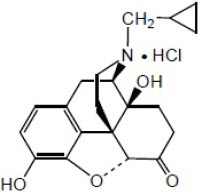
    Naltrexone HCl, USP, an opioid antagonist, is a synthetic congener of oxymorphone with no opioid agonist properties. Naltrexone differs in structure from oxymorphone in that the methyl group on the nitrogen atom is replaced by a cyclopropylmethyl group. Naltrexone HCl is also related to the potent opioid antagonist, naloxone, or n-allylnoroxymorphone.
    Naltrexone HCl has the chemical name of morphinan-6-one, 17-(cyclopropylmethyl)-4,5-epoxy-3,14-dihydroxy-, hydrochloride, (5α)-. The empirical formula is C
    Chemical Structure
    Naltrexone HCl is a white to yellowish, crystalline compound. It is soluble in water to the extent of about 100 mg/mL.
    Bupropion HCl is an antidepressant of the aminoketone class. Bupropion HCl closely resembles the structure of diethylpropion. It is designated as (±)-1-(3 chlorophenyl)-2-[(1,1-dimethylethyl)amino]-1-propranone hydrochloride. It is related to phenylethylamines. The empirical formula is C
    Chemical Structure
    Bupropion HCl powder is white, crystalline, and highly soluble in water.
    CONTRAVE is available for oral administration as a round, bi-convex, film-coated, extended-release tablet. Each tablet has a trilayer core composed of two drug layers, containing the drug and excipients, separated by a more rapidly dissolving inert layer. Each tablet contains 8 mg of naltrexone HCl and 90 mg of bupropion HCl. Tablets are blue and are debossed with NB-890 on one side. Each tablet contains the following inactive ingredients: microcrystalline cellulose, hydroxypropyl cellulose, lactose anhydrous, L-cysteine hydrochloride, crospovidone, magnesium stearate, hypromellose, edetate disodium, lactose monohydrate, colloidal silicon dioxide, Opadry II Blue and FD&C Blue #2 aluminum lake.
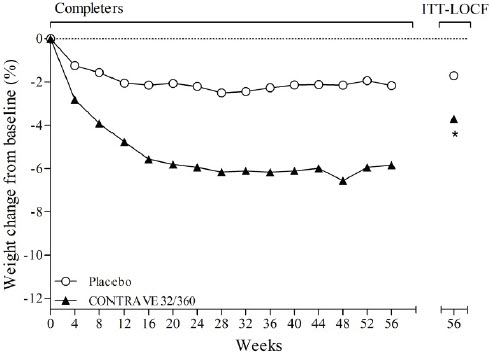
    6CLINICAL STUDIES
    The effects of CONTRAVE on weight reduction and long-term maintenance in conjunction with reduced caloric intake and increased physical activity was studied in double-blind, placebo-controlled trials (BMI range 27 to 45 kg/m
    7HOW SUPPLIED/STORAGE AND HANDLING
    CONTRAVE 8 mg/90 mg (naltrexone HCl 8 mg and bupropion HCl 90 mg) extended-release tablets are blue, round, bi-convex, film-coated tablets debossed with "NB-890" on one side. CONTRAVE tablets are available as follows:
    8PATIENT COUNSELING INFORMATION
    Advise the patient to read the FDA-approved patient labeling (Medication Guide)
    Patient information is printed at the end of this insert. This information and the instructions provided in the Medication Guide should be discussed with patients.
    Patients should be advised to take CONTRAVE exactly as prescribed. Patients should be instructed to follow the dose escalation schedule and not to take more than the recommended dose of CONTRAVE.
    Patients should be made aware that CONTRAVE contains the same active ingredient (bupropion) found in certain antidepressants and smoking cessation products (including, but not limited to, WELLBUTRIN, WELLBUTRIN SR, WELLBUTRIN XL, APLENZIN and ZYBAN) and that CONTRAVE should not be used in combination with any other medications that contain bupropion.
    Patients should be advised that some patients have experienced changes in mood (including depression and mania), psychosis, hallucinations, paranoia, delusions, homicidal ideation, aggression, hostility, agitation, anxiety, and panic, as well as suicidal ideation, suicide attempt, and completed suicide when attempting to quit smoking while taking bupropion. Instruct patients to discontinue CONTRAVE and contact a healthcare professional if they experience such symptoms.
    Patients should be advised of the potential serious risks associated with the use of CONTRAVE, including suicidality, seizures, and increases in blood pressure or heart rate.
    Patients should be advised to call their healthcare provider to report new or sudden changes in mood, behavior, thoughts, or feelings.
    Patients should be advised that taking CONTRAVE can cause mild pupillary dilation, which in susceptible individuals, can lead to an episode of angle-closure glaucoma. Pre-existing glaucoma is almost always open-angle glaucoma because angle-closure glaucoma, when diagnosed, can be treated definitively with iridectomy. Open-angle glaucoma is not a risk factor for angle-closure glaucoma. Patients may wish to be examined to determine whether they are susceptible to angle closure, and have a prophylactic procedure (e.g., iridectomy), if they are susceptible.
    Patients should be educated on the symptoms of hypersensitivity and to discontinue CONTRAVE if they have a severe allergic reaction to CONTRAVE.
    Patients should be told that CONTRAVE should be discontinued and not restarted if they experience a seizure while on treatment.
    Patients should be advised that the excessive use or abrupt discontinuation of alcohol, benzodiazepines, antiepileptic drugs, or sedatives/hypnotics can increase the risk of seizure. Patients should be advised to minimize or avoid use of alcohol.
    Patients should be advised that if they previously used opioids, they may be more sensitive to lower doses of opioids and at risk of accidental overdose should they use opioids after CONTRAVE treatment is discontinued or temporarily interrupted.
    Patients should be advised that because naltrexone, a component of CONTRAVE, can block the effects of opioids, they will not perceive any effect if they attempt to self-administer any opioid drug in small doses while on CONTRAVE. Further advise patients that the attempt to administer large doses of any opioid or to bypass the blockade while on CONTRAVE may lead to serious injury, coma, or death.
    Patients should be off all opioids for a minimum of 7 to 10 days before starting CONTRAVE in order to avoid precipitation of withdrawal. Advise patients they should not take CONTRAVE if they have any symptoms of opioid withdrawal.
    Patients should be advised to call their healthcare provider if they experience increased blood pressure or heart rate.
    Patients should be advised to notify their healthcare provider if they are taking, or plan to take, any prescription or over-the-counter drugs. Concern is warranted because CONTRAVE and other drugs may affect each other's metabolism.
    9PRINCIPAL DISPLAY PANEL - 8 mg/90 mg Tablet Bottle Label
    NDC 51267-890-99
    120 tablets
    Contrave
    8 mg/90 mg
    Attention: Dispense with the
    Tablets should not be cut, chewed,
    Currax™
    Rx only
    PRINCIPAL DISPLAY PANEL - 8 mg/90 mg Tablet Bottle Label