Attention Deficit Hyperactivity Disorder (ADHD) Treatments
Find Attention Deficit Hyperactivity Disorder (ADHD) Treatments
Generic Name
Dexmethylphenidate
Brand Names
Azstarys, Focalin
FDA approval date: November 30, 2001
Classification: Central Nervous System Stimulant
Form: Tablet, Capsule
What is Azstarys (Dexmethylphenidate)?
AZSTARYS is indicated for the treatment of Attention Deficit Hyperactivity Disorder in patients 6 years of age and older. AZSTARYS is a central nervous system stimulant indicated for the treatment of Attention Deficit Hyperactivity Disorder in patients 6 years of age and older.
Approved To Treat
Save this treatment for later
Not sure about your diagnosis?
Tired of the same old research?
Related Clinical Trials
Comparative Effectiveness of Pharmacologic Management of ADHD in Children and Youth With Autism Spectrum Disorder
Summary: This study is a pragmatic clinical trial examining the comparative effectiveness of two stimulant medications (methylphenidate and amphetamine) in the treatment of ADHD in children and adolescents with autism. Using a sequential, multiple assignment randomization trial (SMART) design the study will not only assess these two medications but also the role of an increasingly popular class of ADHD med...
Related Latest Advances
Brand Information
AZSTARYS (Serdexmethylphenidate and Dexmethylphenidate)
WARNING: ABUSE, MISUSE, AND ADDICTION
AZSTARYS has a high potential for abuse and misuse, which can lead to the development of a substance use disorder, including addiction. Misuse and abuse of CNS stimulants, including AZSTARYS, can result in overdose and death [see Overdosage (
Before prescribing AZSTARYS, assess each patient’s risk for abuse, misuse, and addiction. Educate patients and their families about these risks, proper storage of the drug, and proper disposal of any unused drug. Throughout AZSTARYS treatment, reassess each patient’s risk of abuse, misuse, and addiction and frequently monitor for signs and symptoms of abuse, misuse, and addiction [see Warnings and Precautions (
1INDICATIONS AND USAGE
AZSTARYS is indicated for the treatment of Attention Deficit Hyperactivity Disorder (ADHD) in patients 6 years of age and older.
Limitations of Use
The use of AZSTARYS is not recommended in pediatric patients younger than 6 years of age because they had higher plasma exposure and a higher incidence of adverse reactions (e.g., weight loss) than patients 6 years and older at the same dosage [see
2DOSAGE FORMS AND STRENGTHS
AZSTARYS capsules are available as:
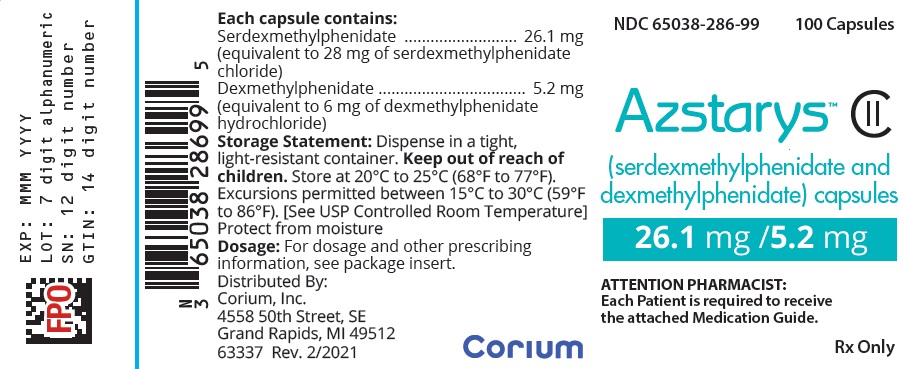
- 26.1 mg/5.2 mg (serdexmethylphenidate/dexmethylphenidate) – blue cap/grey body, imprinted with "286" on cap and "KP415" on the body
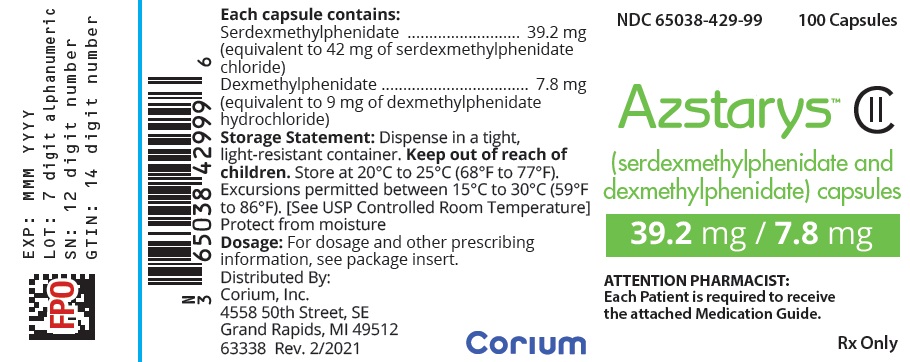
- 39.2 mg/7.8 mg (serdexmethylphenidate/dexmethylphenidate) – dark blue cap/grey body, imprinted with "429" on cap and "KP415" on the body
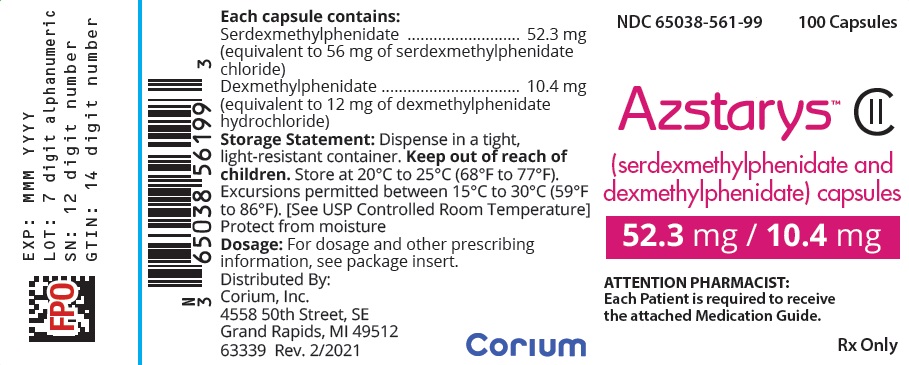
- 52.3 mg/10.4 mg (serdexmethylphenidate/dexmethylphenidate) – orange cap/grey body, imprinted with "5612" on cap and "KP415" on the body
3CONTRAINDICATIONS
AZSTARYS is contraindicated in patients:
- with known hypersensitivity to serdexmethylphenidate, methylphenidate, or other components of AZSTARYS. Bronchospasm, rash, and pruritus have been reported in patients who received AZSTARYS. Hypersensitivity reactions such as angioedema and anaphylactic reactions have been reported in patients treated with other methylphenidate products
- receiving concomitant treatment with monoamine oxidase inhibitors (MAOIs), or within 14 days following discontinuation of treatment with an MAOI, because of the risk of hypertensive crisis
4ADVERSE REACTIONS
The following are discussed in more detail in other sections of the labeling:
- Abuse, Misuse, and Addiction
- Known hypersensitivity to methylphenidate or other ingredients of AZSTARYS
- Hypertensive Crisis with Concomitant Use of Monoamine Oxidase Inhibitors
- Risks to Patients with Serious Cardiac Disease
- Increased Blood Pressure and Heart Rate
- Psychiatric Adverse Reactions
- Priapism
- Peripheral Vasculopathy, including Raynaud's Phenomenon
- Long-Term Suppression of Growth in Pediatric Patients
- Acute Angle Closure Glaucoma
- Increased Intraocular Pressure and Glaucoma
- Motor and Verbal Tics, and Worsening of Tourette’s Syndrome
4.1Clinical Trials Experience
Because clinical trials are conducted under widely varying conditions, adverse reaction rates observed in the clinical trials of a drug cannot be directly compared to rates in the clinical trials of another drug and may not reflect the rates observed in clinical practice.
Adverse Reactions in Studies with Other Methylphenidate Products in Pediatric Patients and Adults with ADHD
Commonly reported (≥ 5% of the methylphenidate group and at least twice the rate of the placebo group) adverse reactions from placebo-controlled trials of methylphenidate products include: decreased appetite, decreased weight, nausea, abdominal pain, dyspepsia, vomiting, insomnia, anxiety, affect lability, irritability, dizziness, increased blood pressure, and tachycardia.
Adverse Reactions in Studies with AZSTARYS in Pediatric Patients (6 to 12 years) with ADHD
Short-Term Study
A short-term study conducted in pediatric patients 6 to 12 years of age with ADHD was comprised of a 3-week, open-label, dose optimization phase in which all patients received AZSTARYS (n=155), followed by a 1-week, double-blind, controlled phase in which patients were randomized to continue AZSTARYS (n=74) or switch to placebo (n=76). Because of the study design, the reported adverse reaction rates cannot be used to predict the rates that may be expected in clinical practice.
Long-Term Study
A long-term, open-label safety study was conducted in pediatric patients 6 to 12 years of age with ADHD who either completed the short-term study or were de novo patients. This study was comprised of a 3-week dose optimization phase for patients not recently treated with AZSTARYS followed by a 12-month treatment phase for all patients during which 238 patients received open- label AZSTARYS and had evaluable safety data. A total of 154 patients were treated for 12 months. Because of the open-label, uncontrolled design of this study, the reported adverse reaction rates cannot be assessed in terms of a causal relationship to AZSTARYS treatment.
To adjust for normal growth, z-scores were derived (measured in standard deviations [SD]); z- scores normalize for the natural growth of children and adolescents by comparisons to age- and sex-matched population standards. A z-score change less than 0.5 SD is considered not clinically significant.
In this study, the mean increase in weight from baseline to Month 12 was 3.4 kg among study completers. The mean change in z-score from baseline to Month 12 was -0.20, indicating a lower than expected increase in body weight compared to children of the same age and sex, on average. Most of the weight z-score decline occurred in the first 4 months of treatment.
The mean increase in height from baseline to Month 12 was 4.9 cm among completers. Using the same z-score analysis for height, the mean change in z-score from baseline to Month 12 was - 0.21, indicating a lower than expected increase in height compared to pediatric patients of the same age and sex, on average.
4.2Postmarketing Experience
The following adverse reactions have been identified during post approval use of methylphenidate products. Because these reactions are reported voluntarily from a population of uncertain size, it is not possible to reliably estimate their frequency or establish a causal relationship to drug exposure. These adverse reactions are as follows:
Blood and Lymphatic System Disorders: pancytopenia, thrombocytopenia, thrombocytopenic purpura
Cardiac Disorders: angina pectoris, bradycardia, extrasystole, supraventricular tachycardia, ventricular extrasystole, palpitations, increased heart rate
Eye Disorders: diplopia, increased intraocular pressure, mydriasis, visual impairment, blurred vision
General Disorders: chest pain, chest discomfort, hyperpyrexia
Gastrointestinal Disorders: dry mouth
Hepatobiliary disorders: hepatocellular injury, acute hepatic failure
Immune System Disorders: hypersensitivity reactions such as angioedema, anaphylactic reactions, auricular swelling, bullous conditions, exfoliative conditions, urticarias, pruritus NEC, rashes, eruptions, and exanthemas NEC
Investigations: alkaline phosphatase increased, bilirubin increased, hepatic enzyme increased, platelet count decreased, white blood cell count abnormal
Musculoskeletal, Connective Tissue and Bone Disorders: arthralgia, myalgia, muscle twitching, rhabdomyolysis, muscle cramps
Nervous System: convulsion, grand mal convulsion, dyskinesia, serotonin syndrome in combination with serotonergic drugs, nervousness, headache, tremor, drowsiness, vertigo, motor and verbal tics
Psychiatric Disorders: disorientation, libido changes, hallucination, hallucination auditory, hallucination visual, logorrhea, mania, restlessness, agitation
Skin and Subcutaneous Tissue Disorders: alopecia, erythema, hyperhidrosis
Urogenital System: priapism
Vascular Disorders: Raynaud's phenomenon
5DESCRIPTION
AZSTARYS (serdexmethylphenidate and dexmethylphenidate) capsules contain dexmethylphenidate, a CNS stimulant, and serdexmethylphenidate, a prodrug of dexmethylphenidate.
AZSTARYS capsules are intended for oral administration and each capsule contains a fixed molar ratio of 30% dexmethylphenidate and 70% serdexmethylphenidate.
AZSTARYS contains 26.1/5.2, 39.2/7.8, or 52.3/10.4 mg of serdexmethylphenidate/ dexmethylphenidate (equivalent to 28/6, 42/9, or 56/12 mg of serdexmethylphenidate chloride/ dexmethylphenidate hydrochloride, respectively. The combined molar dose of serdexmethylphenidate and dexmethylphenidate in each dosage strength of AZSTARYS is equivalent to 20, 30, or 40 mg dexmethylphenidate hydrochloride, respectively (equivalent to 17.3, 25.9 or 34.6 mg dexmethylphenidate free base, respectively).
The chemical name of serdexmethylphenidate chloride is 3-(((
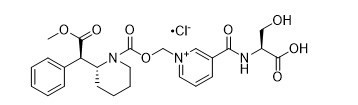
Serdexmethylphenidate chloride is a white to off-white crystalline powder. Its solutions are acid to litmus. It is freely soluble in water, soluble in methanol, and slightly soluble in alcohol and acetone. Its molecular weight is 535.98 g/mol.
Dexmethylphenidate is the
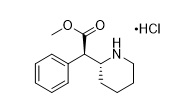
Dexmethylphenidate hydrochloride is a white to off-white powder. Its solutions are acid to litmus. It is freely soluble in water and in methanol, soluble in alcohol, and slightly soluble in chloroform and in acetone. Its molecular weight is 269.77 g/mol.
Inactive ingredients: colloidal silicon dioxide, crospovidone, hypromellose, magnesium stearate, microcrystalline cellulose, and talc.
Each strength capsule also contains colorant ingredients in the capsule shell as follows:
- 26.1/5.2 mg: Black Iron Oxide, FD&C Blue No. 1, Titanium Dioxide
- 39.2/7.8 mg: Black Iron Oxide, FD&C Blue No. 1, FD&C Red No. 40, Titanium Dioxide
- 52.3/10.4 mg: Black Iron Oxide, FD&C Red No. 40, FD&C Yellow No. 6, Titanium Dioxide
6CLINICAL STUDIES
Pediatric Patients 6 to 12 years of age with ADHD
The efficacy of AZSTARYS for the treatment of ADHD in pediatric patients 6 to 12 years of age was evaluated in a randomized, double-blind, placebo-controlled, parallel group, analog classroom study (Study 1; NCT# 03292952). That study was conducted in 150 pediatric patients 6 to 12 years of age who met Diagnostic and Statistical Manual of Mental Disorders, 5
Following washout of previous ADHD medication, subjects entered an open-label dose- optimization period (3 weeks) with an initial dosage of 39.2 mg/7.8 mg once daily in the morning. The dose could be titrated on a weekly basis to either 26.1 mg/5.2 mg, 39.2 mg/7.8 mg, or 52.3 mg/10.4 mg, until an optimal dose or the maximum dosage of 52.3 mg/10.4 mg/day was reached. At the end of optimization period, subjects were randomly assigned into a 1-week parallel group treatment period to receive either the individually optimized dose of AZSTARYS (mean dose of 45.6 mg/9.0 mg) or placebo.
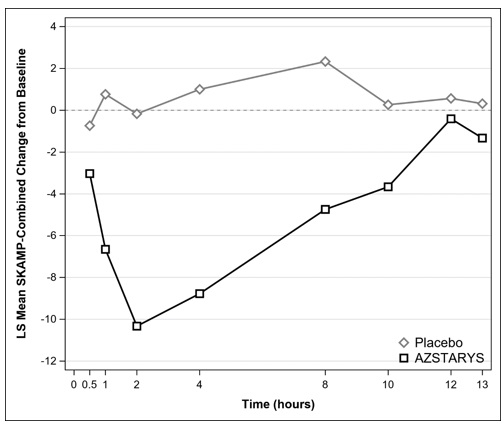
At the end of the 1-week treatment period, raters evaluated the attention and behavior of the subjects in a laboratory classroom setting over a period of 13 hours using the Swanson, Kotkin, Agler, M-Flynn, and Pelham (SKAMP) rating scale. SKAMP is a validated 13-item teacher-rated scale that assesses manifestations of ADHD in a classroom setting. On this day, the dose was administered in the morning immediately after breakfast.
The primary efficacy endpoint was the mean change from baseline (pre-dose at randomization visit) of the SKAMP-Combined scores averaged across the test day (not including baseline score), with assessments conducted at 0.5, 1, 2, 4, 8, 10, 12, and 13 hours post-dose.
The mean change from baseline in the SKAMP-Combined scores, averaged across the test day, was statistically significantly lower (indicating improvement) with AZSTARYS compared to placebo (
Figure 2: LS Mean Change in SKAMP-Combined Score from Baseline after Treatment with AZSTARYS or Placebo during Classroom Day in Pediatric Patients (6 to 12 years) with ADHD
Adults and Pediatric Patients 13 to 17 years of age with ADHD
The efficacy of 52.3 mg/10.4 mg AZSTARYS in adults and pediatric patients 13 to 17 years of age was established by pharmacokinetic bridging between AZSTARYS (52.3 mg/10.4 mg) and dexmethylphenidate hydrochloride extended-release capsules
7HOW SUPPLIED/STORAGE AND HANDLING
AZSTARYS (serdexmethylphenidate/dexmethylphenidate) capsules are available as follows:
- 26.1 mg/5.2 mg Capsules– blue cap/grey body, imprinted with "286" on cap and "KP415" on the body
Bottles of 100 ................................................................... NDC 65038-0286-99 - 39.2 mg/7.8 mg Capsules– dark blue cap/grey body, imprinted with "429" on cap and "KP415" on the body
Bottles of 100 ................................................................... NDC 65038-0429-99 - 52.3 mg/10.4 mg Capsules– orange cap/grey body, imprinted with "5612" on cap and "KP415" on the body
Bottles of 100 ................................................................... NDC 65038-0561-99
Storage
Store at 20°C to 25°C (68°F to 77°F); excursions permitted between 15°C to 30°C (59°F to 86°F). [See USP Controlled Room Temperature]. Protect from moisture.
Dispense in tight container (USP).
8PATIENT COUNSELING INFORMATION
Advise the patient to read the FDA-approved patient labeling (Medication Guide).
Abuse, Misuse, and Addiction
Educate patients and their families about the risks of abuse, misuse, and addiction of AZSTARYS, which can lead to overdose and death, and proper disposal of any unused drug
Risk to Patients with Serious Cardiac Disease
Advise patients that there are potential risks to patients with serious cardiac disease, including sudden death, with AZSTARYS use. Instruct patients to contact a healthcare provider immediately if they develop symptoms such as exertional chest pain, unexplained syncope, or other symptoms suggestive of cardiac disease
Increased Blood Pressure and Heart Rate
Advise patients and their caregivers that AZSTARYS can elevate blood pressure and heart rate
Psychiatric Adverse Reactions
Advise patients and their caregivers that AZSTARYS, at recommended doses, can cause psychotic or manic symptoms, even in patients without a prior history or psychotic symptoms or mania
Priapism
Advise patients and their caregivers of the possibility of painful or prolonged penile erections (priapism). Instruct the patient to seek immediate medical attention in the event of priapism
Circulation Problems in Fingers and Toes [Peripheral vasculopathy, including Raynaud's phenomenon]
- Instruct patients about the risk of peripheral vasculopathy, including Raynaud's phenomenon, and associated signs and symptoms: fingers or toes may feel numb, cool, painful, and/or may change color from pale, to blue, to red.
- Instruct patients to report to their physician any new numbness, pain, skin color change, or sensitivity to temperature in fingers or toes.
- Instruct patients to call their physician immediately with any signs of unexplained wounds appearing on fingers or toes while taking AZSTARYS.
- Further clinical evaluation (e.g., rheumatology referral) may be appropriate for certain patients
Long-Term Suppression of Growth in Pediatric Patients
Advise patients and their caregivers that AZSTARYS can cause slowing of growth and weight loss
Increased Intraocular Pressure (IOP) and Glaucoma
Advise patients that IOP and glaucoma may occur during treatment with AZSTARYS
Motor and Verbal Tics, and Worsening of Tourette’s Syndrome
Advise patients that motor and verbal tics and worsening of Tourette’s Syndrome may occur during treatment with AZSTARYS. Instruct patients to notify their healthcare provider if emergence of new tics or worsening of tics or Tourette’s syndrome occurs
Administration Instructions
Advise patients and their caregivers to administer AZSTARYS capsules whole or opened and sprinkled over applesauce or added to water. If sprinkled, advise patients and their caregivers to consume all the drug/food mixture immediately or within 10 minutes of mixing and not to store for future use
Pregnancy Registry
Advise patients that there is a pregnancy exposure registry that monitors pregnancy outcomes in females exposed to AZSTARYS during pregnancy
Lactation
Advise nursing mother to monitor infants exposed to AZSTARYS through breastmilk for agitation, poor feeding, and reduced weight gain
Distributed by:

9PRINCIPAL DISPLAY PANEL - NDC: 65038-286-99 - 26.1/5.2 mg 100 count Bottle Label
10PRINCIPAL DISPLAY PANEL - NDC: 65038-429-99 - 39.2/7.8 mg 100 count Bottle Label
11PRINCIPAL DISPLAY PANEL - NDC: 65038-561-99 - 52.3/10.4 mg 100 count Bottle Label