Drowsiness Treatments
Find Drowsiness Treatments
Brand Name
Wakix
Generic Name
Pitolisant
View Brand Information FDA approval date: August 14, 2019
Classification: Histamine-3 Receptor Antagonist/Inverse Agonist
Form: Tablet
What is Wakix (Pitolisant)?
WAKIX is indicated for the treatment of excessive daytime sleepiness or cataplexy in patients 6 years of age and older with narcolepsy. WAKIX is a histamine-3 receptor antagonist/inverse agonist indicated for the treatment of excessive daytime sleepiness or cataplexy patients 6 years of age and older with narcolepsy
Approved To Treat


Save this treatment for later
Not sure about your diagnosis?
Tired of the same old research?
Related Clinical Trials
A Phase 3, Randomized, Double-Blind, Placebo-controlled, Efficacy and Safety Study of Pitolisant Followed by an Open-Label Extension in Patients With Prader-Willi Syndrome
Summary: This is a Phase 3, randomized, double-blind, placebo-controlled, multicenter, global clinical study to assess the efficacy and safety of pitolisant in patients living with Prader-Willi syndrome. The primary objective of this study is to evaluate the efficacy of pitolisant in treating excessive daytime sleepiness (EDS) in patients ≥6 years of age with Prader-Willi syndrome. Secondary objectives inc...
WAKIX® (Pitolisant) Pregnancy Registry: An Observational Study of the Safety of Pitolisant Exposure in Pregnant Women and Their Offspring
Summary: The WAKIX (pitolisant) Pregnancy Registry is a US-based, prospective, observational cohort study designed to evaluate the association between pitolisant exposure during pregnancy and subsequent maternal, fetal, and infant outcomes.
Related Latest Advances
Brand Information
Wakix (PITOLISANT HYDROCHLORIDE)
1INDICATIONS AND USAGE
WAKIX is indicated for the treatment of excessive daytime sleepiness (EDS) or cataplexy in patients 6 years of age and older with narcolepsy.
2DOSAGE FORMS AND STRENGTHS
- WAKIX 4.45 mg tablets: white, round, biconvex film-coated tablet, marked with “S” on one side and plain on the other side. Each tablet contains 5 mg of pitolisant hydrochloride equivalent to 4.45 mg of pitolisant.
- WAKIX 17.8 mg tablets: white, round, biconvex film-coated tablet, marked with “H” on one side and plain on the other side. Each tablet contains 20 mg of pitolisant hydrochloride equivalent to 17.8 mg of pitolisant.
3CONTRAINDICATIONS
WAKIX is contraindicated in patients with:
- known hypersensitivity to pitolisant or any component of the formulation. Anaphylaxis has been reported in patients treated with WAKIX
- severe hepatic impairment. WAKIX is extensively metabolized by the liver and there is a significant increase in WAKIX exposure in patients with moderate hepatic impairment
4ADVERSE REACTIONS
The following adverse reactions are discussed in more detail in other sections of the labeling:
- QT Interval Prolongation
4.1Clinical Trials Experience
Because clinical trials are conducted under widely varying conditions, adverse reaction rates observed in the clinical trials of a drug cannot be directly compared to rates in the clinical trials of another drug and may not reflect the rates observed in practice.
Adult Patients with Narcolepsy
In clinical trials for narcolepsy, 172 adult patients were treated with WAKIX in placebo-controlled trials for up to 8 weeks and in open-label extension trials for up to 5 years. In trials in which WAKIX was directly compared to placebo, 6 of the 152 patients (3.9%) who received WAKIX and 4 of the 114 patients (3.5%) who received placebo discontinued because of an adverse reaction.
Most Common Adverse Reactions
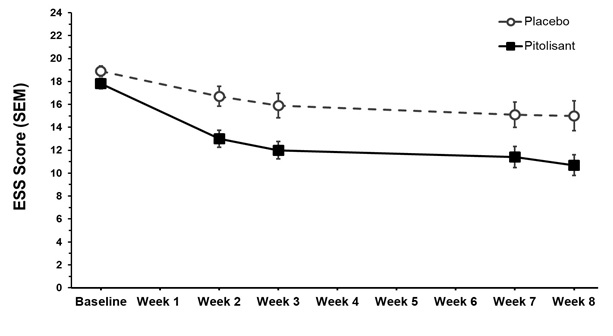
In the placebo-controlled clinical trials conducted in patients with narcolepsy with or without cataplexy, the most common adverse reactions (occurring in ≥5% of patients and at least twice the rate of placebo) with the use of WAKIX were insomnia (6%), nausea (6%), and anxiety (5%).
Table 1 presents the adverse reactions that occurred at a rate of ≥2% in patients treated with WAKIX and more frequently than in patients treated with placebo in the placebo-controlled clinical trials in narcolepsy.
Pediatric Patients (6 years and older) with Narcolepsy
In a clinical trial for narcolepsy, 73 pediatric patients 6 years and older were treated with WAKIX in the placebo-controlled phase for up to 8 weeks and 105 patients in the open-label extension phase for up to 8 years.
Most Common Adverse Reactions
In the placebo-controlled phase of the study, the most common adverse reactions (occurring in ≥5% of patients and greater than the rate of placebo) with the use of WAKIX were headache (19%) and insomnia (7%).
The overall adverse reaction profile of WAKIX in the pediatric clinical trial was similar to that seen in the adult clinical trial program.
4.2Postmarketing Experience
The following adverse reactions have been identified during post-approval use of WAKIX. Because these reactions are reported voluntarily from a population of uncertain size, it is not always possible to reliably estimate their frequency or establish a causal relationship to drug exposure:
General disorders and administration site conditions: fatigue
Immune system disorders: hypersensitivity (anaphylaxis)
Investigations: weight increased
Nervous system disorders: dizziness, epilepsy
Psychiatric disorders: abnormal behavior, abnormal dreams, anhedonia, bipolar disorder, depression, depressed mood, nightmare, sleep disorder, suicide attempt, suicidal ideation
Skin and subcutaneous tissue disorders: pruritus
5OVERDOSAGE
Human Experience
In premarketing clinical studies, overdosage of WAKIX was identified in one patient who ingested 320.4 mg of WAKIX (9 times the maximum recommended daily dose). The patient experienced nystagmus and twitching, reported generalized pain, and had QT prolongation. The patient was monitored in the hospital, received supportive care, and was discharged the following day without sequelae.
There have been postmarketing reports of overdoses of WAKIX. The most frequently reported symptoms with overdoses up to 71.2 mg (twice the maximum recommended daily dose) were headache, nausea, and hallucinations.
Management of Overdosage
No specific antidote for WAKIX is known. In managing acute overdosage, provide general symptomatic and supportive care including close medical supervision and monitoring of vital signs and cardiac rhythm. Specifically, continuous cardiovascular monitoring should be initiated to detect possible arrhythmias
6DESCRIPTION
WAKIX tablets contain pitolisant hydrochloride. Pitolisant is an antagonist/inverse agonist of the histamine-3 (H3) receptor. Pitolisant hydrochloride is a white or almost white crystalline powder with a molecular formula of C
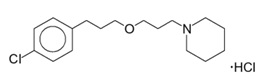
The molecular formula of the pitolisant free base is C
WAKIX tablets are for oral administration and each film-coated tablet contains 5 mg or 20 mg of pitolisant hydrochloride (equivalent to 4.45 mg or 17.8 mg of pitolisant free base, respectively) and the following inactive ingredients: colloidal silicon dioxide, crospovidone, magnesium stearate, microcrystalline cellulose, polyethylene glycol, polyvinyl alcohol, talc, and titanium dioxide.
7PATIENT COUNSELING INFORMATION
Prolongation of the QT Interval
Inform patients to consult their physician immediately if they feel faint, lose consciousness, or have heart palpitations
Contraception
Advise patients that use of WAKIX may reduce the efficacy of hormonal contraceptives. Advise patients using a hormonal contraceptive to use an alternative non-hormonal contraceptive method of contraception during treatment and for at least 21 days after discontinuing treatment
Pregnancy
Advise patients that there is a pregnancy exposure registry that monitors pregnancy outcomes in women exposed to WAKIX during pregnancy
Concomitant Medication
Advise patients to inform their healthcare provider if they are taking, or plan to take, any prescription or over-the-counter drugs, because of the potential for interactions between WAKIX and other drugs
Distributed by: Harmony Biosciences, LLC, Plymouth Meeting, PA 19462 USA
WAKIX is a registered trademark of Bioprojet Europe, Ltd.
Harmony Biosciences name and logo are trademarks of Harmony Biosciences Management, Inc. and are used herein by permission.
Label #100.10
8PRINCIPAL DISPLAY PANEL - NDC 72028-045-03 - 4.45 mg Bottle Label
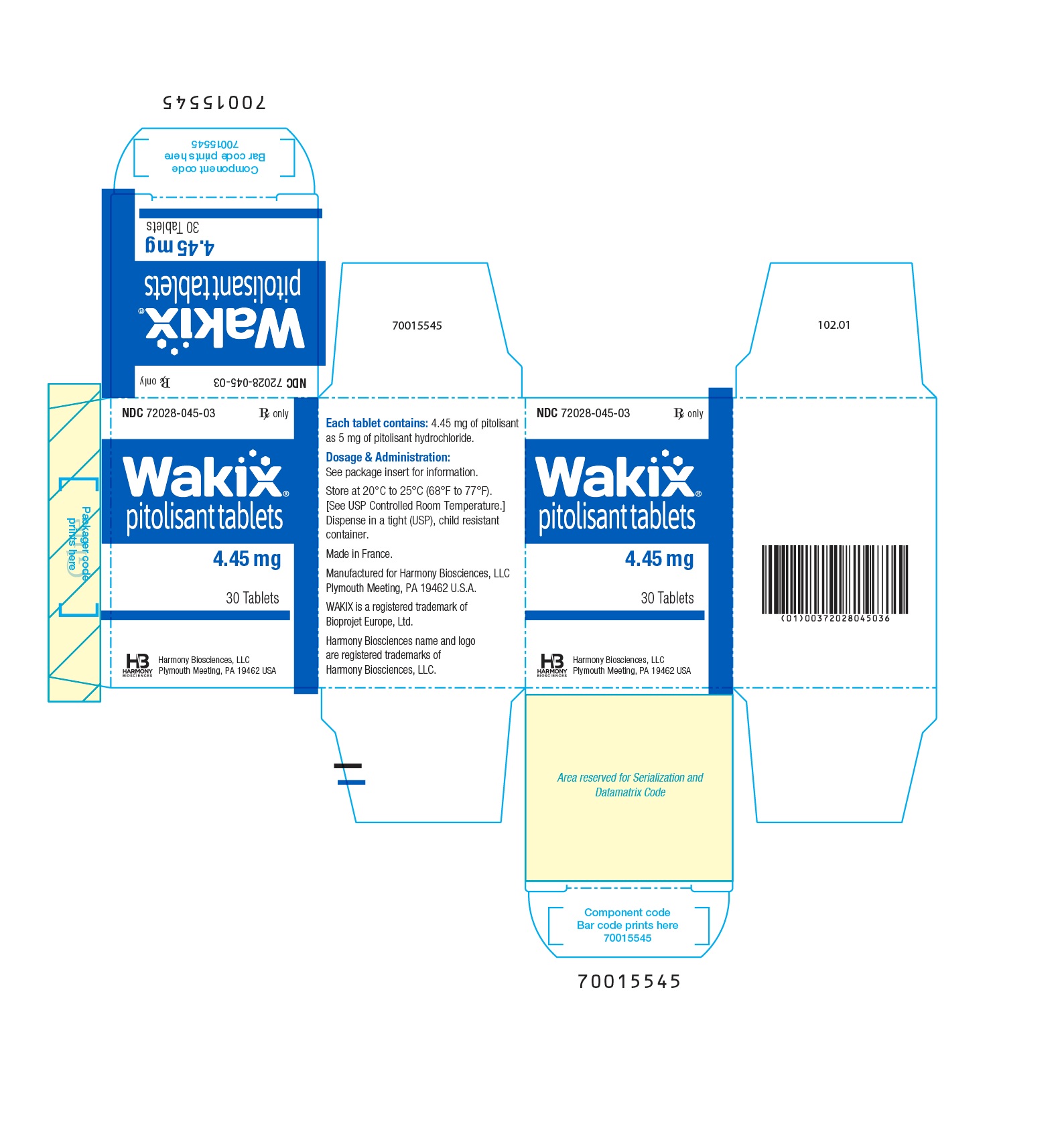
9PRINCIPAL DISPLAY PANEL - NDC 72028-045-03 - 4.45 mg Carton Label

10PRINCIPAL DISPLAY PANEL - NDC 72028-178-03 - 17.8 mg Bottle Label
11PRINCIPAL DISPLAY PANEL - NDC 72028-178-03 - 17.8 mg Carton Label
