Brand Name

Terbutaline

View Brand Information
FDA approval date: June 26, 2001
Form: Injection, Tablet

What is Terbutaline?

Terbutaline sulfate injection is indicated for the prevention and reversal of bronchospasm in patients 12 years of age and older with asthma and reversible bronchospasm associated with bronchitis and emphysema.

Approved To Treat

Save this treatment for later
Sign Up
Not sure about your diagnosis?
Check Your Symptoms
Tired of the same old research?
Check Latest Advances

Related Clinical Trials

Hot Flashes and Neurovascular Function in Women

Summary: Women who experience hot flashes are at greater risk for hypertension and other cardiovascular disease. Neurovascular control mechanisms are likely to play an important role in this relationship. As such, these studies are designed to provide a major step forward in understanding the link between hot flashes and neurovascular dysfunction and, by extension, cardiovascular disease in women.

Pharmacokinetics, Pharmacodynamics, and Safety Profile of Understudied Drugs

Summary: The study investigators are interested in learning more about how drugs, that are given to children by their health care provider, act in the bodies of children and young adults in hopes to find the most safe and effective dose for children. The primary objective of this study is to evaluate the PK of understudied drugs currently being administered to children per SOC as prescribed by their treati...

Brand Information

Terbutaline Sulfate (Terbutaline Sulfate)
1DESCRIPTION
Rx only
Formula1.jpg
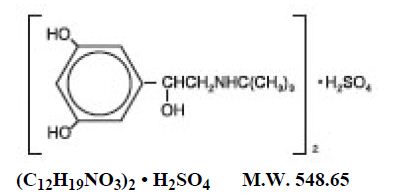
Terbutaline sulfate USP is a white to gray-white crystalline powder. It is odorless or has a faint odor of acetic acid. It is soluble in water and in 0.1N hydrochloric acid, slightly soluble in methanol, and insoluble in chloroform.
2CLINICAL PHARMACOLOGY
Terbutaline is a beta-adrenergic receptor agonist. In vitro and in vivo pharmacologic studies have demonstrated that terbutaline exerts a preferential effect on beta2-adrenergic receptors. While it is recognized that beta2-adrenergic receptors are the predominant receptors in bronchial smooth muscle, data indicate that there is a population of beta2-receptors in the human heart, existing in a concentration between 10% to 50%. The precise function of these receptors has not been established (see WARNINGS). Controlled clinical studies in patients given terbutaline subcutaneously have not revealed a preferential beta2-adrenergic effect. The pharmacologic effects of beta-adrenergic agonists, including terbutaline, are at least in part attributable to stimulation through beta-adrenergic receptors of intracellular adenyl cyclase, the enzyme which catalyzes the conversion of adenosine triphosphate (ATP) to cyclic 3’,5’-adenosine monophosphate (cAMP). Increased cAMP levels are associated with relaxation of bronchial smooth muscle and inhibition of release of mediators of immediate hypersensitivity from cells, especially from mast cells. Controlled clinical studies have shown that terbutaline relieves bronchospasm in acute and chronic obstructive pulmonary disease by significantly increasing pulmonary flow rates (e.g., an increase of 15% or more in FEV1). After subcutaneous administration of 0.25 mg of terbutaline, a measurable change in expiratory flow rate usually occurs within 5 minutes, and a clinically significant increase in FEV1 occurs within 15 minutes. The maximum effect usually occurs within 30 to 60 minutes, and clinically significant bronchodilator activity may continue for 1.5 to 4 hours. The duration of clinically significant improvement is comparable to that observed with equimilligram doses of epinephrine.
Elimination half-life of the drug in 10 of 14 patients was approximately 2.9 hours after subcutaneous administration, but longer elimination half-lives (between 6 to 14 hours) were found in the other 4 patients. About 90% of the drug was excreted in the urine at 96 hours after subcutaneous administration, with about 60% of this being unchanged drug. It appears that the sulfate conjugate is a major metabolite of terbutaline and urinary excretion is the primary route of elimination.
3INDICATIONS & USAGE
Terbutaline Sulfate Injection, USP is indicated for the prevention and reversal of bronchospasm in patients 12 years of age and older with asthma and reversible bronchospasm associated with bronchitis and emphysema.
4CONTRAINDICATIONS
Prolonged Tocolysis
Terbutaline sulfate has not been approved and should not be used for prolonged tocolysis (beyond 48 to 72 hours). In particular, terbutaline sulfate should not be used for maintenance tocolysis in the outpatient or home setting (see BOXED WARNING: PROLONGED TOCOLYSIS).
Hypersensitivity
Terbutaline sulfate injection is contraindicated in patients known to be hypersensitive to sympathomimetic amines or any component of this drug product.
5WARNINGS
Deterioration of Asthma
6PRECAUTIONS
General
Terbutaline, as with all sympathomimetic amines, should be used with caution in patients with cardiovascular disorders, including ischemic heart disease, hypertension, and cardiac arrhythmias; in patients with hyperthyroidism or diabetes mellitus; and in patients who are unusually responsive to sympathomimetic amines or who have convulsive disorders. Significant changes in systolic and diastolic blood pressure have been seen and could be expected to occur in some patients after use of any beta-adrenergic bronchodilator.
Drug Interactions
The concomitant use of terbutaline with other sympathomimetic agents is not recommended, since the combined effect on the cardiovascular system may be deleterious to the patient.
Monoamine Oxidase Inhibitors or Tricyclic Antidepressants
Terbutaline should be administered with extreme caution to patients being treated with monoamine oxidase inhibitors or tricyclic antidepressants, or within 2 weeks of discontinuation of such agents, since the action of terbutaline on the vascular system may be
Beta-Blockers
Beta-adrenergic receptor blocking agents not only block the pulmonary effect of beta-agonists, such as terbutaline, but may produce severe bronchospasm in asthmatic patients. Therefore, patients with asthma should not normally be treated with beta-blockers. However, under certain circumstances, e.g., as prophylaxis after myocardial infarction, there may be no acceptable alternatives to the use of beta-adrenergic blocking agents in patients with asthma. In this setting, cardioselective beta-blockers could be considered, although they should be administered with caution.
Diuretics
The ECG changes and/or hypokalemia that may result from the administration of non-potassium-sparing diuretics (such as loop or thiazide diuretics) can be acutely worsened by beta-agonists, especially when the recommended dose of the beta-agonist is exceeded. Although the clinical significance of these effects is not known, caution is advised in the coadministration of beta-agonists with nonpotassium-sparing diuretics.
Carcinogenesis, Mutagenesis, Impairment of Fertility
In a 2-year study in Sprague-Dawley rats, terbutaline sulfate caused a significant and dose-related increase in the incidence of benign leiomyomas of the mesovarium at dietary doses of 50 mg/kg and above (approximately 810 times the maximum recommended daily subcutaneous (sc) dose for adults on a mg/m2 basis). In a 21-month study in CD-1 mice, terbutaline showed no evidence of tumorigenicity at dietary doses up to 200 mg/kg (approximately 1,600 times the maximum recommended daily sc dose for adults on a mg/m2 basis). The mutagenicity potential of terbutaline has not been determined.
Reproduction studies in rats using terbutaline demonstrated no impairment of fertility at oral doses up to 50 mg/kg (approximately 810 times the maximum recommended daily sc dose for adults on a mg/m2 basis).
Pregnancy: Teratogenic Effect
Pregnancy Category C
There are no adequate and well-controlled studies of terbutaline sulfate in pregnant women. Published animal studies show that rat offspring exhibit alterations in behavior and brain development, including decreased cellular proliferation and differentiation when dams were treated subcutaneously with terbutaline during the late stage of pregnancy and lactation period. Terbutaline exposures in rat dams were approximately 24 to 48 times the common human dose in adults of 2 to 4 mg/day, on a mg/m2 basis. Terbutaline sulfate has not been approved and should not be used for prolonged tocolysis (beyond 48 to 72 hours). In particular, terbutaline sulfate should not be used for maintenance tocolysis in the outpatient or home setting. Serious adverse reactions, including death, have been reported after administration of terbutaline sulfate to pregnant women. In the mother, these adverse reactions include increased heart rate, transient hyperglycemia, hypokalemia, cardiac arrhythmias, pulmonary edema and myocardial ischemia.
Increased fetal heart rate and neonatal hypoglycemia may occur as a result of maternal administration (see BOXED WARNING:
PROLONGED TOCOLYSIS and CONTRAINDICATIONS, Prolonged Tocolysis). In animal embryofetal developmental studies, no teratogenic effects were observed in offspring when pregnant rats and rabbits received terbutaline sulfate at oral doses up to 50 mg/kg/day, approximately 810 and 1600 times, respectively, the maximum recommended daily subcutaneous dose for adults, on a mg/m2 basis. Terbutaline sulfate should be used during pregnancy only if the potential benefits justify the potential risk to the fetus.
Use in Labor and Deivery
Because of the potential for beta-agonist interference with uterine contractility, use of terbutaline for relief of bronchospasm during labor should be restricted to those patients in whom the benefits clearly outweigh the risk. Terbutaline crosses the placenta. After single dose IV administration of terbutaline to 22 women in late pregnancy who were delivered by elective Cesarean section due to clinical reasons, umbilical blood levels of terbutaline were found to range from 11% to 48% of the maternal blood levels.
Nursing Mothers
It is not known whether this drug is excreted in human milk. Therefore, terbutaline should be used during nursing only if the potential benefit justifies the possible risk to the newborn.
Pediatric Use
Terbutaline is not recommended for patients under the age of 12 years because of insufficient clinical data to establish safety and effectiveness.
Geriatric Use
Clinical studies of Terbutaline Sulfate Injection, USP did not include sufficient numbers of subjects aged 65 and over to determine whether they respond differently from younger subjects. Other reported clinical experience has not identified differences in responses between the elderly and younger patients. In general, dose selection for an elderly patient should be cautious, usually starting at the low end of the dosing range, reflecting the greater frequency of decreased hepatic, renal, or cardiac function, and of concomitant disease or other drug therapy.
7ADVERSE REACTIONS
Adverse reactions observed with terbutaline are similar to those commonly seen with other sympathomimetic agents. All these reactions are transient in nature and usually do not require treatment.
The following table compares adverse reactions seen in patients treated with terbutaline (0.25 mg and 0.5 mg), with those seen in patients treated with epinephrine injection (0.25 mg and 0.5 mg), during eight double-blind crossover studies involving a total of 214 patients.
Note: Some patients received more than one dosage strength of terbutaline and epinephrine. In addition, there were reports of anxiety, muscle cramps, and dry mouth (less than 0.5%). There have been rare reports of elevations in liver enzymes and of hypersensitivity vasculitis with terbutaline administration.
8OVERDOSAGE
The median sc lethal dose of terbutaline in mature rats was approximately 165 mg/kg (approximately 2,700 times the maximum recommended daily sc dose for adults on a mg/m2 basis). The median sc lethal dose of terbutaline in young rats was approximately 2,000 mg/kg (approximately 32,000 times the maximum recommended daily sc dose for adults on a mg/m2 basis). The expected symptoms with overdosage are those of excessive beta-adrenergic stimulation and/or occurrence or exaggeration of any of the symptoms listed under ADVERSE REACTIONS, e.g., seizures, angina, hypertension or hypotension, tachycardia with rates up to 200 beats per minute, arrhythmias, nervousness, headache, tremor, dry mouth, palpitation, nausea, dizziness, fatigue, malaise, and insomnia. Hypokalemia may also occur. There is no specific antidote. Treatment consists of discontinuation of terbutaline together with appropriate symptomatic therapy. The judicious use of a cardioselective beta-receptor blocker may be considered, bearing in mind that such medication can produce bronchospasm. There is insufficient evidence to determine if dialysis is beneficial for overdosage of terbutaline.
9DOSAGE & ADMINISTRATION
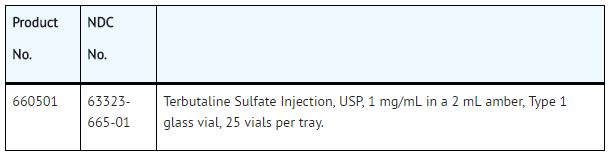
Terbutaline Sulfate Injection, USP should be used only for subcutaneous administration and not intravenous infusion. Sterility and accurate dosing cannot be assured if the vials are not used in accordance with DOSAGE AND ADMINISTRATION.
10HOW SUPPLIED
Image1.jpg
Discard unused portion after single patient use.

Fresenius Kabi
Lake Zurich, IL 60047
451001E
Revised: April 2022
11Sample Package Label
Label1.jpg