Generic Name

Levetiracetam

Brand Names
Keppra, Roweepra, Elepsia, Spritam
FDA approval date: April 24, 2000
Form: Injection, Tablet, Solution

What is Keppra (Levetiracetam)?

Primary Generalized Tonic-Clonic Seizures Levetiracetam in Sodium Chloride Injection is indicated as adjunctive therapy in the treatment of primary generalized tonic-clonic seizures in adults with idiopathic generalized epilepsy. Partial Onset Seizures Levetiracetam in Sodium Chloride Injection is indicated as adjunctive therapy in thetreatment of partial onset seizures in adults with epilepsy. Levetiracetam in Sodium Chloride Injection is an antiepileptic drug indicated for adult patients when oral administration is temporarily not feasible. Levetiracetam in Sodium Chloride Injection is an antiepileptic drug indicated for adjuncttherapy in adults with the following seizure types when oraladministration is temporarily not feasible: Partial onset seizures. MyoclonicSeizures in Patients with Juvenile Myoclonic Epilepsy Levetiracetam in Sodium Chloride Injection is indicated as adjunctive therapy in the treatment of myoclonic seizures in adults with juvenile myoclonic epilepsy.
Save this treatment for later
Sign Up
Not sure about your diagnosis?
Check Your Symptoms
Tired of the same old research?
Check Latest Advances

Related Clinical Trials

Clinical Trial Evaluating the Efficacy and Safety of AGB101 for Treatment of Parkinson's Disease Related Psychosis

Summary: This clinical trial will test whether AGB101 (low-dose levetiracetam, 220 mg, extended release tablet) can improve symptoms of psychosis in Parkinson's disease. Participants will be asked to complete up to 5 in-person study visits over approximately 20 weeks. Participants will receive both AGB101 and a placebo to take once a day for 6 weeks, with a 4-week washout in between. Participation will als...

Population Pharmacokinetics of Antiepileptic in Pediatrics

Summary: The purpose of this study is to develop population pharmacokinetic models for antiepileptic drugs in a pediatric population. The interest of these models is multiple: * describe the pharmacokinetics of these molecules in children and explain the inter-individual variability of concentrations through covariates such as weight, age, co-treatments, genetic polymorphisms and renal function; * estimate...

A Platform Protocol to Investigate Post-Transplant Cyclophosphamide-Based Graft-Versus-Host Disease Prophylaxis in Patients With Hematologic Malignancies Undergoing Mismatched Unrelated Donor Peripheral Blood Stem Cell Transplantation

Summary: The purpose of this clinical trial is to compare drug combinations to learn which drugs work best to prevent graft-versus-host-disease (GVHD) in people who have received a stem cell transplant. The source of stem cells is from someone who is not related and has a different blood cell type than the study participant. The researchers will compare the new drug combination to a standard drug combinati...

Brand Information

    Keppra (levetiracetam)
    1INDICATIONS AND USAGE
    KEPPRA XR
    2DOSAGE FORMS AND STRENGTHS
    KEPPRA XR tablets are white, oblong-shaped, film-coated extended-release tablets imprinted in red with "UCB 500XR" on one side and contain 500 mg levetiracetam.
    KEPPRA XR tablets are white, oblong-shaped, film-coated extended-release tablets imprinted in red with "UCB 750XR" on one side and contain 750 mg levetiracetam.
    3CONTRAINDICATIONS
    KEPPRA XR is contraindicated in patients with a hypersensitivity to levetiracetam
    4ADVERSE REACTIONS
    The following adverse reactions are discussed in more details in other sections of labeling:
    • Behavioral abnormalities and Psychotic Symptoms
    • Suicidal Behavior and Ideation
    • Somnolence and Fatigue
    • Anaphylaxis and Angioedema
    • Serious Dermatological Reactions
    • Drug Reaction with Eosinophilia and Systemic Symptoms (DRESS)/Multiorgan Hypersensitivity
    • Coordination Difficulties
    • Hematologic Abnormalities
    4.1Clinical Trials Experience
    Because clinical trials are conducted under widely varying conditions, adverse reaction rates observed in the clinical trials of a drug cannot be directly compared to rates in the clinical trials of another drug and may not reflect the rates observed in practice.
    4.2Postmarketing Experience
    The following adverse reactions have been identified during postapproval use of immediate-release KEPPRA tablets. Because these reactions are reported voluntarily from a population of uncertain size, it is not always possible to reliably estimate their frequency or establish a causal relationship to drug exposure.
    The listing is alphabetized: abnormal liver function test, acute kidney injury, anaphylaxis, angioedema, agranulocytosis, choreoathetosis, drug reaction with eosinophilia and systemic symptoms (DRESS), dyskinesia, erythema multiforme, hepatic failure, hepatitis, hyponatremia, muscular weakness, obsessive-compulsive disorders (OCD), pancreatitis, pancytopenia (with bone marrow suppression identified in some of these cases), panic attack, thrombocytopenia, weight loss, and worsening of seizures including in patients with SCN8A mutations. Alopecia has been reported with immediate-release KEPPRA use; recovery was observed in majority of cases where immediate-release KEPPRA was discontinued.
    5DESCRIPTION
    KEPPRA XR is an antiepileptic drug available as 500 mg and 750 mg (white) extended-release tablets for oral administration.
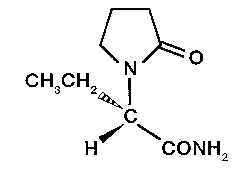
    The chemical name of levetiracetam, a single enantiomer, is (-)-(S)-α-ethyl-2-oxo-1-pyrrolidine acetamide, its molecular formula is C
    Chemical Structure
    Levetiracetam is a white to off-white crystalline powder with a faint odor and a bitter taste. It is very soluble in water (104.0 g/100 mL). It is freely soluble in chloroform (65.3 g/100 mL) and in methanol (53.6 g/100 mL), soluble in ethanol (16.5 g/100 mL), sparingly soluble in acetonitrile (5.7 g/100 mL) and practically insoluble in n-hexane. (Solubility limits are expressed as g/100 mL solvent.)
    KEPPRA XR tablets contain the labeled amount of levetiracetam. Inactive ingredients: colloidal anhydrous silica, hypromellose, magnesium stearate, polyethylene glycol 6000, polyvinyl alcohol-partially hydrolyzed, titanium dioxide (E171), Macrogol/PEG3350, and talc. The imprinting ink contains shellac, FD&C Red #40, n-butyl alcohol, propylene glycol, titanium dioxide, ethanol, and methanol.
    The medication is combined with a drug release controlling polymer that provides a drug release at a controlled rate. The biologically inert components of the tablet may occasionally remain intact during GI transit and will be eliminated in the feces as a soft, hydrated mass.
    6CLINICAL STUDIES
    The effectiveness of KEPPRA XR for the treatment of partial-onset seizures in adults was established in one multicenter, randomized, double-blind, placebo-controlled clinical study in patients who had refractory partial-onset seizures with or without secondary generalization. This was supported by the demonstration of efficacy of immediate-release KEPPRA tablets (see below) in partial seizures in three multicenter, randomized, double-blind, placebo-controlled clinical studies in adults, as well as a demonstration of comparable bioavailability between the XR and immediate-release formulations
    6.1KEPPRA XR in Adults
    The effectiveness of KEPPRA XR for the treatment of partial-onset seizures in adults was established in one multicenter, randomized, double-blind, placebo-controlled clinical study across 7 countries in patients who had refractory partial-onset seizures with or without secondary generalization (Study 1).
    6.2Immediate-Release KEPPRA in Adults
    The effectiveness of immediate-release KEPPRA for the treatment of partial-onset seizures in adults was established in three multicenter, randomized, double-blind, placebo-controlled clinical studies in patients who had refractory partial-onset seizures with or without secondary generalization (Studies 2, 3, and 4). The tablet formulation was used in all three studies. In these studies, 904 patients were randomized to placebo, KEPPRA 1000 mg, KEPPRA 2000 mg, or KEPPRA 3000 mg/day. Patients enrolled in Study 2 or Study 3 had refractory partial-onset seizures for at least two years and had taken two or more AEDs. Patients enrolled in Study 4 had refractory partial-onset seizures for at least 1 year and had taken one AED. At the time of the study, patients were taking a stable dose regimen of at least one AED and could take a maximum of two AEDs. During the baseline period, patients had to have experienced at least two partial-onset seizures during each 4-week period.
    6.3Immediate-Release KEPPRA in Pediatric Patients 4 Years to 16 Years
    The use of KEPPRA XR in pediatric patients 12 years of age and older is supported by Study 5, which was conducted using immediate-release KEPPRA. KEPPRA XR is not indicated in children below 12 years of age.
    7PATIENT COUNSELING INFORMATION
    Advise the patient to read the FDA-approved patient labeling (Medication Guide). The Medication Guide accompanies the product and can also be accessed on www.keppraxr.com or by calling 1-844-599-2273.
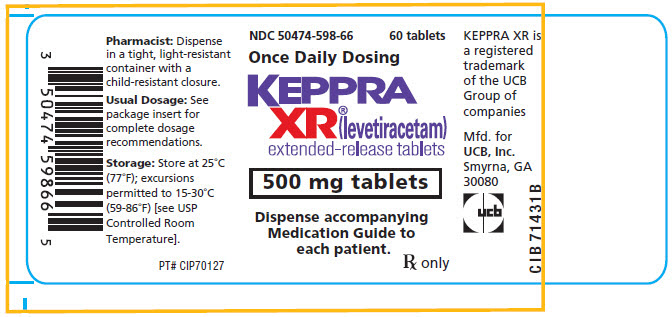
    8PRINCIPAL DISPLAY PANEL - 500 mg Tablet Bottle Label
    NDC 50474-598-66
    Once Daily Dosing
    KEPPRA
    500 mg tablets
    Dispense accompanying
    Rx only
    PRINCIPAL DISPLAY PANEL - 500 mg Tablet Bottle Label
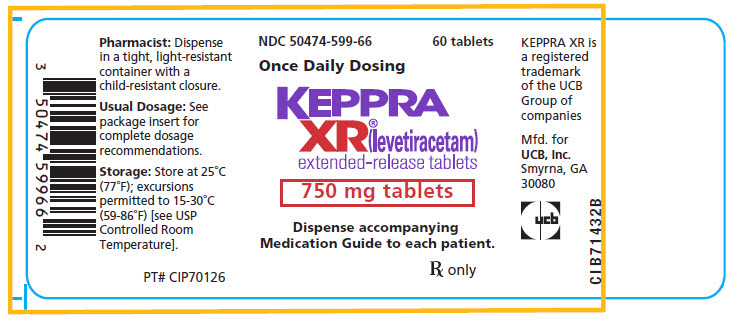
    9PRINCIPAL DISPLAY PANEL - 750 mg Tablet Bottle Label
    NDC 50474-599-66
    Once Daily Dosing
    KEPPRA
    750 mg tablets
    Dispense accompanying
    Rx only
    PRINCIPAL DISPLAY PANEL - 750 mg Tablet Bottle Label