Gastrointestinal Stromal Tumor Treatments
Find Gastrointestinal Stromal Tumor Treatments
Stivarga
What is Stivarga (Regorafenib)?
Approved To Treat
Top Global Experts


Related Clinical Trials
Summary: Glioblastoma (GBM) adaptive, global, innovative learning environment (GBM AGILE) is an international, seamless Phase II/III response adaptive randomization platform trial designed to evaluate multiple therapies in newly diagnosed (ND) and recurrent GBM. All institutions are enrolling Newly Diagnosed participants. Institutions also enrolling Recurrent participants are marked with an asterisk (\*).
Summary: NB003-04 is a phase II/III, multicenter, open-label clinical study designed to evaluate the efficacy, safety, and pharmacokinetic (PK) profile of NB003 in patients with gastrointestinal stromal tumors aged 18 years and above (or the legal adult age of consent per local regulations, whichever is older). Participants who are eligible for this study are those who have experienced disease progression ...
Summary: Advanced solid tumors remain a major therapeutic challenge due to their complex heterogeneity and the immunosuppressive tumor microenvironment (TME). Although cancer vaccines are designed to induce long-lasting antitumor immunity, their efficacy is often limited by the TME's immune-evasive mechanisms. Building on this rationale, investigators developed a novel vaccine comprising irradiated tumor c...
Related Latest Advances
Brand Information
- Severe and sometimes fatal hepatotoxicity has occurred in clinical trials
- Monitor hepatic function prior to and during treatment
- Interrupt and then reduce or discontinue STIVARGA for hepatotoxicity as manifested by elevated liver function tests or hepatocellular necrosis, depending upon severity and persistence
- Hepatotoxicity
- Infections
- Hemorrhage
- Gastrointestinal Perforation or Fistula
- Dermatological Toxicity
- Hypertension
- Cardiac Ischemia and Infarction
- Reversible Posterior Leukoencephalopathy Syndrome (RPLS)
- a Adverse reactions graded according to National Cancer Institute Common Toxicity for Adverse Events version 3.0 (NCI CTCAE v3.0).
- b The term rash represents reports of events of drug eruption, rash, erythematous rash, generalized rash, macular rash, maculo-papular rash, papular rash, and pruritic rash.
- b The term rash represents reports of events of rash, erythematous rash, macular rash, maculo-papular rash, papular rash and pruritic rash.
- c Fatal outcomes observed.
- a Percent based on number of patients with post-baseline samples which may be less than 132 (regorafenib) or 66 (placebo).
- b Fatal outcomes observed.
- a Percent based on number of patients with post-baseline samples which may be less than 374 (regorafenib) or 193 (placebo).
- hypersensitivity reaction
- nephrotic syndrome
- cardiac failure
- arterial (including aortic) aneurysms, dissections, and rupture
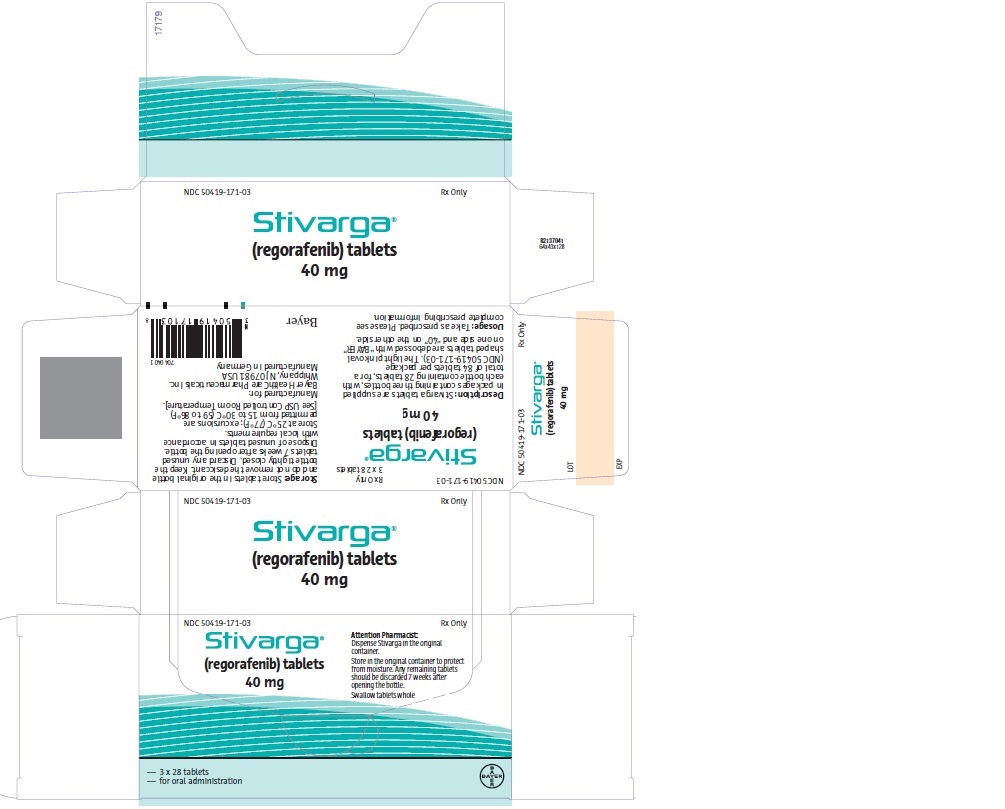
- Packages containing three bottles, with each bottle containing 28 tablets, for a total of 84 tablets per package
- Packages containing four bottles, with each bottle containing 21 tablets, for a total of 84 tablets per package
- Advise women of reproductive potential of the need for effective contraception during STIVARGA treatment and for 2 months after completion of treatment. Instruct women of reproductive potential to immediately contact her healthcare provider if pregnancy is suspected or confirmed during or within 2 months of completing treatment with STIVARGA
- Advise men of reproductive potential of the need for effective contraception during STIVARGA treatment and for 2 months after completion of treatment
- Advise patients to swallow the STIVARGA tablet whole with water at the same time each day following a low-fat meal. Inform patients that the low-fat meal should contain less than 600 calories and less than 30% fat
- Advise patients to store medicine in the original container. Do not place medication in daily or weekly pill boxes. Discard any remaining tablets 7 weeks after opening the bottle. Tightly close bottle after each opening and keep the desiccant in the bottle