Interstitial Keratitis Treatments

Find Interstitial Keratitis Treatments

Brand Name

Zirgan

Generic Name
Ganciclovir
View Brand Information
FDA approval date: April 30, 2010
Classification: Cytomegalovirus Nucleoside Analog DNA Polymerase Inhibitor
Form: Injection, Gel

What is Zirgan (Ganciclovir)?

Ganciclovir Injection is a deoxynucleoside analogue cytomegalovirus DNA polymerase inhibitor indicated for the: treatment of CMV retinitis in immunocompromised adult patients, including patients with acquired immunodeficiency syndrome .
Save this treatment for later
Sign Up
Not sure about your diagnosis?
Check Your Symptoms
Tired of the same old research?
Check Latest Advances

Related Clinical Trials

Pharmacokinetics and Safety of Commonly Used Drugs in Lactating Women and Breastfed Infants

Summary: Over half of women in the US who are breastfeeding their infants take prescription drugs. You are being asked to participate in this study because you are breastfeeding your infant and are currently taking, as part of your medical care, at least one of the drugs we are studying. We are interested in studying drugs commonly prescribed to women who are breastfeeding so we can learn more about the am...

A Phase I Pharmacokinetic and Safety Assessment of Oral Letermovir in Infants With Symptomatic Congenital Cytomegalovirus Disease

Summary: This is a Phase 1 single-arm open-label study of letermovir in neonates with symptomatic congenital Cytomegalovirus (CMV) disease. There will be two groups enrolled. Group 1 will be comprised of 4 subjects. Following documentation study inclusion and signing of informed consent, Group 1 subjects will receive one dose of oral letermovir (Study Day 0), using the dose bands. A full pharmacokinetics (...

Natural History Study of the KSHV Inflammatory Cytokine Syndrome (KICS)

Background: \- KSHV inflammatory cytokine syndrome (KICS) is a newly recognized disease caused by Kaposi sarcoma-associated herpesvirus (KSHV). This virus can cause cancer. People with KICS can have severe symptoms. They include fever, weight loss, and fluid in the legs or abdomen. People with KICS may also be at risk of getting other cancers associated with KSHV. These cancers include Kaposi sarcoma and lymp...

Brand Information

ZIRGAN (ganciclovir)
1INDICATIONS AND USAGE
ZIRGAN is indicated for the treatment of acute herpetic keratitis (dendritic ulcers) in adults and pediatric patients aged 2 years and older.
2DOSAGE AND ADMINISTRATION
The recommended dosage is 1 drop in the affected eye 5 times per day (approximately every 3 hours while awake) until the corneal ulcer heals, and then 1 drop 3 times per day for 7 days.
3DOSAGE FORMS AND STRENGTHS
Ophthalmic gel: 0.15% ganciclovir.
4CONTRAINDICATIONS
None.
5ADVERSE REACTIONS
Most common adverse reactions reported in patients were blurred vision (60%), eye irritation (20%), punctate keratitis (5%), and conjunctival hyperemia (5%).
6DESCRIPTION
ZIRGAN (ganciclovir ophthalmic gel) 0.15% contains ganciclovir, a nucleoside analog antiviral. ZIRGAN is a sterile, preserved, clear, colorless, ophthalmic gel for topical ophthalmic use.
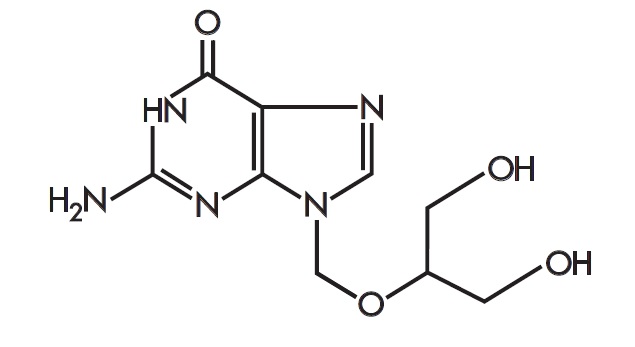
The chemical name is 9-[[2-hydroxy-1-(hydroxymethyl)ethoxy]methyl]guanine (CAS number 82410-32-0). Ganciclovir is represented by the following structural formula:
ChemStructure
Ganciclovir has a molecular weight of 255.23, and the empirical formula is C
Each gram of gel contains: ACTIVE: ganciclovir 1.5 mg (0.15%). INACTIVES: carbomer homopolymer, water for injection, sodium hydroxide (to adjust the pH to 7.2-7.6), mannitol. PRESERVATIVE: benzalkonium chloride 0.075 mg (0.0075%).
7CLINICAL STUDIES
In one open-label, randomized, controlled, multicenter clinical trial which enrolled 164 patients with herpetic keratitis, ZIRGAN was non-inferior to acyclovir ophthalmic ointment, 3% in patients with dendritic ulcers. Clinical resolution (healed ulcers) at Day 7 was achieved in 77% (55/71) for ZIRGAN versus 72% (48/67) for acyclovir, 3% (difference 5.8%, 95% CI - 9.6%-18.3%). In three randomized, single-masked, controlled, multicenter clinical trials which enrolled 213 total patients, ZIRGAN was non-inferior to acyclovir ophthalmic ointment, 3% in patients with dendritic ulcers. Clinical resolution at Day 7 was achieved in 72% (41/57) for ZIRGAN versus 69% (34/49) for acyclovir (difference 2.5%, 95% CI - 15.6%-20.9%).
8HOW SUPPLIED/STORAGE AND HANDLING
ZIRGAN (ganciclovir ophthalmic gel) 0.15% is supplied as 5 grams of a sterile, preserved, clear, colorless, topical ophthalmic gel containing 0.15% of ganciclovir in a polycoated aluminum tube with a white polyethylene tip and cap and protective band (NDC 24208-535-35).
Storage
Store at 15°C to 25°C (59°F to 77°F). Do not freeze.
9PATIENT COUNSELING INFORMATION
When to Consult a Physician
Advise patients to consult a physician if pain develops, or if redness, itching, or inflammation becomes aggravated.
Risk of Contamination
ZIRGAN is sterile when packaged. Advise patients to not allow the dropper tip to touch any surface, as this may contaminate the gel.
Avoidance of Contact Lenses
Advise patients to not wear contact lenses when using ZIRGAN.
Distributed by:
Bausch & Lomb Americas Inc.
Bridgewater, NJ 08807 USA
Manufactured by:
Bausch & Lomb Incorporated
Tampa, FL 33637 USA
Zirgan is a trademark of Laboratoires Théa Corporation used under license.
© 2025 Bausch & Lomb Incorporated or its affiliates
9224806
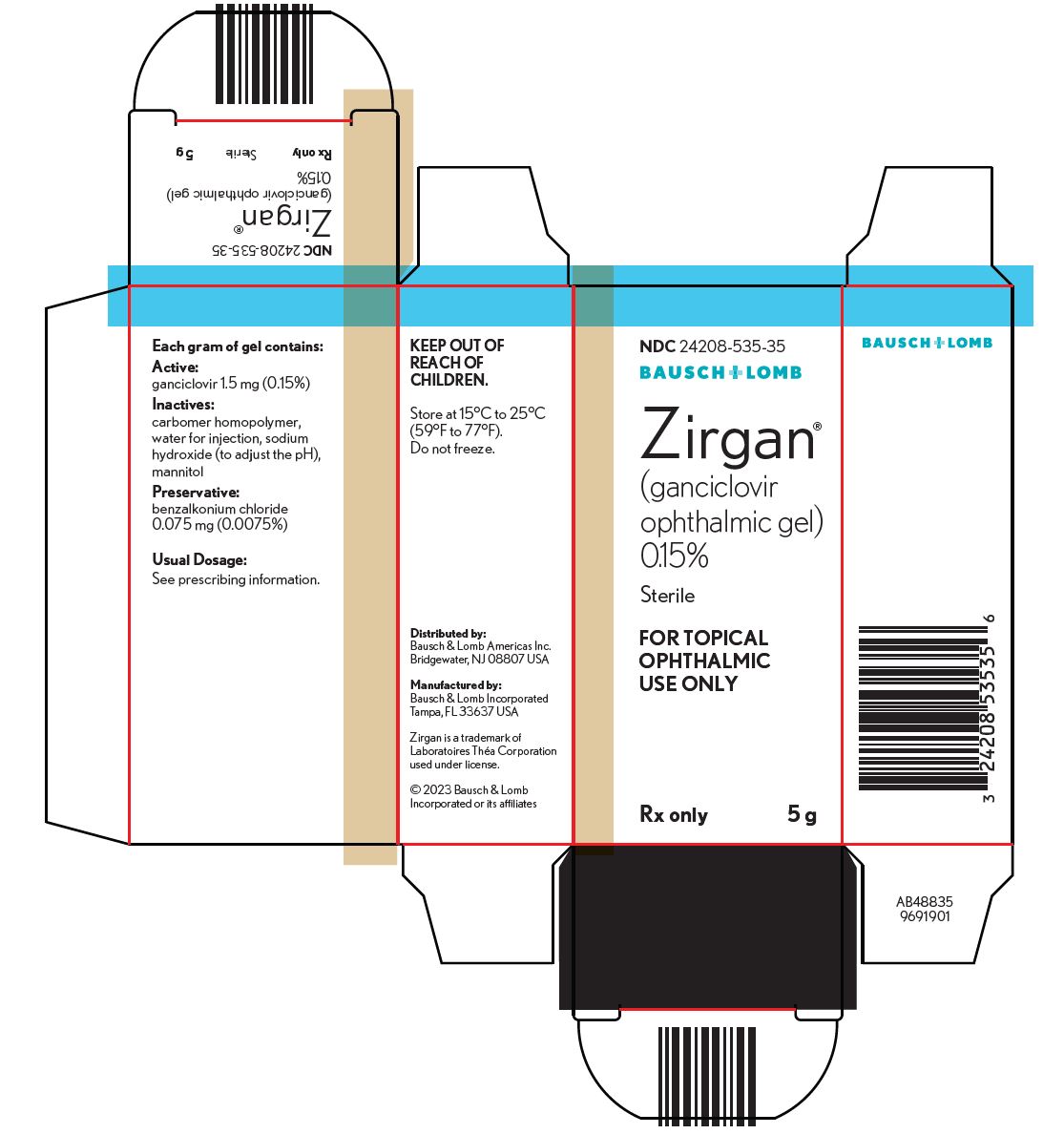
10PACKAGE/LABEL PRINCIPAL DISPLAY PANEL
NDC24208-535-35
BAUSCH + LOMB
Zirgan
(ganciclovir
ophthalmic gel)
0.15%
Sterile
FOR TOPICAL
OPHTHALMIC
USE ONLY
Rx only
5 g
AB48835
9691901
Carton