Generic Name

Tafenoquine

Brand Names
Arakoda, Kodatef, Krintafel
FDA approval date: August 20, 2018
Form: Tablet

What is Arakoda (Tafenoquine)?

ARAKODA is indicated for the prophylaxis of malaria in patients aged 18 years and older. ARAKODA is an antimalarial indicated for the prophylaxis of malaria in patients aged 18 years and older.

Approved To Treat

Save this treatment for later
Sign Up
Not sure about your diagnosis?
Check Your Symptoms
Tired of the same old research?
Check Latest Advances

Related Clinical Trials

FocaL Mass Drug Administration for Vivax Malaria Elimination (FLAME): a Pragmatic Cluster Randomized Controlled Trial in Peru

Summary: FLAME is an open-label cluster-randomized controlled trial that aims to determine the effectiveness of focal mass drug administration (fMDA) to reduce the incidence of Plasmodium vivax malaria in the Loreto Department in Peru. Standard interventions, including symptomatic and asymptomatic screening for malaria infections, provision of insecticide-treated bednets, and environmental transmission mon...

Safety, Pharmacokinetics, and Preliminary Efficacy of Tafenoquine for the Treatment of Vivax Malaria in Papua New Guinean Children

Summary: Plasmodium vivax is the most geographically widespread malaria species and the second largest contributor to symptomatic malaria worldwide. It accounts for half of all malaria cases outside Africa, with an estimated 14.3 million clinical vivax malaria cases reported annually, contributing to an annual cost of US$359 million. Children are most vulnerable to infection, with P. vivax prevalence peaki...

B-FREE Chronic Babesiosis Study: A Phase 2 Open Label Study of Tafenoquine for Treatment of Chronic Babesiosis Patients With Severe Fatigue

Summary: Phase 2 Open Label Study of Tafenoquine for Treatment of Chronic Babesiosis Patients with Severe Fatigue

Brand Information

    Arakoda (Tafenoquine)
    1INDICATIONS AND USAGE
    ARAKODA is indicated for the prophylaxis of malaria in patients aged 18 years and older.
    2DOSAGE FORMS AND STRENGTHS
    ARAKODA tablets are dark pink, film-coated, capsule-shaped tablets debossed with ‘TQ100’ on one side containing 100 mg of tafenoquine.
    3CONTRAINDICATIONS
    ARAKODA is contraindicated in:
    • patients with G6PD deficiency or unknown G6PD status due to the risk of hemolytic anemia
    • breastfeeding by a lactating woman when the infant is found to be G6PD deficient or if the G6PD status of the infant is unknown
    • patients with a history of psychotic disorders or current psychotic symptoms (i.e., hallucinations, delusions, and/or grossly disorganized behavior)
    • patients with known hypersensitivity reactions to tafenoquine, other 8-aminoquinolines, or any component of ARAKODA
    4ADVERSE REACTIONS
    The following clinically significant adverse reactions observed with ARAKODA are discussed in detail in the Warnings and Precautions section:
    • Hemolytic Anemia
    • Methemoglobinemia
    • Psychiatric Effects
    • Hypersensitivity Reactions
    4.1Clinical Trials Experience
    Because clinical trials are conducted under widely varying conditions, adverse reaction rates observed in the clinical trials of a drug cannot be directly compared with rates in the clinical trials of another drug and may not reflect the rates observed in practice.
    The safety of tafenoquine was studied in clinical trials at various doses and regimens in 3,184 subjects. The recommended ARAKODA regimen was evaluated in 825 subjects in 5 controlled clinical trials (Trials 1, Trial 2, Trial 3, Trial 4 and Trial 5). The mean duration of exposure to ARAKODA in these five clinical trials was 21 weeks (range 10-29 weeks). Trial 1, 2 and 4 were conducted in healthy semi-immune volunteers in Ghana or Kenya and were placebo-controlled; a mefloquine arm was included in Trials 2 and 4 as a benchmark. Trial 3, an active comparator (mefloquine) controlled trial was conducted in healthy soldiers deployed in East Timor (Timor Leste). A placebo-controlled Trial 5 was conducted in healthy volunteers in the United States and United Kingdom. The mean age of the subjects included in the five trials was 29 years (range 17 to 69 years); 84% were male.
    Adverse Reactions Reported with ARAKODA in Trial 3 and Pooled Trials 1, 2, 4, and 5
    Adverse reactions occurring in ≥1% of subjects in the ARAKODA group in the placebo-controlled pooled Trials 1, 2, 3, and 4 are presented in
    Adverse reactions occurring in ≥1% of subjects in the ARAKODA group in the active-control Trial 3 conducted in military personnel deployed to malaria endemic areas are presented in
    Clinically Significant Adverse Reactions in Trials 1 to 5 (Overall Safety Population)
    Clinically significant adverse reactions with ARAKODA (200 mg daily for 3 days, followed by 200 mg weekly) in Trials 1 to 5 (n= 825) are described below:
    Ocular Adverse Reactions
    Vortex keratopathy was reported in 21% to 93% of subjects receiving ARAKODA in the trials which included ophthalmic evaluations (Trials 3, 5, and Trial 6 (NCT # 01290601, an active-control trial in patients from Thailand with
    A total of 7 serious ocular adverse reactions (SARs) were reported in ARAKODA-treated subjects in the trials which included ophthalmic evaluations: 5 reports of keratopathy and two reports of retinal disorders.
    Laboratory Abnormalities
    Methemoglobinemia: Asymptomatic methemoglobin elevations were observed in 13% of subjects receiving ARAKODA.
    Hemoglobin decrease: Hemoglobin decreases of ≥ 3 g/dL were observed in 2.3% of subjects receiving ARAKODA.
    Adverse Reactions Reported in < 1% of Subjects Receiving ARAKODA in Trials 1 to 5
    The following selected adverse reactions were reported in subjects receiving ARAKODA in Trials 1 to 5 at a rate of less than 1%.
    Blood and lymphatic system disorders: hemolytic anemia, anemia, thrombocytopenia
    Ear and labyrinth disorders: hyperacusis, Meniere’s disease
    Eye disorders: night blindness, photophobia, blurred vision, visual acuity reduced, visual impairment, vitreous floaters
    Hepatobiliary disorders: hyperbilirubinemia, jaundice cholestatic
    Immune system disorders: hypersensitivity
    Investigations: blood bilirubin increased, blood creatinine increased, glomerular filtration rate decreased
    Nervous system disorders: amnesia, coordination abnormal, hyperesthesia, hypoesthesia, somnolence, syncope, tremor, visual field defect
    Psychiatric disorders: agitation, neurosis
    Skin and subcutaneous tissue disorders: urticaria.
    5OVERDOSAGE
    There were no reported cases of ARAKODA overdose. Hemoglobin decline and methemoglobinemia may be encountered in an overdose with ARAKODA. Treatment of overdosage consists of institution of appropriate symptomatic and/or supportive therapy.
    6DESCRIPTION
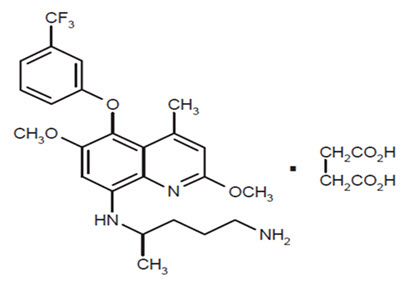
    ARAKODA contains tafenoquine succinate, an antimalarial agent for oral administration. The structural formula of tafenoquine succinate is:
    Figure 1: Tafenoquine Succinate Structure
    The chemical name of tafenoquine succinate is (±)-8-[(4-amino-1-methylbutyl) amino]-2,6-dimethoxy-4-methyl-5-[3-(trifluoromethyl) phenoxy]quinoline succinate. The molecular formula of tafenoquine succinate is C
    Each ARAKODA tablet contains 100 mg of tafenoquine (equivalent to 125.5 mg of tafenoquine succinate). Inactive ingredients include magnesium stearate, mannitol, and microcrystalline cellulose. The tablet film coating inactive ingredients include: hypromellose, iron oxide red, macrogol/polyethylene glycol and titanium dioxide.
    7CLINICAL STUDIES
    Clinical Trials 1, 2, and 3
    Three double-blind, randomized, controlled studies have been performed to evaluate the efficacy of ARAKODA.
    Trial 1 (NCT #02491606) was a Phase IIb, placebo-controlled study conducted in Kenya, an area of holoendemic
    Trial 2 (NCT #02488902) was a comparison of tafenoquine to placebo for prophylaxis in healthy semi-immune residents of a malarious region in Ghana. After treating existing parasitemia with quinine/doxycycline/primaquine, subjects were randomized into prophylactic groups including ARAKODA and placebo. Patients were administered a loading regimen of daily drug or placebo for 3 days followed by a maintenance regimen of weekly drug or placebo for 12 weeks. For the ARAKODA and placebo groups, males were 65% of the total population. The mean age was 38.4 years and 53.5 years for males and females, respectively, as women in reproductive ages were excluded from the study. The mean weight was 55.4 kg and 47.5 kg for males and females, respectively. Subjects were evaluated for parasitemia by weekly blood smears. Parasitemia required a blood smear positive for asexual stage of
    Trial 3 compared ARAKODA with mefloquine for the prophylaxis of both
    Clinical Trial 7
    In a randomized, double-blind, placebo-controlled trial (Trial 7) in healthy, non-immune volunteers, ARAKODA was shown to have prophylactic activity directed against blood-stage
    8HOW SUPPLIED/STORAGE AND HANDLING
    How Supplied
    ARAKODA tablets contain 100 mg of tafenoquine (equivalent to 125.5 mg of tafenoquine succinate) and are dark pink, film-coated, capsule-shaped, and debossed with ‘TQ100’ on one side.
    ARAKODA tablets are packed in blister packs or bottles.
    For the blister pack presentation, ARAKODA tablets are packed in polyamide aluminum and PVC formable laminate backed blisters with a polyethylene terephthalate aluminum foil cover. Each blister card contains 8 tablets. Each package contains 2 blister cards (16 tablets) housed in a contiguous outer paperboard child-resistant carton component (NDC 71475-257-01).
    For the bottle presentation, ARAKODA tablets are packed in 40 cc, 33 mm white high-density polyethylene bottles with a 33 mm polypropylene screw-top child resistant cap with an induction seal liner. Each bottle contains 8 tablets (NDC 71475-257-02).
    Storage
    Store at less than 30°C (86°F). Protect from moisture. Dispense only in the original carton or bottle.
    9PATIENT COUNSELING INFORMATION
    Advise the patient to read the FDA-approved patient labeling (
    G6PD Testing and Hemolytic Anemia
    Inform patients of the need for testing for G6PD deficiency before starting ARAKODA. Advise patients on the symptoms of hemolytic anemia and instruct them to seek medical advice promptly if such symptoms occur. Patients should contact their health care provider if they have darker lips or urine as these may be signs of hemolysis or methemoglobinemia
    Important Administration Instructions
    • Advise patients to take ARAKODA with food.
    • Advise patients to swallow the tablet whole and not to break, crush or chew it.
    • Advise patients to complete the full course of ARAKODA including the loading dose, maintenance dose and terminal dose.
    Potential Harm to the Fetus
    Advise females of reproductive potential of the potential risk of ARAKODA to a fetus and to inform their healthcare provider of a known or suspected pregnancy
    Advise females of reproductive potential to avoid pregnancy or use effective contraception during treatment with ARAKODA and for 3 months after the final dose
    Lactation
    Advise women with a G6PD-deficient infant, or if they do not know the G6PD status of their infant, not to breastfeed during treatment with ARAKODA and for 3 months after the final dose
    Methemoglobinemia
    Inform patients that methemoglobinemia has occurred with ARAKODA. Advise patients on the symptoms of methemoglobinemia and instruct them to seek medical advice promptly if such symptoms occur
    Psychiatric Symptoms
    Advise patients who experience hallucinations, delusions, or confused thinking while taking ARAKODA to seek medical attention as soon as possible. Other psychiatric symptoms, such as changes in mood, anxiety, insomnia, and nightmares, should be promptly evaluated by a medical professional if they last more than three days or severe
    Hypersensitivity Reactions
    Inform patients that hypersensitivity reactions have occurred with ARAKODA. Advise patients on the symptoms of hypersensitivity reactions and instruct them to seek medical advice promptly if such symptoms occur
    Manufactured For:
    1217a
    10Medication Guide
    This Medication Guide has been approved by the U.S. Food and Drug Administration
    Issued: August 2018
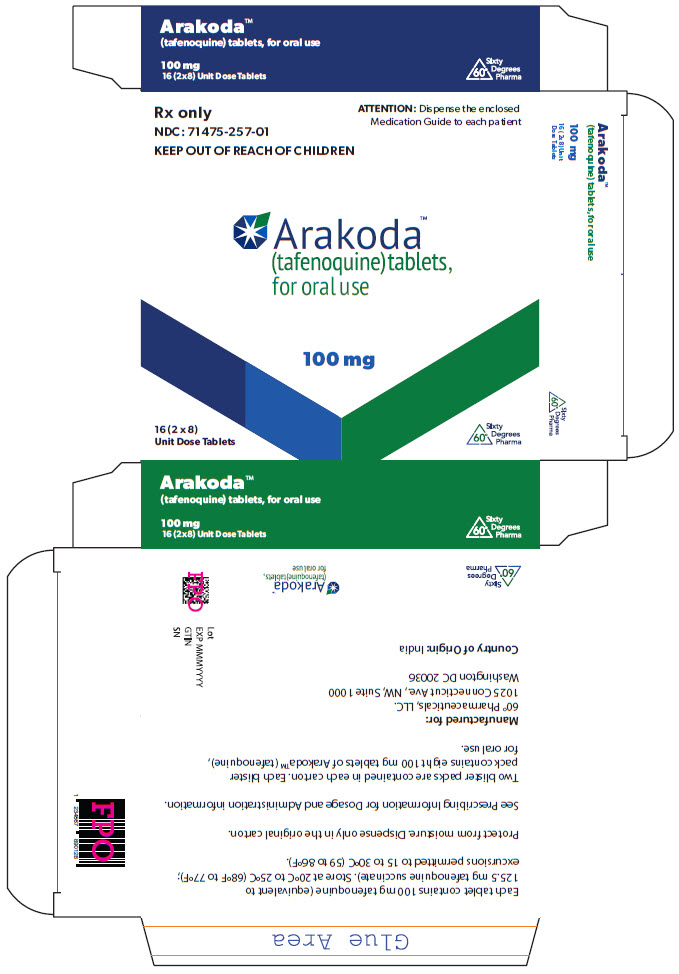
    11PRINCIPAL DISPLAY PANEL - Carton Label
    Rx only
    NDC: 71475-257-01
    KEEP OUT OF REACH OF CHILDREN
    ATTENTION: Dispense the enclosed
    Medication Guide to each patient
    Arakoda(tafenoquine) tablets,
    for oral use
    100 mg
    16 (2 x 8)
    Sixty
    Each tablet contains 100 mg tafenoquine (equivalent to 125.5 mg
    Protect from moisture. Dispense only in the original carton.
    See Prescribing Information for Dosage and Administration
    Two blister packs are contained in each carton. Each
    Manufactured for:60 Degrees Pharmaceuticals, Inc.
    1025 Connecticut Ave., NW, Suite 1000
    Washington DC 20036
    Country of Origin: India
    Sixty
    Arakoda
    (tafenoquine) tablets,
    for oral use
    Principal Display Panel - Carton Label
    Principal Display Panel - Inner Carton Label
    Rx only
    NDC: 71475-257-01
    KEEP OUT OF REACH OF CHILDREN
    ATTENTION: Dispense the enclosed
    Medication Guide to each patient
    Arakoda(tafenoquine) tablets,
    for oral use
    100 mg
    16 (2 x 8)
    Sixty
    Arakoda(tafenoquine) tablets,
    for oral use
    100 mg
    Principal Display Panel - Inner Carton Label
    Principal Display Panel - Blister Label
    CODE: MP/DRUGS/25/10/92
    NDC: 71475-257-01
    21541667
    EM 15572
    Sixty
    Arakoda
    100 mg
    Exp:
    Principal Display Panel - Blister Label
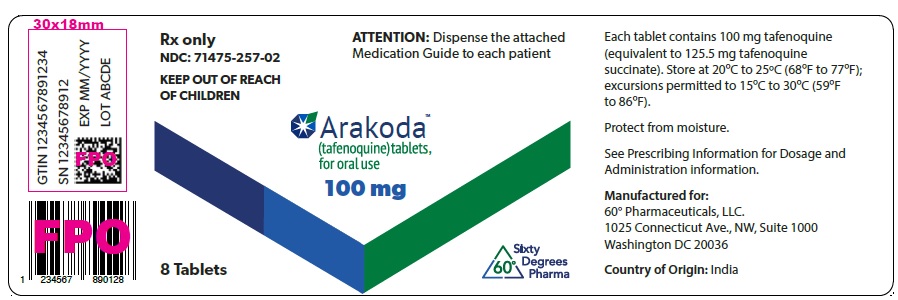
    Principal Display Panel - Bottle Label
    Rx only
    NDC: 71475-257-02
    KEEP OUT OF REACH
    ATTENTION: Dispense the attached
    Medication Guide to each patient
    Arakoda(tafenoquine) tablets,
    for oral use
    100 mg
    8 Tablets
    Sixty
    Each tablet contains 100 mg
    Protect from moisture.
    See Prescribing Information for Dosage
    Manufactured for:60 Degrees Pharmaceuticals, Inc.
    1025 Connecticut Ave., NW, Suite 1000
    Washington DC 20036
    Country of Origin: India
    Principal Display Panel - Bottle Label