Anafranil
What is Anafranil (Clomipramine)?
Approved To Treat
Related Clinical Trials
Summary: The goal of this clinical trial is to learn if self-help book can be used to treat obsessive-compulsive disorder (OCD) in adolescents aged 10 to 17. The main questions it aims to answer are: Can adolescents and their parents effectively reduce the severity of the obsessive-compulsive symptoms in adolescents who are already stably taking medications through self-help books? What are the characteris...
Summary: This study is conducted to explore the efficacy and cost-effectiveness of stepped-care internet-based cognitive behavior therapy (sc-ICBT) with reduced support compared to cognitive-behavioral group therapy(CBGT), to identify the optimal transition points for shorter effective stepped treatments, to find clinical indicators that can predict the effectiveness of CBT interventions, and to investigat...
Related Latest Advances
Brand Information
Capsules 25 mg – ivory body imprinted in black with "
 " and melon-yellow cap imprinted in black with "ANAFRANIL 25 mg"
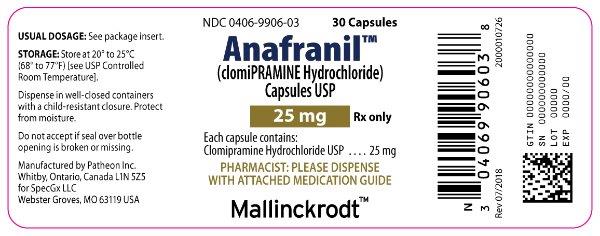
Bottles of 30………....………...……….....………… NDC 0406-9906-03
 " and aqua blue cap imprinted in black with "ANAFRANIL 50 mg"
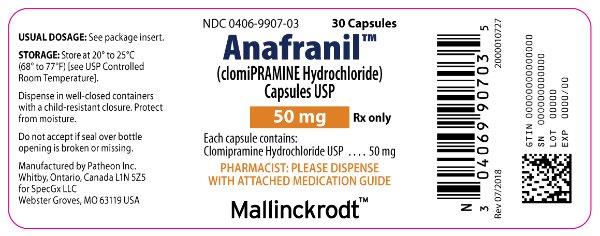
Bottles of 30………..………....………...……….....…NDC 0406-9907-03
 " and yellow cap imprinted in black with "ANAFRANIL 75 mg"
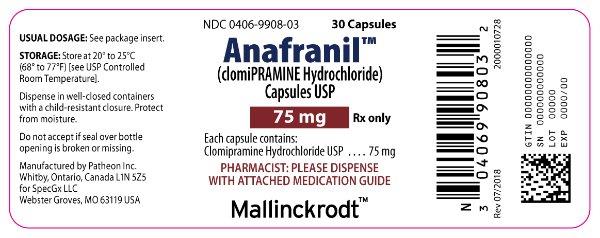
Bottles of 30………..………...……….....………....…NDC 0406-9908-03
Pharmaceuticals
- all risks and benefits of treatment with antidepressant medicines
- all treatment choices for depression or other serious mental illness
- Antidepressant medicines may increase suicidal thoughts or actions in some children, teenagers, and young adults within the first few months of treatment.
- Depression and other serious mental illnesses are the most important causes of suicidal thoughts and actions. Some people may have a particularly high risk of having suicidal thoughts or actions. These include people who have (or have a family history of) bipolar illness (also called manic-depressive illness) or suicidal thoughts or actions.
- How can I watch for and try to prevent suicidal thoughts and actions in myself or a family member?
- Pay close attention to any changes, especially sudden changes, in mood, behaviors, thoughts, or feelings. This is very important when an antidepressant medicine is started or when the dose is changed.
- Call the healthcare provider right away to report new or sudden changes in mood, behavior, thoughts, or feelings.
- Keep all follow-up visits with the healthcare provider as scheduled. Call the healthcare provider between visits as needed, especially if you have concerns about symptoms.
- thoughts about suicide or dying
- attempts to commit suicide
- new or worse depression
- new or worse anxiety
- feeling very agitated or restless
- panic attacks
- trouble sleeping (insomnia)
- new or worse irritability
- acting aggressive, being angry, or violent
- acting on dangerous impulses
- an extreme increase in activity and talking (mania)
- other unusual changes in behavior or mood
- headache
- weakness or feeling unsteady
- confusion, problems concentrating or thinking or memory problems
- eye pain
- changes in vision
- swelling or redness in or around the eye
- take a monoamine oxidase inhibitor (MAOI). Ask your healthcare provider or pharmacist if you are not sure if you take an MAOI, including the antibiotic linezolid.
- Never stop an antidepressant medicine without first talking to a healthcare provider. Stopping an antidepressant medicine suddenly can cause other symptoms.
- Antidepressants are medicines used to treat depression and other illnesses. It is important to discuss all the risks of treating depression and also the risks of not treating it. Patients and their families or other caregivers should discuss all treatment choices with the healthcare provider, not just the use of antidepressants.
- Antidepressant medicines have other side effects. Talk to the healthcare provider about the side effects of the medicine prescribed for you or your family member.
- Antidepressant medicines can interact with other medicines. Know all of the medicines that you or your family member takes. Keep a list of all medicines to show the healthcare provider. Do not start new medicines without first checking with your healthcare provider.
- Not all antidepressant medicines prescribed for children are FDA approved for use in children. Talk to your child's healthcare provider for more information.