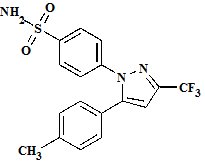
Celecoxib
What is Celebrex (Celecoxib)?
Top Global Experts


Related Clinical Trials
Summary: As the role of (neuro)inflammation in depression is emerging, augmentation of antidepressant treatments with anti-inflammatory drugs such as celecoxib has shown encouraging preliminary results. However, inflammation is not present in all depressed patients. Depression is heterogeneous: patients express diverse and sometimes opposing symptoms and biological profiles. The investigators of the presen...
Summary: In this exploratory study, patients with stage 1-3 adenocarcinoma of the colon with no signs of distant metastases will be treated with short-term immunotherapy + novel IO combinations (i.e. anti-IL 8, COX2-inhibitors, anti-LAG3). This treatment will be given during the window period until surgical resection of the tumor. The duration of treatment will be in between approximately 6 and 12 weeks.
Summary: This randomized phase II trial evaluates the efficacy of long-course chemoradiotherapy (50Gy/25Fx + capecitabine) versus short-course radiotherapy (25Gy/5Fx) combined with CAPOX(Capecitabine and Oxaliplatin), PD-1 inhibitor (serplulimab), and COX-2 inhibitor (celecoxib) in MSS(MicroSatellite Stable) locally advanced rectal cancer, with primary endpoint of complete response rate (pCR+cCR)(Complete ...
Related Latest Advances
Brand Information
- Nonsteroidal anti-inflammatory drugs (NSAIDs) cause an increased risk of serious cardiovascular thrombotic events, including myocardial infarction, and stroke, which can be fatal. This risk may occur early in the treatment and may increase with duration of use
- CELEBREX is contraindicated in the setting of coronary artery bypass graft (CABG) surgery
- NSAIDs cause an increased risk of serious gastrointestinal (GI) adverse events including bleeding, ulceration, and perforation of the stomach or intestines, which can be fatal. These events can occur at any time during use and without warning symptoms. Elderly patients and patients with a prior history of peptic ulcer disease and/or GI bleeding are at greater risk for serious GI events
- 50 mg white, with reverse printed white on red band of body and cap with markings of 7767 on the cap and 50 on the body.
- 100 mg white, with reverse printed white on blue band of body and cap with markings of 7767 on the cap and 100 on the body.
- 200 mg white, with reverse printed white on gold band with markings of 7767 on the cap and 200 on the body.
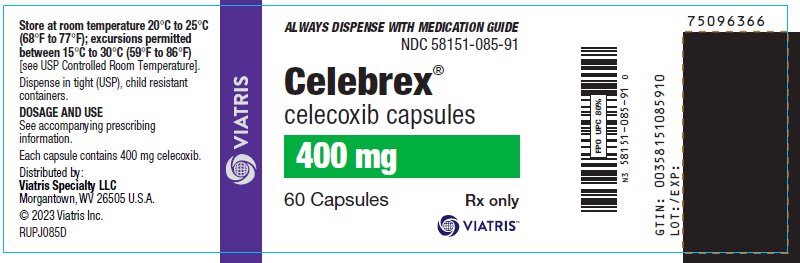
- 400 mg white, with reverse printed white on green band with markings of 7767 on the cap and 400 on the body.
- Known hypersensitivity (e.g., anaphylactic reactions and serious skin reactions) to celecoxib, any components of the drug product
- History of asthma, urticaria, or other allergic-type reactions after taking aspirin or other NSAIDs. Severe, sometimes fatal, anaphylactic reactions to NSAIDs, have been reported in such patients
- In the setting of CABG surgery
- In patients who have demonstrated allergic-type reactions to sulfonamides
- Cardiovascular Thrombotic Events
- GI Bleeding, Ulceration and Perforation
- Hepatotoxicity
- Hypertension
- Heart Failure and Edema
- Renal Toxicity and Hyperkalemia
- Anaphylactic Reactions
- Serious Skin Reactions
- Hematologic Toxicity
58151-083-05 bottle of 500
58151-083-88 carton of 100 unit dose
58151-084-01 bottle of 100
58151-084-05 bottle of 500
58151-084-88 carton of 100 unit dose
58151-085-91 bottle of 60
58151-085-88 carton of 100 unit dose
[see USP Controlled
Room Temperature].
See accompanying
prescribing information.
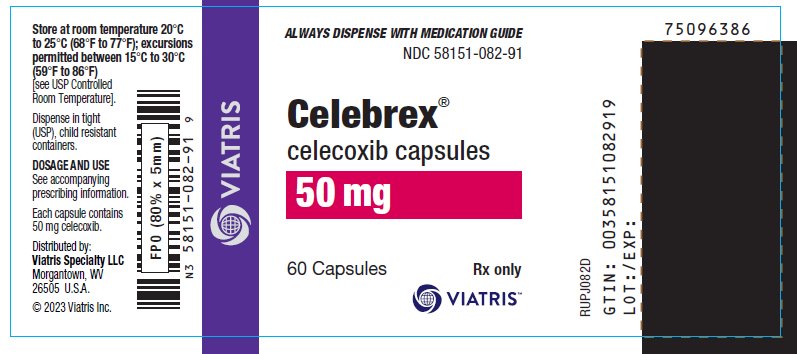
[see USP Controlled Room Temperature].
See accompanying prescribing
information.
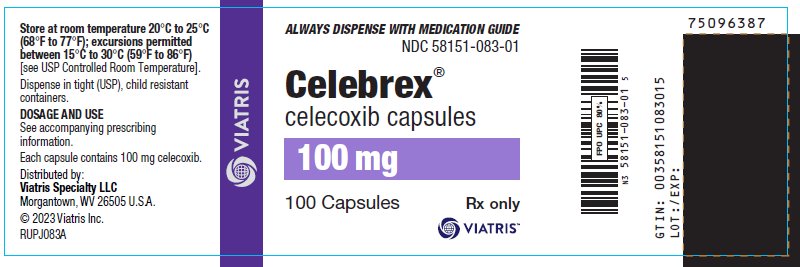
[see USP Controlled Room Temperature].
See accompanying prescribing
information.
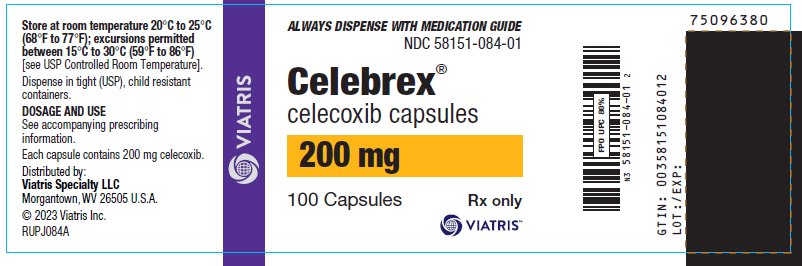
[see USP Controlled Room Temperature].
See accompanying prescribing
information.