Pelvic Inflammatory Disease Treatments

Find Pelvic Inflammatory Disease Treatments

Generic Name

Azithromycin

Brand Names
Azasite, Zithromax
FDA approval date: October 19, 1995
Classification: Macrolide Antimicrobial
Form: Injection, Tablet, Powder, Suspension, Solution

What is Azasite (Azithromycin)?

AzaSite ® is indicated for the treatment of bacterial conjunctivitis caused by susceptible isolates of the following microorganisms: CDC coryneform group G Efficacy for this organism was studied in fewer than 10 infections. Haemophilus influenzae Staphylococcus aureus Streptococcus mitis group Streptococcus pneumoniae AzaSite is a macrolide antimicrobial indicated for the treatment of bacterial conjunctivitis caused by susceptible isolates of the following microorganisms: CDC coryneform group G, Haemophilus influenzae, Staphylococcus aureus, Streptococcus mitis group, and Streptococcus pneumoniae.
Save this treatment for later
Sign Up
Not sure about your diagnosis?
Check Your Symptoms
Tired of the same old research?
Check Latest Advances

Related Clinical Trials

An Open-Label, Phase 2 Study to Evaluate the Activity of Belumosudil in Subjects With New Onset and Incipient Bronchiolitis Obliterans Syndrome Following Allogeneic Hematopoietic Cell Transplantation

Summary: The goal of this research study is to test the efficacy of a novel immunosuppressive agent, belumosudil, in allogeneic hematopoietic stem cell transplant (HSCT) recipients who have been newly diagnosed or have developing (early stage) bronchiolitis obliterans syndrome (BOS). The name of the study drugs involved in this study are: * Belumosudil (an immunotherapy) * Fluticasone (an intranasal cortic...

A Randomized, Double-blind, Placebo-controlled, Parallel Group, Phase 3 Study, Followed by Open-label Extensions, to Evaluate the Efficacy of Oral Belumosudil in Adult Participants With Chronic Lung Allograft Dysfunction (CLAD) Following Bilateral Lung Transplantation

Summary: This double-blind, randomized, placebo-controlled, multinational, multicenter, parallel-group, Phase 3, 2-arm, study will investigate the efficacy and safety of belumosudil compared with placebo, both administered on top of azithromycin and standard-of-care regimen of immunosuppression in male or female participants at least 1 year after bilateral lung transplant, who are at least 18 years of age ...

A Human Controlled Infection Study to Establish Safety of Infection With Bordetella Pertussis With Antibiotic Therapy Delayed for up to 6 Weeks

Summary: Primary objective- To assess the safety of nasal inoculation of healthy volunteers with B. pertussis with antibiotic therapy given to eradicate colonisation at 6 weeks after inoculation or at symptom onset, whichever occurs first Secondary objectives - To measure the rate of natural clearance of carriage of B. pertussis following nasal inoculation * To assess the kinetics of B. pertussis colonisat...

Brand Information

    AZASITE (azithromycin monohydrate)
    1INDICATIONS AND USAGE
    AzaSite
    CDC coryneform group G
    2DOSAGE AND ADMINISTRATION
    The recommended dosage regimen for the treatment of bacterial conjunctivitis is:
    Instill 1 drop in the affected eye(s) twice daily, eight to twelve hours apart for the first two days and then instill 1 drop in the affected eye(s) once daily for the next five days.
    3DOSAGE FORMS AND STRENGTHS
    2.5 mL of a 1% sterile topical ophthalmic solution.
    4CONTRAINDICATIONS
    Azasite is contraindicated in patients with hypersensitivity to any component of this product.
    5ADVERSE REACTIONS
    Because clinical trials are conducted under widely varying conditions, adverse reaction rates observed in one clinical trial of a drug cannot be directly compared with the rates in the clinical trials of the same or another drug and may not reflect the rates observed in practice.
    The data described below reflect exposure to AzaSite in 698 patients. The population was between 1 and 87 years old with clinical signs and symptoms of bacterial conjunctivitis. The most frequently reported ocular adverse reaction reported in patients receiving AzaSite was eye irritation. This reaction occurred in approximately 1 to 2% of patients. Other adverse reactions associated with the use of AzaSite were reported in less than 1% of patients and included ocular reactions (blurred vision, burning, stinging and irritation upon instillation, contact dermatitis, corneal erosion, dry eye, eye pain, itching, ocular discharge, punctate keratitis, visual acuity reduction) and non-ocular reactions (dysgeusia, facial swelling, hives, nasal congestion, periocular swelling, rash, sinusitis, urticaria).
    6DESCRIPTION
    AzaSite® (azithromycin ophthalmic solution) is a 1% sterile aqueous topical ophthalmic solution of azithromycin formulated in DuraSite
    7CLINICAL STUDIES
    In a randomized, vehicle-controlled, double-blind, multicenter clinical study in which patients were dosed twice daily for the first two days, then once daily on days 3, 4, and 5, AzaSite solution was superior to vehicle on days 6 to 7 in patients who had a confirmed clinical diagnosis of bacterial conjunctivitis. Clinical resolution was achieved in 63% (82/130) of patients treated with AzaSite versus 50% (74/149) of patients treated with vehicle. The p-value for the comparison was 0.03 and the 95% confidence interval around the 13% (63% to 50%) difference was 2% to 25%. The microbiological success rate for the eradication of the baseline pathogens was approximately 88% compared to 66% of patients treated with vehicle (p<0.001, confidence interval around the 22% difference was 13% to 31%). Microbiologic eradication does not always correlate with clinical outcome in anti-infective trials.
    8HOW SUPPLIED/STORAGE AND HANDLING
    AzaSite® is a sterile aqueous topical ophthalmic formulation of 1% azithromycin.
    NDC 82584-307-03: 2.5 mL in 5 mL bottle containing a total of 25 mg of azithromycin in a white, oblong, low-density polyethylene (LDPE) bottle, with a clear LDPE dropper tip, and a tan colored high density polyethylene (HDPE) eyedropper cap. A white tamper evident over-cap is provided.
    9PATIENT COUNSELING INFORMATION
    See FDA-Approved Patient Labeling (
    Avoiding Contamination of the Applicator Tip
    Advise patients to avoid contaminating the applicator tip by not allowing it to touch the eye, fingers or other sources.
    When to Seek Physician Advice
    Direct patients to discontinue use and contact a physician if any signs of an allergic reaction occur.
    Tell patients that although it is common to feel better early in the course of the therapy, the medication should be taken exactly as directed. Skipping doses or not completing the full course of therapy may (1) decrease the effectiveness of the immediate treatment and (2) increase the likelihood that bacteria will develop resistance and will not be treatable by AzaSite (azithromycin ophthalmic solution) or other antibacterial drugs in the future.
    Contact Lens Use
    Advise patients not to wear contact lenses if they have signs or symptoms of bacterial conjunctivitis.
    Administration Instructions
    Advise patients to thoroughly wash hands prior to using AzaSite.
    Advise patients to invert the closed bottle (upside down) and shake once before each use. Remove cap with bottle still in the inverted position. Tilt head back, and with bottle inverted, gently squeeze bottle to instill one drop into the affected eye(s).
    10PATIENT INFORMATION
    AzaSite (A-zuh-site)

    (azithromycin ophthalmic solution) 1%
    Read this Patient Information before you start using AzaSite
    What is AzaSite?
    AzaSite is a prescription sterile eye drop solution. AzaSite is used to treat bacterial conjunctivitis which is an infection of the eye caused by certain bacteria.
    Information about bacterial conjunctivitis.
    Bacterial conjunctivitis is a bacterial infection of the mucous membranes which line the inside of the eyelids. Symptoms may include redness of the eye and discharge. The infection can be spread to other people and to both eyes.
    Who should not use AzaSite?
    Do not use AzaSite if you are allergic to azithromycin or any of the ingredients in AzaSite. See the end of this Patient Information leaflet for a complete list of the ingredients in AzaSite.
    What should I tell my doctor before using AzaSite?
    Before you use AzaSite, tell your doctor if you:
    • wear contact lenses. Do not wear contact lenses if you have signs or symptoms of bacterial conjunctivitis.
    • are pregnant or plan to become pregnant. Talk to your doctor if you are pregnant or plan to become pregnant.
    • are breast-feeding or plan to breast-feed. AzaSite passes into your breast milk. Talk to your doctor about the best way to feed your baby if you are using AzaSite.
    Tell your doctor about all the medicines you take, including prescription and non-prescription medicines, vitamins, and herbal supplements.
    Know the medicines you take. Keep a list of them to show your doctors and pharmacist when you get a new medicine.
    How should I use AzaSite?
    • Read the Instructions for Use at the end of this Patient Information leaflet for the right way to use AzaSite.
    • Use AzaSite exactly as your doctor tells you to use it.
    • For the first 2 days place 1 drop of AzaSite in your eye (or eyes) each morning and 1 drop in your eye (or eyes) each evening. Wait 8 to 12 hours after placing your morning drops before you place evening drops in your eye (or eyes).
    • For the next 5 days place 1 drop of AzaSite in your eye (or eyes) 1 time each day.
    • Make sure you continue to use AzaSite as directed by your doctor even if you feel better after you start using it. Skipping drops can increase the chances that:
    What should I be aware of while using AzaSite?
    Do not wear contact lenses if you have signs or symptoms of bacterial conjunctivitis and until you have finished your prescribed course of treatment. The symptoms of bacterial conjunctivitis may include:
    • discharge coming from the eye
    • eye redness
    • eye irritation
    Only your doctor can tell you if you have bacterial conjunctivitis.
    Severe allergic reactions have been reported rarely when azithromycin has been taken by mouth.
    • Serious rash or serious allergic reactions may occur. Azithromycin, the active ingredient in AzaSite, may cause a serious rash or a serious allergic reaction. Both of these reactions may need to be treated in a hospital and may be life-threatening.
    • Stop taking AzaSite and call your doctor right away or get emergency help if you have any of these symptoms:
    Increased risk of other infections caused by bacteria or fungi.
    • Using AzaSite for a long time may cause other bacteria or fungi to grow. If this happens you may get a new infection. Tell your doctor right away if your symptoms do not get better.
    What are the possible side effects of AzaSite?
    The most common side effect of AzaSite is eye irritation.
    Other side effects seen with AzaSite include:
    • eye burning, stinging and irritation when the drop hits your eye
    • irritation on your eyelid and the skin around your eye
    • a feeling of discomfort and irritation or that something is in your eye
    • dry eye
    • eye pain
    • eye itching
    • discharge coming from your eye
    • changes to the surface of your eye
    • blurred vision
    • changes in your taste
    • hives and rash on your skin
    • stuffy nose and sinus infection
    • swelling around your eye or of your face
    Tell your doctor about any side effect that bothers you or that does not go away.
    These are not all of the possible side effects of AzaSite. For more information, ask your doctor or pharmacist.
    Call your doctor for medical advice about side effects. You may report side effects to FDA at 1-800-FDA-1088.
    How should I store AzaSite?
    • Before you open your AzaSite, store it in the refrigerator between 36°F to 46°F (2°C to 8°C).
    • After you open your AzaSite, store it at room temperature or the refrigerator between 36°F to 77°F (2°C to 25°C)
    • AzaSite should not be stored for more than 14 days after opening. After 14 days, throw the AzaSite bottle away.
    • Safely throw away medicine that is out of date or no longer needed.
    Keep AzaSite and all medicines out of reach of children.
    General information about the safe and effective use of AzaSite
    Medicines are sometimes prescribed for purposes other than those listed in a Patient Information leaflet. Do not use AzaSite for a condition for which it was not prescribed. Do not give AzaSite to other people, even if they have the same symptoms that you have. It may harm them.
    This Patient Information summarizes the most important information about AzaSite. If you would like more information, talk with your doctor. You can ask your pharmacist or doctor for information about AzaSite that is written for health professionals.
    For more information, call 1-833-838-4028.
    What are the ingredients in AzaSite?
    Active ingredient: azithromycin
    Inactive ingredients: 0.003% benzalkonium chloride, mannitol, citric acid, sodium citrate, poloxamer 407, polycarbophil, edetate disodium (EDTA), sodium chloride, water, and sodium hydroxide.
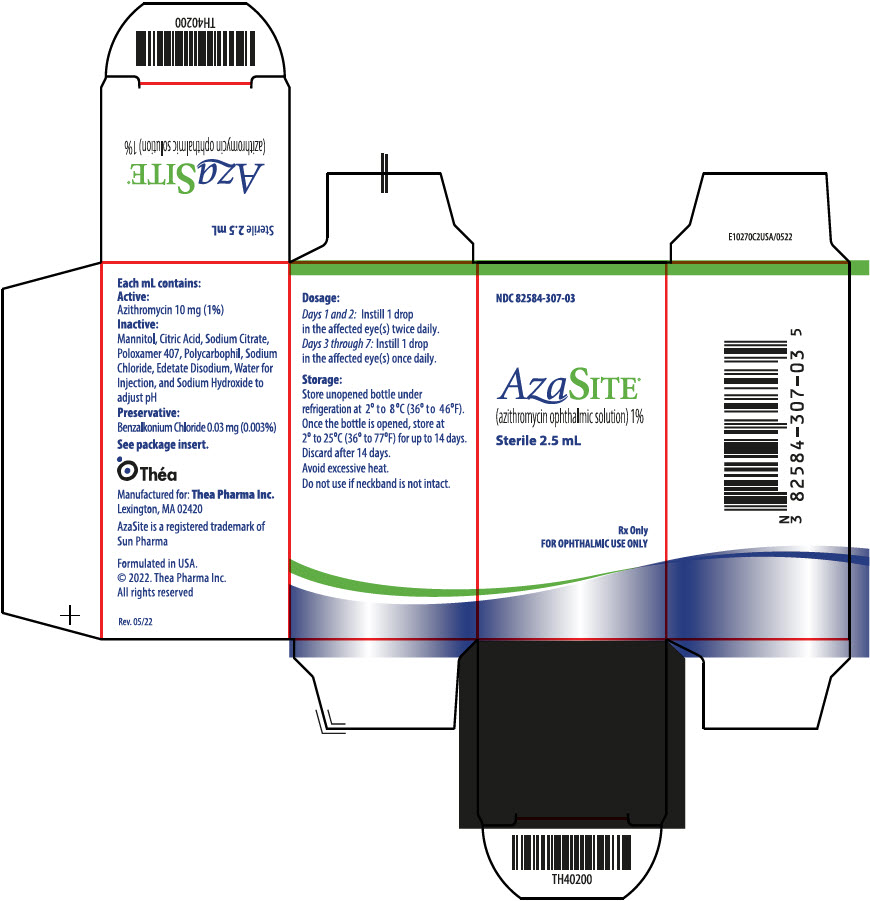
    12PRINCIPAL DISPLAY PANEL - 2.5 mL Bottle Carton
    NDC 82584-307-03
    AzaSITE
    Sterile 2.5 mL
    Rx Only
    FOR OPHTHALMIC USE ONLY
    PRINCIPAL DISPLAY PANEL - 2.5 mL Bottle Carton