Phenylketonuria (PKU) Treatments
Find Phenylketonuria (PKU) Treatments
Palynziq
What is Palynziq (Pegvaliase-Pqpz)?
Approved To Treat
Related Clinical Trials
Summary: Study 165-401 is a Phase 4, open-label study designed to examine the concomitant use of methotrexate (MTX) to suppress immune responses to Palynziq and improve tolerability and efficacy in adults with PKU.
Summary: This is a 10-year multi-center, global, observational study to further characterize the safety profile of pegvaliase, including hypersensitivity reactions, long-term safety and tolerability, and the effectiveness of the additional risk minimization measures (aRMMs) (European Union (EU) only) in subjects receiving pegvaliase for the treatment of PKU. Subjects for whom a clinical decision has been m...
Summary: This is a 10-year multi-center, prospective, longitudinal, single arm study evaluating immunologic, inflammatory and laboratory parameters associated with long-term Palynziq treatment in subjects with phenylketonuria (PKU) in the United States (US). Subjects in the US for whom a clinical decision has been made that they will receive pegvaliase to treat their PKU within 30 days following the date o...
Related Latest Advances
Brand Information
- Anaphylaxis has been reported after administration of PALYNZIQ and may occur at any time during treatment
- Administer the initial dose of PALYNZIQ under the supervision of a healthcare provider equipped to manage anaphylaxis, and closely observe patients for at least 60 minutes following injection. Prior to self-injection, confirm patient competency with self-administration, and patient's and observer's (if applicable) ability to recognize signs and symptoms of anaphylaxis and administer epinephrine, if needed
- Consider having an adult observer for patients who may need assistance in recognizing and managing anaphylaxis during PALYNZIQ treatment. If an adult observer is needed, the observer should be present during and for at least 60 minutes after PALYNZIQ administration, should be able to administer epinephrine, and call for emergency medical support upon its use
- Prescribe epinephrine to all patients treated with PALYNZIQ. Prior to the first dose, instruct the patient and observer (if applicable) how to recognize the signs and symptoms of anaphylaxis, how to properly administer epinephrine, and to seek immediate medical care upon its use. Instruct patients to carry epinephrine with them at all times during treatment with PALYNZIQ
- Consider the risks and benefits of readministering PALYNZIQ following an episode of anaphylaxis. If the decision is made to readminister PALYNZIQ, readminister the first dose under the supervision of a healthcare provider equipped to manage anaphylaxis and closely observe the patient for at least 60 minutes following the dose
- Because of the risk of anaphylaxis, PALYNZIQ is available only through a restricted program under a Risk Evaluation and Mitigation Strategy (REMS) called the PALYNZIQ REMS
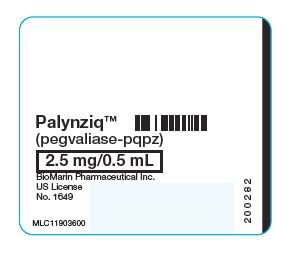
- Injection: 2.5 mg/0.5 mL single-dose prefilled syringe
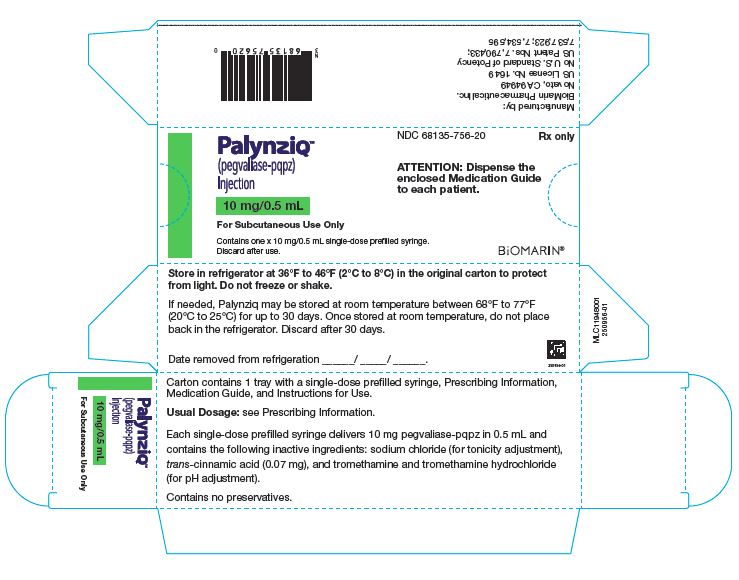
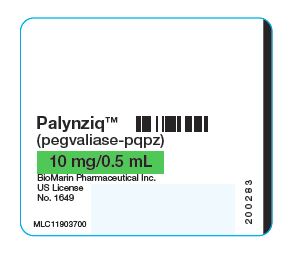
- Injection: 10 mg/0.5 mL single-dose prefilled syringe
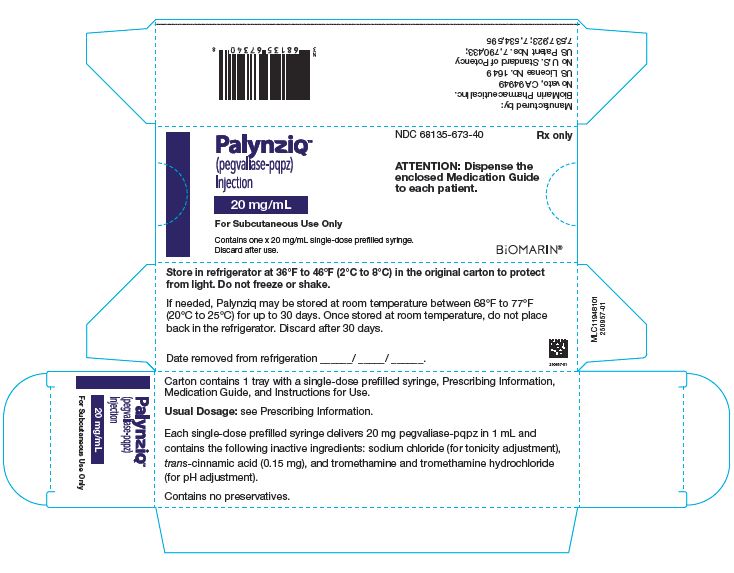
- Injection: 20 mg/mL single-dose prefilled syringe
- Anaphylaxis
- Other Hypersensitivity Reactions
- Injection Site Infections
- Hypophenylalaninemia
- Advise patients that PALYNZIQ may cause hypersensitivity reactions, including anaphylaxis that can occur at any time. Instruct patients to recognize the signs and symptoms of anaphylaxis
- Instruct patients to carry epinephrine with them at all times during PALYNZIQ treatment. Instruct the patient and observer (if applicable) on the appropriate use of epinephrine for anaphylaxis
- Instruct patients who experience anaphylaxis to seek immediate medical care, discontinue therapy, and resume treatment only at the instruction of a healthcare provider
- Patients must be enrolled in the PALYNZIQ REMS.
- Patients must be educated about the risk of anaphylaxis by a certified prescriber to ensure they understand the risks and benefits of treatment with PALYNZIQ.
- Patients must fill a prescription for epinephrine and carry it with them at all times.
- Patients will be given a PALYNZIQ Patient Wallet Card that they should carry with them at all times. This card describes symptoms which, if experienced, should prompt the patient and observer (if applicable) to immediately seek medical care. Advise the patient to show the PALYNZIQ Wallet Card to other treating healthcare providers.
- Advise patients to monitor their dietary protein and phenylalanine intake throughout treatment with PALYNZIQ, and adjust intake as directed by their healthcare provider based on blood phenylalanine concentrations
- Provide appropriate instruction for methods of self-injection, including careful review of the PALYNZIQ Medication Guide and Instructions for Use. Instruct patients in the use of aseptic technique when administering PALYNZIQ
- Inform patients that a healthcare provider will show them or their caregiver how to prepare to inject PALYNZIQ before self-administering.
- Advise patients not to inject into moles, scars, birthmarks, bruises, rashes, or areas where the skin is hard, tender, red, damaged, burned, inflamed, or tattooed.
- Advise patients to rotate injection sites with each dose.
- Advise patients that injection site infections may occur and to check the injection site for redness, swelling, or tenderness prior to injection. Instruct patients to contact their healthcare provider if signs or symptoms of an infection develop, persist, or worsen
- Advise patients to not administer PALYNZIQ into the affected area until the infection has resolved.
- Advise patients to follow sharps disposal recommendations
- Advise patients that the shelf-life expires after storage at room temperature for 30 days or after the expiration date on the product carton, whichever is earlier.
- Follow these instructions carefully while you are using PALYNZIQ.
- If your healthcare provider decides that you (or your caregiver) can give the injections of PALYNZIQ at home, your healthcare provider will show you (or your caregiver) how to inject PALYNZIQ the right way.
- Your healthcare provider should watch you (or your caregiver) give the first PALYNZIQ injection and monitor you for signs and symptoms of a severe allergic reaction (anaphylaxis).
- Do not inject PALYNZIQ until your healthcare provider shows you (or your caregiver) how to inject PALYNZIQ the right way and has watched you (or your caregiver) give your injection.
- Do not use a PALYNZIQ prefilled syringe more than 1 time.
- Do not pull back on the plunger at any time.
- Do not remove the needle cap until you are ready to inject.
- Do not share your prefilled syringes with anyone else. You may give an infection to them or get an infection from them.
- Store your PALYNZIQ prefilled syringe(s) in its original carton in the refrigerator. See " at the end of this Instructions for Use.
- Talk to your healthcare provider if you (or your caregiver) have any questions about how to inject PALYNZIQ the right way.
- PALYNZIQ prefilled syringe(s) in sealed tray(s).
- 1 gauze pad or cotton ball
- 1 alcohol pad
- 1 bandage
- 1 puncture resistant or sharps disposal container. See
- PALYNZIQ prefilled syringes come in 3 different strengths (See
- Before you inject PALYNZIQ, check each carton and syringe to make sure you have the right prefilled syringe for your prescribed dose.