Schizophrenia Treatments

Find Schizophrenia Treatments

Generic Name

RisperiDONE

Brand Names
Perseris, Risperdal, Risperdal Consta, Risperdal M-TAB, Rykindo, UZEDY
FDA approval date: December 29, 1993
Classification: Atypical Antipsychotic
Form: Injection, Tablet, Kit, Solution

What is Perseris (RisperiDONE)?

PERSERIS is indicated for the treatment of schizophrenia in adults. PERSERIS is an atypical antipsychotic indicated for the treatment of schizophrenia in adults.
Save this treatment for later
Sign Up
Not sure about your diagnosis?
Check Your Symptoms
Tired of the same old research?
Check Latest Advances

Related Clinical Trials

Biomarkers to Enhance Early Schizophrenia Treatment

Summary: This study is recruiting participants who are experiencing a first episode of psychosis and who have certain genetic factors that may make them respond better to certain medications that are used to treat people with psychosis.

The Role of the Subjective Experience in Supporting Positive Effects Following Psilocybin: a Randomized, Controlled Clinical Trial Using Risperidone in Healthy Adults

Summary: The purpose of this study is to determine the importance of the acute subjective experience induced by psilocybin (the primary component of magic mushrooms) in facilitating positive outcomes. Participants in this study will be given psilocybin in combination with either a placebo or risperidone, an atypical antipsychotic that block the subjective effects of psilocybin.

Brand Information

    PERSERIS (Risperidone)
    WARNING: INCREASED MORTALITY IN ELDERLY PATIENTS WITH DEMENTIA-RELATED PSYCHOSIS
    Elderly patients with dementia-related psychosis treated with antipsychotic drugs are at an increased risk of death. PERSERIS®is not approved for the treatment of patients with dementia-related psychosis[see Warnings and Precautions (
    1INDICATIONS AND USAGE
    PERSERIS is indicated for the treatment of schizophrenia in adults
    2DOSAGE FORMS AND STRENGTHS
    PERSERIS (risperidone) for extended-release injectable suspension for subcutaneous use is available in strengths of 90 mg and 120 mg.
    Each strength is provided as a kit which includes: one pre-filled syringe containing a white to yellow risperidone powder in a sealed pouch, one pre-filled syringe containing a colorless to yellow delivery system in a sealed pouch, and one 18-gauge, 5/8-inch needle.
    3CONTRAINDICATIONS
    PERSERIS is contraindicated in patients with a known hypersensitivity to risperidone, its metabolite, paliperidone, or to any of its components. Hypersensitivity reactions, including anaphylactic reactions and angioedema, have been reported in patients treated with risperidone or paliperidone.
    4ADVERSE REACTIONS
    The following are discussed in more detail in previous sections of the labeling:
    • Increased Mortality in Elderly Patients with Dementia-Related Psychosis
    • Cerebrovascular Adverse Reactions, Including Stroke, in Elderly Patients with Dementia-Related Psychosis
    • Neuroleptic Malignant Syndrome (NMS)
    • Tardive Dyskinesia
    • Metabolic Changes
    • Hyperprolactinemia
    • Orthostatic Hypotension and Syncope
    • Falls
    • Leukopenia, Neutropenia and Agranulocytosis
    • Potential for Cognitive and Motor Impairment
    • Seizures
    • Dysphagia
    • Priapism
    • Body Temperature Regulation
    4.1Clinical Trials Experience
    Because clinical trials are conducted under widely varying conditions, adverse reaction rates observed in the clinical trials of a drug cannot be directly compared to rates in the clinical trials of another drug and may not reflect the rates observed in practice.
    The safety of PERSERIS was evaluated in a total of 837 adult patients with schizophrenia who received at least 1 dose of PERSERIS during the clinical development program. A total of 322 patients were exposed to PERSERIS for at least 6 months, of which 234 patients were exposed to PERSERIS for at least 12 months; 281 and 176 of these, respectively, received the 120 mg dose.
    Adverse drug reactions in adult patients with schizophrenia (≥ 5% in any PERSERIS-treated group and greater than placebo) during the 8-week double-blind, placebo-controlled study) were weight increased, constipation, sedation/somnolence, pain in extremity, back pain, akathisia, anxiety, and musculoskeletal pain. In addition, the frequency of reported injection site reactions was similar across treatment groups with both PERSERIS and placebo; the most common (≥ 5%) of which were injection site pain, and erythema. The systemic safety profile for PERSERIS was consistent with the known safety profile of oral risperidone.
    4.2Postmarketing Experience
    The following adverse reactions have been identified during post approval use of oral risperidone. Because these reactions are reported voluntarily from a population of uncertain size, it is not always possible to reliably estimate their frequency or establish a causal relationship to drug exposure. These adverse reactions include: alopecia, anaphylactic reaction, angioedema, atrial fibrillation, cardiopulmonary arrest, catatonia, diabetic ketoacidosis in patients with impaired glucose metabolism, dysgeusia, hypoglycemia, hypothermia, ileus, inappropriate antidiuretic hormone secretion, intestinal obstruction, jaundice, mania, pancreatitis, pituitary adenoma, precocious puberty, pulmonary embolism, QT prolongation, sleep apnea syndrome, somnambulism, Stevens-Johnson syndrome and toxic epidermal necrolysis (SJS/TEN), sudden death, thrombocytopenia, thrombotic thrombocytopenic purpura, urinary retention, and water intoxication.
    Postmarketing cases of extrapyramidal symptoms (dystonia and dyskinesia) have been reported in patients concomitantly taking methylphenidate and risperidone when there was an increase or decrease in dosage, initiation, or discontinuation of either or both medications.
    5DRUG INTERACTIONS
    The interactions of PERSERIS with co-administration of other drugs have not been studied. The drug interaction data provided in this section is based on studies with oral risperidone.
    5.1Drugs Having Clinically Important Interactions with PERSERIS
    Table 5includes clinically significant drug interactions with PERSERIS.
    5.2Drugs Having No Clinically Important Interactions with PERSERIS
    Based on pharmacokinetic studies with oral risperidone, no dosage adjustment of PERSERIS is required when administered concomitantly with amitriptyline, cimetidine, ranitidine, clozapine, topiramate and moderate CYP3A4 inhibitors (erythromycin). Additionally, no dosage adjustment is necessary for lithium, valproate, topiramate, digoxin and CYP2D6 substrates (donepezil and galantamine) when co-administered with PERSERIS
    6DESCRIPTION
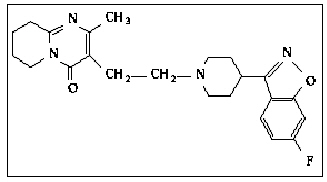
    PERSERIS contains risperidone, an atypical antipsychotic. Risperidone belongs to the chemical class of benzisoxazole derivatives. The chemical designation 3-[2-[4-(6-fluoro-1,2-benzoxazol-3-yl) piperidin-1-yl] ethyl]-2-methyl-6,7,8,9-tetrahydropyrido[1,2-a] pyrimidin-4-one. Its molecular formula is C
    The structural formula is:
    Structural Formula
    Risperidone is a white to off-white powder. It is practically insoluble in water and soluble in methanol and 0.1 N HCl.
    PERSERIS is available as a sterile two-syringe mixing system: a liquid syringe prefilled with the delivery system (colorless to yellow solution), and a powder syringe prefilled with risperidone (white to yellow).
    PERSERIS for extended release injectable suspension, for subcutaneous use, is available in 90 mg and 120 mg risperidone strengths. The quantitative composition is provided below (
    7CLINICAL STUDIES
    Efficacy for PERSERIS was demonstrated in an 8-week, randomized, double-blind, placebo-controlled study (Study 1, NCT #02109562). The study evaluated the efficacy, safety and tolerability of PERSERIS (90 and 120 mg subcutaneous every 4-weeks) compared with placebo in adults (age 18- to 55-years, inclusive) experiencing acute exacerbations of schizophrenia. Patients were required to have a Positive and Negative Syndrome Scale (PANSS) total score of 80- to 120-inclusive (moderate to severely ill) at the screening visit, occurring 3- to 8-days before the start of double-blind treatment, without an improvement in the PANSS total score of ≥ 20% between screening and the first dosing day.
    At the screening visit, all patients received two doses of 0.25 mg oral risperidone 24-hours apart to establish tolerability. Patients were then placed in an inpatient setting, if not already hospitalized, and tapered off their current oral antipsychotic medication (if they were taking one) over a period of 3- to 8-days. Patients were randomized to receive 2 doses of subcutaneous PERSERIS (90 mg or 120 mg) or placebo 28-days apart (on Day 1 and Day 29). No supplemental oral risperidone was permitted during the study.
    The primary endpoint was the change in PANSS total score from baseline to end of study (Day 57). Both PERSERIS 90 and 120 mg doses demonstrated a statistically significant improvement compared with placebo based on the primary endpoint (
    Characteristics of the patient population were balanced across the treatment groups. The mean baseline PANSS total score ranged from 94 to 96 across the groups. Most patients were male (74 to 83% per group), and the mean ages were 40 to 43 in each group. Most patients in this study were black or African American (71 to 75% per group). Of the 354 patients randomized to treatment, 337 were included in the intent-to-treat (ITT) population, and 259 (73%) completed the study.
    Subgroup analyses by gender, age, and race did not suggest any clear evidence of differential responsiveness to PERSERIS.
    Figure 14. Least Square Mean Change from Baseline (+/- Standard Error) in PANSS Total Scores by Days
    Figure
    The secondary efficacy endpoint was defined as the CGI-S score at Day 57. Both PERSERIS treatment groups demonstrated statistically significantly better CGI-S scores versus placebo.
    8HOW SUPPLIED/STORAGE AND HANDLING
    PERSERIS (risperidone) for extended-release injectable suspension, for subcutaneous use is, when fully mixed a viscous suspension that, varies from white to yellow-green and is available in dosage strengths of 90 mg and 120 mg.
    PERSERIS 90 mg is supplied in a single-dose kit, packaged in a carton (NDC 12496-0090-1), containing the following:
    • One pouch with a sterile syringe (labelled ‘P’) prefilled with risperidone powder
    • One pouch with a sterile syringe (labelled ‘L’) prefilled with the delivery system, and desiccant.
    • One 18-gauge, 5/8-inch sterile safety needle.
    PERSERIS 120 mg is supplied in a single-dose kit, packaged in a carton (NDC 12496-0120-1), containing the following:
    • One pouch with a sterile syringe (labelled ‘P') prefilled with risperidone powder.
    • One pouch with a sterile syringe (labelled ‘L') prefilled with the delivery system, and desiccant.
    • One 18-gauge, 5/8-inch sterile safety needle.