Thyroid Cancer Treatments
Find Thyroid Cancer Treatments
Sorafenib
What is Nexavar (Sorafenib)?
Approved To Treat


Related Clinical Trials
Summary: A prospective open label, multicenter study to evaluate the feasibility and acute toxicity of using molecularly guided therapy in combination with standard therapy followed by a Randomized Controlled Trial of standard immunotherapy with or without DFMO followed by DFMO maintenance for Newly Diagnosed High-Risk Neuroblastoma.
Summary: This is an open-label, multicenter, randomized controlled Phase II trial. Patients with advanced hepatocellular carcinoma (HCC) who developed secondary resistance to first-line targeted-immunotherapy were randomly assigned to receive either the original first-line targeted-immunotherapy combined with FMT and PULSAR (experimental group), or second-line targeted-immunotherapy (control group). The fi...
Summary: Prospective, open, interventional, randomized, non-commercial trial
Related Latest Advances
Brand Information
- 200 mg sorafenib, round, biconvex, red film-coated tablets, debossed with the “Bayer cross” on one side and “200” on the other side.
- 200 mg sorafenib, round, faceted biconvex, red film-coated tablets, debossed with the “Bayer cross” on one side and “200” on the other side.
- NEXAVAR is contraindicated in patients with known severe hypersensitivity to sorafenib or any other component of NEXAVAR.
- NEXAVAR in combination with carboplatin and paclitaxel is contraindicated in patients with squamous cell lung cancer
- Cardiovascular events
- Hemorrhage
- Hypertension
- Dermatologic toxicities
- Gastrointestinal perforation
- QT interval prolongation
- Drug-induced liver injury
- Impairment of TSH suppression in DTC
- Adverse reactions graded according to National Cancer Institute Common Terminology Criteria for Adverse Events version 3.0 (NCI CTCAE v3.0).
- Laboratory parameters graded according to National Cancer Institute Common Terminology Criteria for Adverse Events version 3.0 (NCI CTCAE v3.0).
- Adverse reactions graded according to National Cancer Institute Common Terminology Criteria for Adverse Events version 3.0 (NCI CTCAE v3.0).
- Laboratory parameters graded according to National Cancer Institute Common Terminology Criteria for Adverse Events version 3.0 (NCI CTCAE v3.0).
- National Cancer Institute Common Terminology Criteria for Adverse Events Version 3.0
- Includes the following terms: abdominal pain, abdominal discomfort, hepatic pain, esophageal pain, esophageal discomfort, abdominal pain lower, abdominal pain upper, abdominal tenderness, abdominal rigidity
- Includes the following terms: stomatitis, aphthous stomatitis, mouth ulceration, mucosal inflammation
- Includes the following terms: oral pain, oropharyngeal discomfort, glossitis, burning mouth syndrome, glossodynia
- Palmar-plantar erythrodysesthesia syndrome (Hand-foot skin reaction)
- Includes the following terms: hypertension, blood pressure increased, blood pressure systolic increased
- Laboratory parameters graded according to National Cancer Institute Common Terminology Criteria for Adverse Events version 3.0 (NCI CTCAE v3.0).
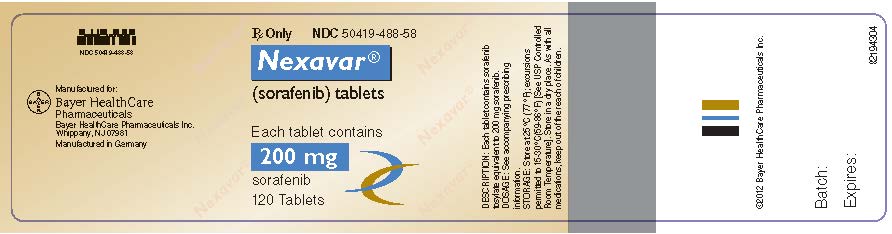
- 200 mg, round, biconvex, red film-coated tablets, debossed with the “Bayer cross” on one side and “200” on the other side. NDC 50419-488-58
- 200 mg, round, faceted, biconvex, red film-coated tablets, debossed with the “Bayer cross” on one side and “200” on the other side. NDC 50419-489-01
(sorafenib) tablets
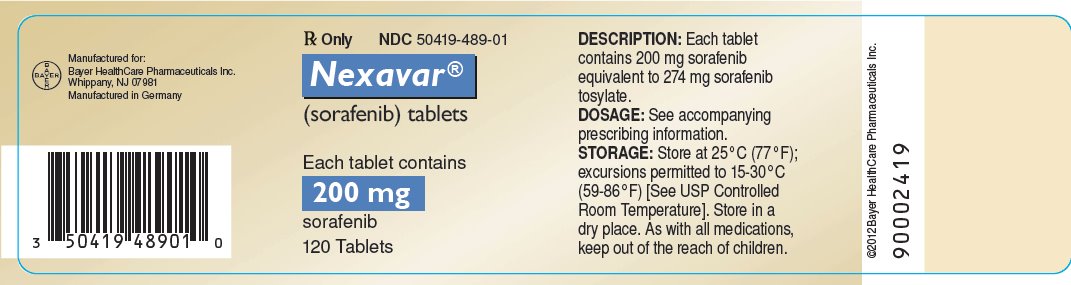
(sorafenib) tablets