Thyroid Cancer Treatments
Find Thyroid Cancer Treatments
Sorafenib
What is Nexavar (Sorafenib)?
Approved To Treat
Top Global Experts


Related Clinical Trials
Summary: This study will test the hypothesis that a novel combination of three drugs (sorafenib, sonidegib, and irinotecan), in conjunction with individually optimized doses, can be safely administered and lead to improved clinical outcomes in patients with hepatocellular carcinoma compared to standard of care. The main objective of this study is to establish safe dose ranges for the coadministration of so...
Summary: This is a phase I/II study to evaluate the safety of combining intravenous (IV) atezolizumab and bevacizumab every three weeks, with daily oral cyclophosphamide and pharmacokinetic (PK)-guided sorafenib in children and adolescent and young adults (AYA) with relapsed or refractory solid malignancies (Part 1), and then evaluate the response rate of this combination in children, AYA with relapsed or ...
Summary: The purpose of this observational study is to assess the role of plasma concentration monitoring of treatment drugs for patients with metastatic renal cell carcinoma (mRCC) in terms of efficacy and side effects. It furthermore holds microbiome characterization of CPI-treated patients. Furthermore, the investigators examines the role of anti-drug antibodies and receptor polymorphisms in CTLA-4 and ...
Related Latest Advances
Brand Information
- 200 mg sorafenib, round, biconvex, red film-coated tablets, debossed with the “Bayer cross” on one side and “200” on the other side.
- 200 mg sorafenib, round, faceted biconvex, red film-coated tablets, debossed with the “Bayer cross” on one side and “200” on the other side.
- NEXAVAR is contraindicated in patients with known severe hypersensitivity to sorafenib or any other component of NEXAVAR.
- NEXAVAR in combination with carboplatin and paclitaxel is contraindicated in patients with squamous cell lung cancer
- Cardiovascular events
- Hemorrhage
- Hypertension
- Dermatologic toxicities
- Gastrointestinal perforation
- QT interval prolongation
- Drug-induced liver injury
- Impairment of TSH suppression in DTC
- Adverse reactions graded according to National Cancer Institute Common Terminology Criteria for Adverse Events version 3.0 (NCI CTCAE v3.0).
- Laboratory parameters graded according to National Cancer Institute Common Terminology Criteria for Adverse Events version 3.0 (NCI CTCAE v3.0).
- Adverse reactions graded according to National Cancer Institute Common Terminology Criteria for Adverse Events version 3.0 (NCI CTCAE v3.0).
- Laboratory parameters graded according to National Cancer Institute Common Terminology Criteria for Adverse Events version 3.0 (NCI CTCAE v3.0).
- National Cancer Institute Common Terminology Criteria for Adverse Events Version 3.0
- Includes the following terms: abdominal pain, abdominal discomfort, hepatic pain, esophageal pain, esophageal discomfort, abdominal pain lower, abdominal pain upper, abdominal tenderness, abdominal rigidity
- Includes the following terms: stomatitis, aphthous stomatitis, mouth ulceration, mucosal inflammation
- Includes the following terms: oral pain, oropharyngeal discomfort, glossitis, burning mouth syndrome, glossodynia
- Palmar-plantar erythrodysesthesia syndrome (Hand-foot skin reaction)
- Includes the following terms: hypertension, blood pressure increased, blood pressure systolic increased
- Laboratory parameters graded according to National Cancer Institute Common Terminology Criteria for Adverse Events version 3.0 (NCI CTCAE v3.0).
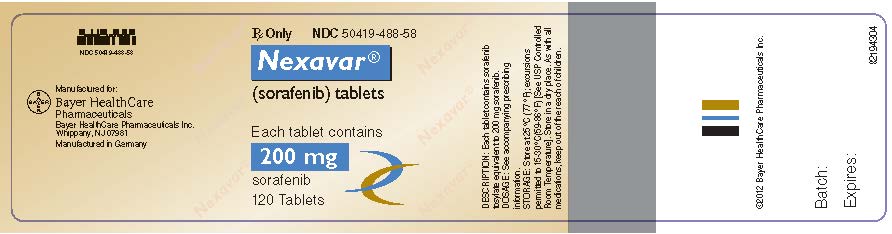
- 200 mg, round, biconvex, red film-coated tablets, debossed with the “Bayer cross” on one side and “200” on the other side. NDC 50419-488-58
- 200 mg, round, faceted, biconvex, red film-coated tablets, debossed with the “Bayer cross” on one side and “200” on the other side. NDC 50419-489-01
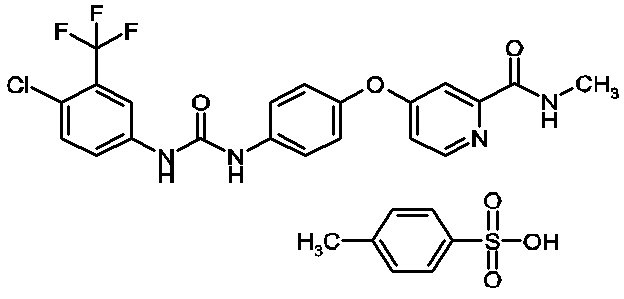
(sorafenib) tablets
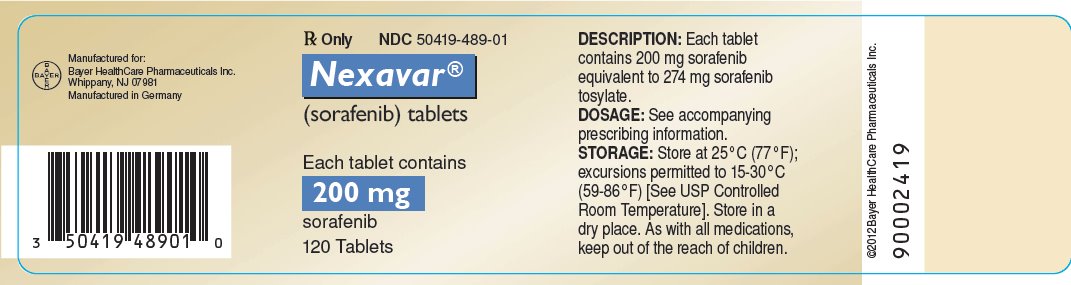
(sorafenib) tablets