Brand Name

Odomzo

Generic Name
Sonidegib
View Brand Information
FDA approval date: September 21, 2017
Classification: Hedgehog Pathway Inhibitor
Form: Capsule

What is Odomzo (Sonidegib)?

ODOMZO is indicated for the treatment of adult patients with locally advanced basal cell carcinoma that has recurred following surgery or radiation therapy, or those who are not candidates for surgery or radiation therapy. ODOMZO is a hedgehog pathway inhibitor indicated for the treatment of adult patients with locally advanced basal cell carcinoma that has recurred following surgery or radiation therapy, or those who are not candidates for surgery or radiation therapy.

Approved To Treat

Save this treatment for later
Sign Up
Not sure about your diagnosis?
Check Your Symptoms
Tired of the same old research?
Check Latest Advances

Related Clinical Trials

Evaluation of Radiotherapy After Complete Response to Sonic Hedgehog Pathway Inhibitors in Patients With Locally Advanced Basal Cell Carcinoma: a Prospective Multicenter Study

Summary: Locally advanced basal cell carcinoma (BCC) are large BCCs or BCCs located in areas subject to functional and aesthetic risk following surgery or radiotherapy. In these particular situations, surgery and radiotherapy are sometimes not appropriate, and Sonic Hedgehog inhibitors (SHHi) (Vismodegib and Sonidegib) can be proposed. SHHi are effective treatments in laBCC but most CR patients discontinue...

Blue-Light Photodynamic Therapy and Sonidegib for Multiple Basal Cell Carcinomas

Summary: This research study is testing combination Blue-light photodynamic therapy and Sonidegib as a possible treatment for people with multiple basal cell carcinoma lesions. Basal cell carcinoma lesions are typically treated by freezing the lesion or surgically removing the lesion. These types of treatment can cause scarring. Photodynamic therapy uses light along with a drug applied to the skin to kill ...

Registration of Oral Hedgehog Inhibitors Vismodegib and Sonidegib in the Treatment of Advanced and Multiple Basal Cell Carcinoma in the Netherlands: a Prospective Registration Study.

Background: Oral hedgehog inhibitors vismodegib and sonidegib have been used for the treatment of locally advanced (laBCC), metastatic basal cell carcinoma (mBCC) and in basal cell nevus syndrome (BCNS) patients. In the Netherlands, targeted therapy with vismodegib and sonidegib has been available since 2013 and 2021, respectively. No direct comparative studies have been performed between the two oral hedgeho...

Brand Information

Odomzo (sonidegib)
WARNING: EMBRYO-FETAL TOXICITY
1INDICATIONS AND USAGE
ODOMZO (sonidegib) is indicated for the treatment of adult patients with locally advanced basal cell carcinoma (BCC) that has recurred following surgery or radiation therapy, or those who are not candidates for surgery or radiation therapy.
2DOSAGE FORMS AND STRENGTHS
Capsules: 200 mg, opaque pink colored with ‘SONIDEGIB 200MG’ printed on the body and ‘NVR’ printed on the cap in black ink (equivalent to 281 mg of diphosphate salt of sonidegib).
3CONTRAINDICATIONS
None.
4ADVERSE REACTIONS
The following clinically significant adverse reactions are described elsewhere in the labeling:
  • Musculoskeletal Adverse Reactions
4.1Clinical Trials Experience
Because clinical trials are conducted under widely varying conditions, adverse reaction rates observed in the clinical trials of a drug cannot be directly compared to rates in the clinical trials of another drug and may not reflect the rates observed in clinical practice.
The safety of ODOMZO was evaluated in BOLT, a randomized, double-blind, multiple cohort trial in which 229 patients received ODOMZO at either 200 mg (n=79) or 800 mg (n=150) daily. The frequency of common adverse reactions including muscle spasms, alopecia, dysgeusia, fatigue, nausea, decreased weight, decreased appetite, myalgia, pain, and vomiting was greater in patients treated with ODOMZO 800 mg as compared to 200 mg.
The data described below reflect exposure to ODOMZO 200 mg daily in 79 patients with locally advanced BCC (laBCC; n=66) or metastatic BCC (mBCC; n=13) enrolled in BOLT. Patients were followed for at least 18 months unless discontinued earlier. The median duration of treatment with ODOMZO was 11.0 months (range 1.3 to 33.5 months).
The study population characteristics were: median age of 67 years (range 25 to 92; 59% were ≥65 years), 61% male, and 90% white. The majority of patients had prior surgery (75%), radiotherapy (24%), systemic chemotherapy (4%), or topical or photodynamic therapies (18%) for treatment of BCC. No patient had prior exposure to a Hh pathway inhibitor.
ODOMZO was permanently discontinued in 34% of patients or temporarily interrupted in 20% of patients for adverse reactions. Adverse reactions reported in at least two patients that led to discontinuation of the drug were: muscle spasms, and dysgeusia (each 5%), asthenia, increased lipase, and nausea (each 4%), fatigue, decreased appetite, alopecia, and decreased weight (each 3%). Serious adverse reactions occurred in 18% of patients.
The most common adverse reactions occurring in ≥10% of patients treated with ODOMZO 200 mg were muscle spasms, alopecia, dysgeusia, fatigue, nausea, musculoskeletal pain, diarrhea, decreased weight, decreased appetite, myalgia, abdominal pain, headache, pain, vomiting, and pruritus (Table 1).
The key laboratory abnormalities are described in Table 2.
Table 1: Adverse Reactions Occurring in ≥10% of Patients in BOLT
Table 2: Key Laboratory Abnormalitiesa in BOLT
Amenorrhea
Amenorrhea lasting for at least 18 months occurred in two of 14 pre-menopausal women treated with ODOMZO 200 mg or 800 mg once daily.
5DESCRIPTION
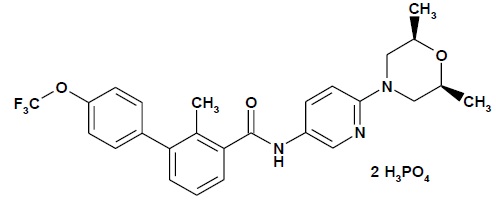
Sonidegib is a Hh pathway inhibitor. The molecular formula for sonidegib phosphate is C
odomzo-1
Sonidegib phosphate is a white to off-white powder. Sonidegib freebase is practically insoluble.
ODOMZO (sonidegib) capsules for oral use contain 200 mg of sonidegib as the freebase (equivalent to 281 mg of diphosphate salt of sonidegib) and the following inactive ingredients: colloidal silicon dioxide, crospovidone, lactose monohydrate, magnesium stearate, poloxamer and sodium lauryl sulfate. The opaque pink hard gelatin capsule shell contains gelatin, red iron oxide, and titanium dioxide. The black printing ink contains ammonium hydroxide, black iron oxide, propylene glycol, and shellac.
6CLINICAL STUDIES
The safety and effectiveness of ODOMZO were evaluated in a single, multicenter, double-blind, multiple cohort clinical trial conducted in patients with locally advanced basal cell carcinoma (laBCC) (n=194) or metastatic basal cell carcinoma (mBCC) (n=36) (BOLT, NCT01327053). Patients were randomized (2:1) to receive either ODOMZO 800 mg or 200 mg orally, once daily, until disease progression or intolerable toxicity. Randomization was stratified by stage of disease (locally advanced or metastatic), laBCC disease histology (aggressive vs. non-aggressive), and geographic region. Patients with laBCC were required to have lesions for which radiotherapy was contraindicated or inappropriate (e.g., Gorlin syndrome or limitations because of location of tumor), that had recurred after radiotherapy, that were unresectable or for which surgical resection would result in substantial deformity, or that had recurred after prior surgical resection.
The major efficacy outcome measure of the trial was objective response rate (ORR) as determined by blinded central review according to modified Response Evaluation Criteria in Solid Tumors (mRECIST) for patients with laBCC or RECIST version 1.1 for patients with mBCC. Duration of response (DoR), determined by blinded central review, was a key secondary outcome measure.
For patients with laBCC, the evaluation of tumor response was based on a composite assessment that integrated tumor measurements obtained by radiographic assessments of target lesions (per RECIST 1.1), digital clinical photography, and histopathology assessments (via punch biopsies). All modalities used must have demonstrated absence of tumor to achieve a composite assessment of complete response (CR). Response by digital clinical photography was evaluated by World Health Organization (WHO) adapted criteria [partial response (PR): ≥50% decrease in the sum of the product of perpendicular diameters (SPD) of the lesions, CR: disappearance of all lesions, progressive disease (PD): ≥25% increase in the SPD of the lesions]. Multiple punch biopsies of target lesions were performed to confirm a CR or when a response assessment was confounded by presence of lesion ulceration, cyst, and or scarring/fibrosis.
A total of 66 patients randomized to ODOMZO 200 mg daily had laBCC. Three of these patients had a diagnosis of Gorlin Syndrome. The demographic characteristics of the 66 patients with laBCC were: median age of 67 years (range: 25 to 92 years; 58% were ≥65 years); 58% male, 89% white, and ECOG performance status of 0 (67%). Seventy-six percent of patients had prior therapy for treatment of BCC; this included surgery (73%), radiotherapy (18%), and topical/photodynamic therapies (21%). Approximately half of these patients (56%) had aggressive histology.
Patients with laBCC randomized to receive ODOMZO 200 mg daily were followed for at least 30 months unless discontinued earlier. The ORR was 56% (95% confidence interval: 43, 68), consisting of 3 (5%) complete responses and 34 (52%) partial responses. A pre-specified sensitivity analysis using an alternative definition for complete response, defined as at least a PR according to MRI and/or photography and no evidence of tumor on biopsy of the residual lesion, yielded a CR rate of 21%. The median duration of response was 26.1 months (95% CI:10.1, not reached).
A total of 128 patients randomized to ODOMZO 800 mg daily had laBCC. Twelve of these patients had a diagnosis of Gorlin Syndrome. There was no evidence of better antitumor activity (ORR) among patients with laBCC randomized to receive ODOMZO 800 mg daily and followed for at least 30 months unless discontinued earlier.
7HOW SUPPLIED/STORAGE AND HANDLING
Each ODOMZO capsule has an opaque pink color with ‘SONIDEGIB 200MG’ printed on the capsule body and ‘NVR’ printed on the cap in black ink. ODOMZO capsules are supplied as follows:
Bottle of 30 capsules                                   NDC 47335-303-83
Store at 25°C (77°F); excursions permitted to 15°C to 30°C (59°F to 86°F)
8PATIENT COUNSELING INFORMATION
Advise the patient to read the FDA-approved patient labeling (
Females of Reproductive Potential
  • Advise female patients of the potential risk to a fetus. Advise female patients and female partners of male patients to contact their healthcare provider with a known or suspected pregnancy.
  • Advise females of reproductive potential to use effective contraception during treatment with ODOMZO and for at least 20 months after the last dose.
  • Advise females who may have been exposed to ODOMZO during pregnancy, either directly or through seminal fluid, to contact Sun Pharmaceutical Industries Inc. at 1-800-406-7984.
Males
  • Advise males, even those with prior vasectomy, to use condoms, to avoid potential drug exposure in both pregnant partners and female partners of reproductive potential during treatment with ODOMZO and for at least 8 months after the last dose.
Blood Donation
  • Advise patients not to donate blood or blood products while taking ODOMZO and for 20 months after stopping treatment.
Musculoskeletal Adverse Reactions
Advise patients to contact their healthcare provider immediately for new or worsening signs or symptoms of muscle toxicity, dark urine, decreased urine output, or the inability to urinate
Administration Instructions
Advise patients to take ODOMZO on an empty stomach, at least 1 hour before or 2 hours after a meal
Lactation
Advise women not to breastfeed during treatment with ODOMZO and for up to 20 months after the last dose
Manufactured for Sun Pharmaceutical Industries Limited.
By:
Patheon Inc.
Distributed by:
Sun Pharmaceutical Industries, Inc.
ODOMZO is a registered trademark of Sun Pharmaceutical Industries Limited.
© 2022 Sun Pharmaceutical Industries, Inc.
All rights reserved.
Rev. 08/2023
2000016519 US
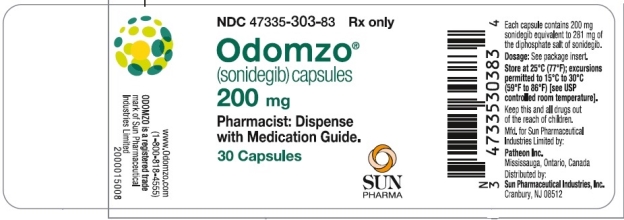
9PRINCIPAL DISPLAY PANEL
NDC 47335-303-83 Rx only
Odomzo®
(sonidegib) capsules
200 mg
Pharmacist: Dispense with Medication Guide.
30 Capsules
SUN PHARMA
odomzo