Generic Name
Icatibant
Brand Names
Firazyr, Sajazir
FDA approval date: August 25, 2011
Classification: Bradykinin B2 Receptor Antagonist
Form: Injection
What is Firazyr (Icatibant)?
FIRAZYR ® is indicated for the treatment of acute attacks of hereditary angioedema in adults 18 years of age and older. FIRAZYR is a bradykinin B2 receptor antagonist indicated for treatment of acute attacks of hereditary angioedema in adults 18 years of age and older.
Approved To Treat

Save this treatment for later
Not sure about your diagnosis?
Related Clinical Trials
Prevention of Intradialytic Hypotension by Inhibiting Bradykinin B2 Receptor A Randomized, Double-blind, Placebo-controlled, Cross Over Explorative Study
Summary: Currently, there is no medication available to adequately treat patients undergoing hemodialysis who are suffering from intradialytic hypotension (IDH). Medical interventions such as Trendelenburg positioning, saline bolus administration, reduction of ultrafiltration rate, interruption of the hemodialysis, and other medical treatments are the methods of choice to treat the hypotensive condition of...
Related Latest Advances
Brand Information
Firazyr (icatibant acetate)
1INDICATIONS AND USAGE
FIRAZYR
2DOSAGE FORMS AND STRENGTHS
FIRAZYR injection is supplied in a prefilled syringe delivering 30 mg icatibant. Each syringe delivers 3 mL solution with a concentration of 10 mg per mL.
3CONTRAINDICATIONS
None.
4OVERDOSAGE
In a clinical study evaluating a 90 mg dose (30 mg in each of 3 subcutaneous sites), the adverse event profile was similar to that seen with 30 mg administered in a single subcutaneous site.
In another clinical study, a dose of 3.2 mg/kg administered intravenously (approximately 8 times the therapeutic dose for HAE) caused erythema, itching and hypotension in healthy subjects. No therapeutic intervention was necessary.
5DESCRIPTION
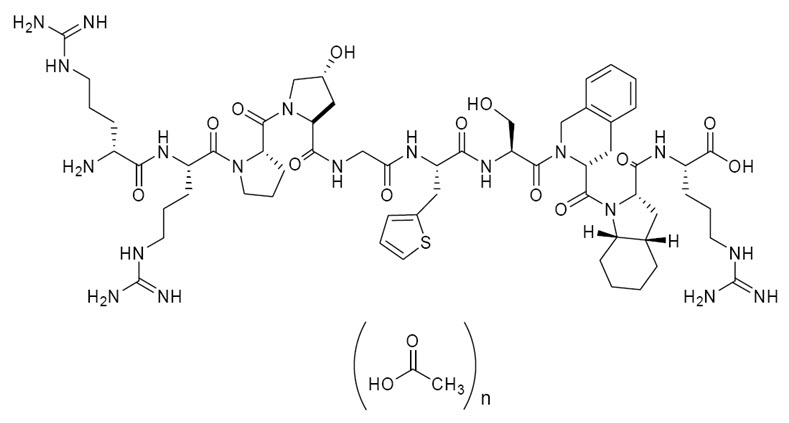
FIRAZYR (icatibant) is a synthetic decapeptide with five non-proteinogenic amino acids. The chemical structure of icatibant acetate is presented in Figure 1.
Figure 1 Chemical Structure
6CLINICAL STUDIES
The efficacy and safety of FIRAZYR for the treatment of acute attacks of HAE in adults were studied in three controlled clinical trials. Among the 223 patients in these studies, the mean age was 38 years, 64% were female, and 95% were white. Approximately 57% of patients reported use of attenuated androgens, antifibrinolytic agents, or C1 inhibitors. Response to therapy was primarily assessed using visual analog scores on a 100 mm scale and patient- and physician-reported symptom scores for abdominal and cutaneous pain and swelling.
Trial 1 was a randomized, placebo-controlled, double-blind, parallel-group study of 98 adult patients with a median age of 36 years. Patients who had developed moderate to severe cutaneous or abdominal or mild to moderate laryngeal attacks of HAE were randomized to receive either FIRAZYR 30 mg or placebo by subcutaneous injection. Patients with severe laryngeal attacks of HAE received open-label FIRAZYR 30 mg. The primary endpoint was assessed using a 3-item composite visual analog score (VAS), comprised of averaged assessments of skin swelling, skin pain, and abdominal pain. Response was defined as at least a 50% reduction from the pretreatment composite 3-item VAS score (Figure 2). The median time to 50% reduction in symptoms for patients with cutaneous or abdominal attacks treated with FIRAZYR (n=43) compared to placebo (n=45) was 2.0 hours [95% CI 1.5, 3.0] versus 19.8 hours [95% CI 6.1, 26.3], respectively (p<0.001).
Figure 2 Time to 50% reduction from baseline in 3-item VAS score.
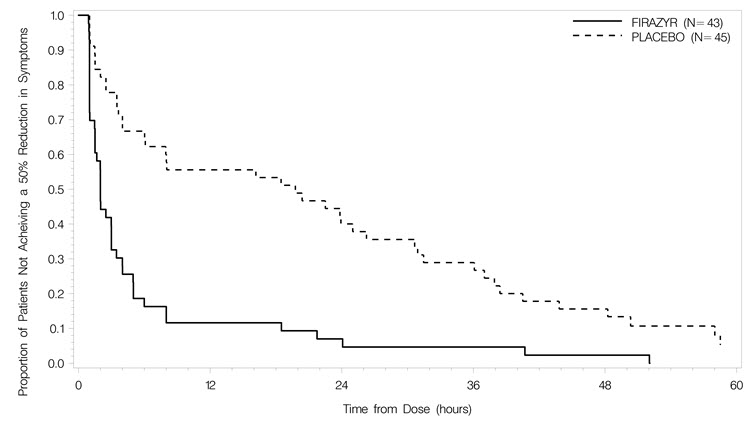
Other evaluated endpoints included time to almost complete symptom relief (VAS<10 mm) and rescue medication use. In Trial 1, the median times to almost complete symptom relief were 8.0 versus 36.0 hours for FIRAZYR and placebo, respectively. In terms of rescue medication use, 3/43 (7%) patients treated with FIRAZYR used additional rescue medication in comparison to 18/45 (40%) patients treated with placebo.
In a second placebo-controlled trial and an active-controlled trial, a total of 26 and 35 patients, respectively, received FIRAZYR 30 mg for the treatment of an acute HAE attack. Across the three trials, FIRAZYR had a median time to 50% reduction from baseline symptoms ranging from 2.0 to 2.3 hours.
7PATIENT COUNSELING INFORMATION
Advise the patient to read the FDA-approved patient labeling (
7.1Information for Patients
Patients may self-administer FIRAZYR upon recognition of an HAE attack after training under the guidance of a healthcare professional.
Patients with laryngeal symptoms should seek medical attention immediately in an appropriate healthcare facility after administration of FIRAZYR
Injection site reactions are reported in most patients after administration of FIRAZYR. Other adverse reactions reported after administration of FIRAZYR include pyrexia, increase in transaminases, dizziness, and rash
Tiredness, drowsiness, and dizziness have been reported following the use of FIRAZYR. Patients should be advised not to drive or use machinery if they feel tired or dizzy.
8PRINCIPAL DISPLAY PANEL - 3 mL Syringe Carton - 54092-702-03
Takeda
Prefilled Syringe
Rx ONLY
Carton contains:
One single-dose,
prefilled syringe and one 25G
hypodermic needle.
Full prescribing information with
patient injection instructions.
The syringe is closed with a protective cap.
One single-dose,
prefilled syringe and one 25G
hypodermic needle.
Full prescribing information with
patient injection instructions.
The syringe is closed with a protective cap.
firazyr
FOR SUBCUTANEOUS USE ONLY
FOR SUBCUTANEOUS USE ONLY
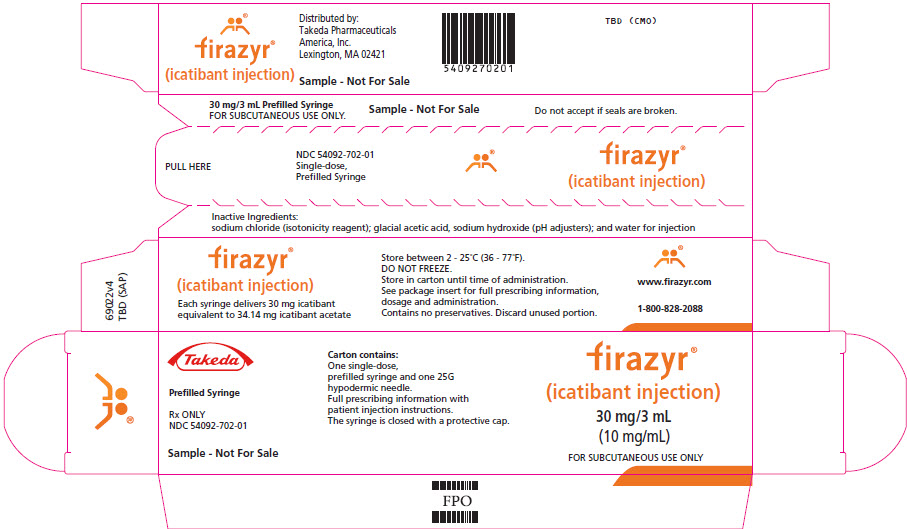
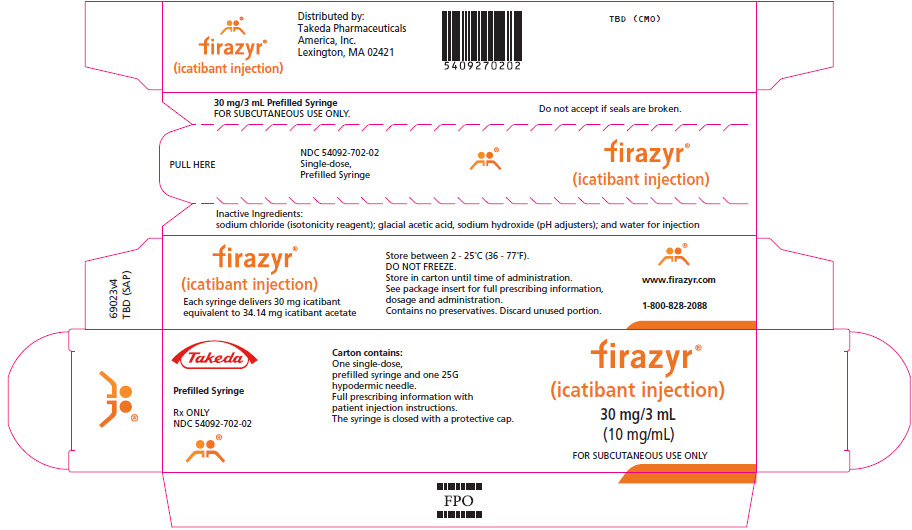
9PRINCIPAL DISPLAY PANEL - 3 mL Syringe Carton - 54092-702-02
Takeda
Prefilled Syringe
Rx ONLY
Carton contains:
One single-dose,
prefilled syringe and one 25G
hypodermic needle.
Full prescribing information with
patient injection instructions.
The syringe is closed with a protective cap.
One single-dose,
prefilled syringe and one 25G
hypodermic needle.
Full prescribing information with
patient injection instructions.
The syringe is closed with a protective cap.
firazyr
FOR SUBCUTANEOUS USE ONLY
FOR SUBCUTANEOUS USE ONLY
10PRINCIPAL DISPLAY PANEL - 3 mL Syringe Carton - 54092-702-03
Takeda
Prefilled Syringe
Rx ONLY
Carton contains:
Three cartons, each with one single-dose, prefilled syringe
and one 25G hypodermic needle.
Full prescribing information with patient injection instructions.
The syringe is closed with a protective cap.
Three cartons, each with one single-dose, prefilled syringe
and one 25G hypodermic needle.
Full prescribing information with patient injection instructions.
The syringe is closed with a protective cap.
firazyr
FOR SUBCUTANEOUS USE ONLY
FOR SUBCUTANEOUS USE ONLY