Brand Name
Onpattro
Generic Name
Patisiran
View Brand Information FDA approval date: August 13, 2018
Classification: Transthyretin-directed RNA Interaction
Form: Injection
What is Onpattro (Patisiran)?
ONPATTRO is indicated for the treatment of the polyneuropathy of hereditary transthyretin-mediated amyloidosis in adults. ONPATTRO contains a transthyretin-directed small interfering RNA and is indicated for the treatment of the polyneuropathy of hereditary transthyretin-mediated amyloidosis in adults.
Approved To Treat


Save this treatment for later
Not sure about your diagnosis?
Related Clinical Trials
ConTTRibute: A Global Observational Multicenter Long-Term Study of Patients With Transthyretin (TTR)-Mediated Amyloidosis (ATTR Amyloidosis)
Summary: The purpose of this study is to: * Describe epidemiological and clinical characteristics, natural history and real-world clinical management of ATTR amyloidosis patients * Characterize the safety and effectiveness of patisiran and vutrisiran as part of routine clinical practice in the real-world clinical setting * Describe disease emergence/progression in pre-symptomatic carriers of a known diseas...
Related Latest Advances
Brand Information
Onpattro (patisiran)
1INDICATIONS AND USAGE
ONPATTRO is indicated for the treatment of the polyneuropathy of hereditary transthyretin-mediated amyloidosis in adults.
2DOSAGE FORMS AND STRENGTHS
Lipid Complex Injection: 10 mg/5 mL (2 mg/mL) white to off-white, opalescent, homogeneous solution in a single-dose vial.
3CONTRAINDICATIONS
None.
4ADVERSE REACTIONS
The following clinically significant adverse reactions are described elsewhere in the labeling:
- Infusion-Related Reactions
4.1Clinical Trials Experience
Because clinical studies are conducted under widely varying conditions, adverse reaction rates observed in the clinical studies of ONPATTRO cannot be directly compared to rates in the clinical studies of another drug and may not reflect the rates observed in practice.
A total of 224 patients with polyneuropathy caused by hereditary transthyretin-mediated amyloidosis (hATTR amyloidosis) received ONPATTRO in the placebo-controlled and open-label clinical studies, including 186 patients exposed for at least 1 year, 137 patients exposed for at least 2 years, and 52 patients exposed for at least 3 years. In the placebo-controlled study, 148 patients received ONPATTRO for up to 18 months (mean exposure 17.7 months). Baseline demographic and disease characteristics were generally similar between treatment groups. The median age of study patients was 62 years and 74% were male. Seventy-two percent of study patients were Caucasian, 23% were Asian, 2% were Black, and 2% were reported as other. At baseline, 46% of patients were in Stage 1 of the disease and 53% were in Stage 2. Forty-three percent of patients had Val30Met mutations in the transthyretin gene; the remaining patients had 38 other point mutations. Sixty-two percent of ONPATTRO-treated patients had non-Val30Met mutations, compared to 48% of the placebo-treated patients.
Upper respiratory tract infections and infusion-related reactions were the most common adverse reactions. One patient (0.7%) discontinued ONPATTRO because of an infusion-related reaction.
Patients were instructed to take the recommended daily allowance of vitamin A
Table 1 lists the adverse reactions that occurred in at least 5% of patients in the ONPATTRO-treated group and that occurred at least 3% more frequently than in the placebo-treated group in the randomized controlled clinical trial.
Four serious adverse reactions of atrioventricular (AV) heart block (2.7%) occurred in ONPATTRO-treated patients, including 3 cases of complete AV block. No serious adverse reactions of AV block were reported in placebo-treated patients.
Ocular adverse reactions that occurred in 5% or less of ONPATTRO-treated patients in the controlled clinical trial, but in at least 2% of ONPATTRO-treated patients, and more frequently than on placebo, include dry eye (5% vs. 3%), blurred vision (3% vs. 1%), and vitreous floaters (2% vs. 1%).
Extravasation was observed in less than 0.5% of infusions in clinical studies, including cases that were reported as serious. Signs and symptoms included phlebitis or thrombophlebitis, infusion or injection site swelling, dermatitis (subcutaneous inflammation), cellulitis, erythema or injection site redness, burning sensation, or injection site pain.
4.2Immunogenicity
The detection of antibody formation is highly dependent on the sensitivity and specificity of the assay. In addition, the observed incidence of antibody (including neutralizing antibody) positivity in an assay may be influenced by several factors, including assay methodology, sample handling, timing of sample collection, concomitant medications, and underlying disease. For these reasons, comparison of the incidence of antibodies to ONPATTRO in the studies described below with the incidence of antibodies in other studies or to other products may be misleading.
Anti-drug antibodies to ONPATTRO were evaluated by measuring antibodies specific to PEG
4.3Postmarketing Experience
The following adverse reactions have been identified during postapproval use of ONPATTRO. Because these reactions are reported voluntarily from a population of uncertain size, it is not always possible to reliably estimate their frequency or establish a causal relationship to drug exposure.
Symptoms of infusion-related reactions have included syncope
5DESCRIPTION
ONPATTRO contains patisiran, a double-stranded small interfering ribonucleic acid (siRNA), formulated as a lipid complex for delivery to hepatocytes. Patisiran specifically binds to a genetically conserved sequence in the 3' untranslated region (3'UTR) of mutant and wild-type transthyretin (TTR) messenger RNA (mRNA).
The structural formula is:
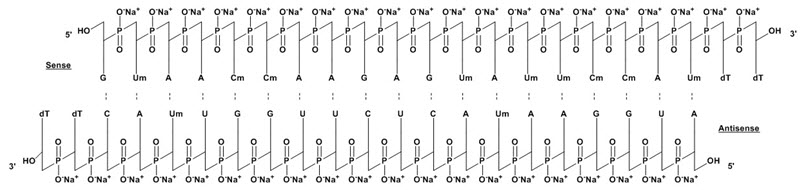
A, adenosine; C, cytidine; G, guanosine; U, uridine; Cm, 2'-
ONPATTRO is supplied as a sterile, preservative-free, white to off-white, opalescent, homogeneous solution for intravenous infusion in a single-dose glass vial. Each 1 mL of solution contains 2 mg of patisiran (equivalent to 2.1 mg of patisiran sodium). Each 1 mL also contains 6.2 mg cholesterol USP, 13.0 mg (6Z,9Z,28Z,31Z)-heptatriaconta-6,9,28,31-tetraen-19-yl-4-(dimethylamino) butanoate (DLin-MC3-DMA), 3.3 mg 1,2-distearoyl-
The molecular formula of patisiran sodium is C
6CLINICAL STUDIES
The efficacy of ONPATTRO was demonstrated in a randomized, double-blind, placebo-controlled, multicenter clinical trial in adult patients with polyneuropathy caused by hATTR amyloidosis (NCT 01960348). Patients were randomized in a 2:1 ratio to receive ONPATTRO 0.3 mg/kg (N=148) or placebo (N=77), respectively, via intravenous infusion once every 3 weeks for 18 months. All patients received premedication with a corticosteroid, acetaminophen, and H1 and H2 blockers. Ninety-three percent of ONPATTRO-treated patients and 62% of placebo-treated patients completed 18 months of the assigned treatment.
The primary efficacy endpoint was the change from baseline to Month 18 in the modified Neuropathy Impairment Score +7 (mNIS+7). The mNIS+7 is an objective assessment of neuropathy and comprises the NIS and Modified +7 (+7) composite scores. In the version of the mNIS+7 used in the trial, the NIS objectively measures deficits in cranial nerve function, muscle strength, and reflexes, and the +7 assesses postural blood pressure, quantitative sensory testing, and peripheral nerve electrophysiology. The maximum possible score was 304 points, with higher scores representing a greater severity of disease.
The clinical meaningfulness of effects on the mNIS+7 was assessed by the change from baseline to Month 18 in Norfolk Quality of Life-Diabetic Neuropathy (QoL-DN) total score. The Norfolk QoL-DN scale is a patient-reported assessment that evaluates the subjective experience of neuropathy in the following domains: physical functioning/large fiber neuropathy, activities of daily living, symptoms, small fiber neuropathy, and autonomic neuropathy. The version of the Norfolk QoL-DN that was used in the trial had a total score range from -4 to 136, with higher scores representing greater impairment.
The changes from baseline to Month 18 on both the mNIS+7 and the Norfolk QoL-DN significantly favored ONPATTRO (Table 2, Figure 1 and Figure 3). The distributions of changes in mNIS+7 and Norfolk QoL-DN scores from baseline to Month 18 by percent of patients are shown in Figure 2 and Figure 4, respectively.
The changes from baseline to Month 18 in modified body mass index (mBMI) and gait speed (10-meter walk test) significantly favored ONPATTRO (Table 2).
Figure 1: Change from Baseline in mNIS+7
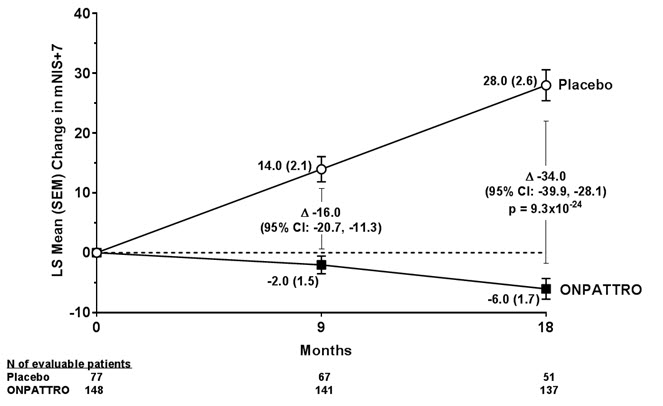
A decrease in mNIS+7 indicates improvement.
Δ indicates between-group treatment difference, shown as the LS mean difference (95% CI) for ONPATTRO – placebo.
Figure 2: Histogram of mNIS+7 Change from Baseline at Month 18
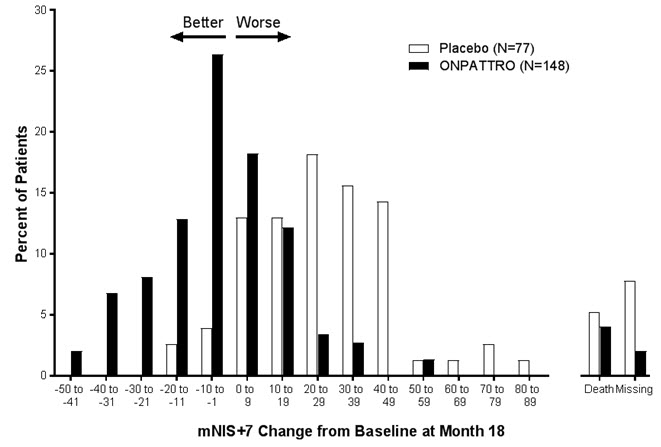
mNIS+7 change scores are rounded to the nearest whole number; last available post-baseline scores were used.
Categories are mutually exclusive; patients who died before 18 months are summarized in the "Death" category only.
Figure 3: Change from Baseline in Norfolk QoL-DN Score
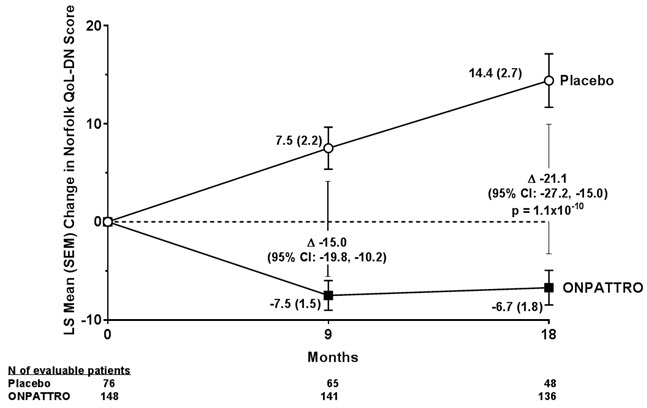
A decrease in Norfolk QoL-DN score indicates improvement.
Δ indicates between-group treatment difference, shown as the LS mean difference (95% CI) for ONPATTRO – placebo.
Figure 4: Histogram of Norfolk QoL-DN Change from Baseline at Month 18
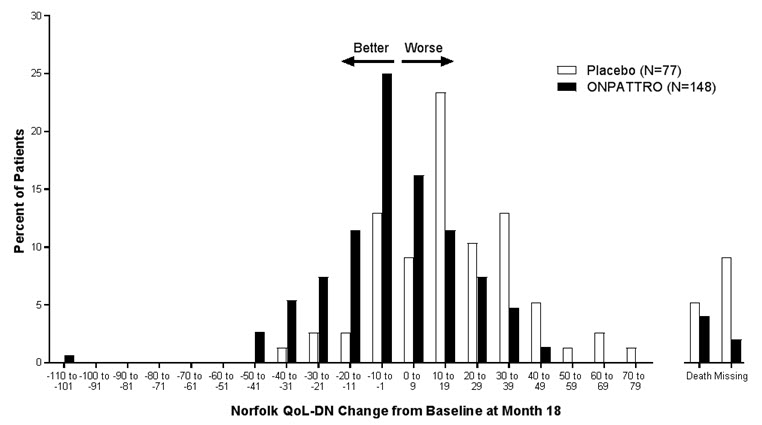
Norfolk QoL-DN change scores are rounded to the nearest whole number; last available post-baseline scores were used.
Categories are mutually exclusive; patients who died before 18 months are summarized in the "Death" category only.
Patients receiving ONPATTRO experienced similar improvements relative to placebo in mNIS+7 and Norfolk QoL-DN score across all subgroups including age, sex, race, region, NIS score, Val30Met mutation status, and disease stage.
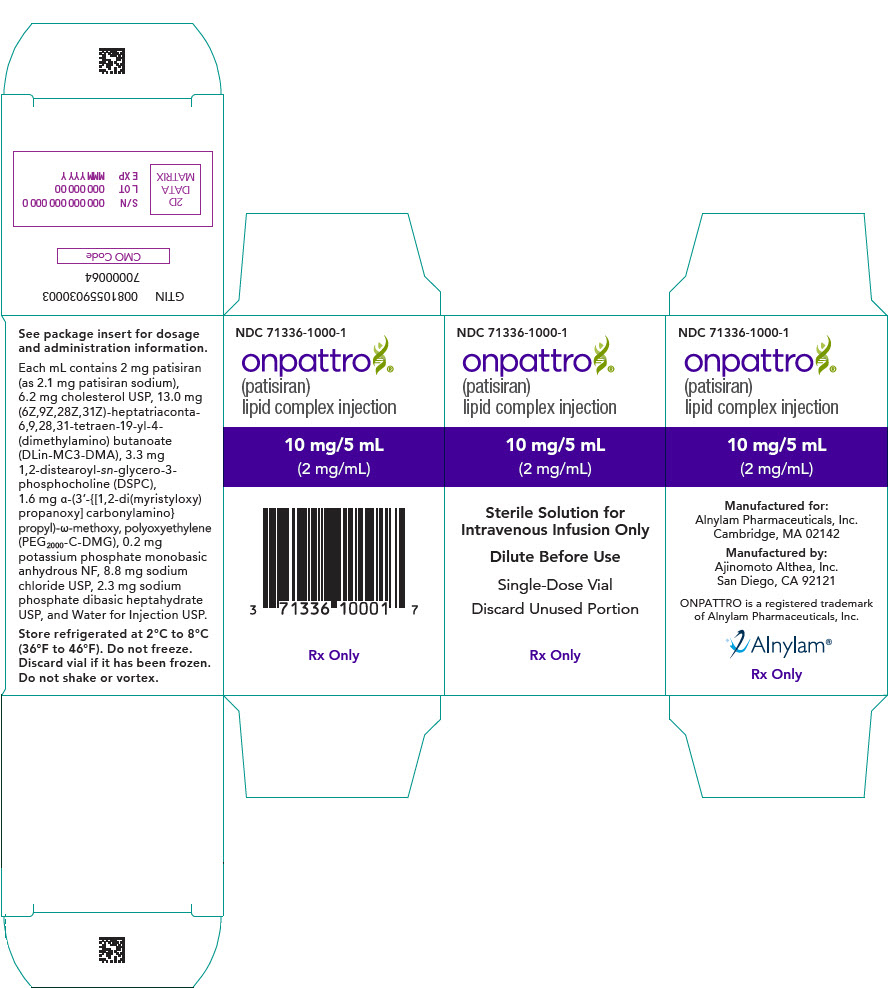
7PRINCIPAL DISPLAY PANEL - 2 mg/mL Vial Carton
NDC 71336-1000-1
onpattro
10 mg/5 mL
Sterile Solution for
Dilute Before Use
Single-Dose Vial
Discard Unused Portion
Rx Only