Brevibloc
What is Brevibloc (Esmolol)?
Approved To Treat
Top Global Experts


Related Clinical Trials
Summary: This randomized prospective study aims to compare the effects of two target-controlled infusion models, the Schnider and Eleveld models, on anesthetic depth and hemodynamic responses during anesthesia induction in adult patients undergoing spinal surgery. Patients scheduled for spinal surgery will be randomized into either the Schnider or Eleveld group. Before induction, standard monitoring will b...
Summary: There are 120,000 outpatient laparoscopic cholecystectomies with orotracheal intubation per year in France. Sufentanil is the most commonly used morphine during surgery in France, but morphines have harmful effects when administered for surgery. As with other morphine-based analgesics (painkillers), sufentanil can be associated with nausea and vomiting, confusion, itching and addiction. There is a...
Summary: This prospective, observational, non-randomized clinical study aims to evaluate the intraoperative and postoperative effects of opioid-free multimodal anesthesia compared with opioid-containing anesthesia methods in adult patients undergoing lumbar spinal surgery. Patients will be managed according to routine clinical practice and assigned to one of three groups based on the analgesic strategy use...
Related Latest Advances
Brand Information
- Severe sinus bradycardia: May precipitate or worsen bradycardia resulting in cardiogenic shock and cardiac arrest
- Heart block greater than first degree: Second- or third-degree atrioventricular block may precipitate or worsen bradycardia resulting in cardiogenic shock and cardiac arrest
- Sick sinus syndrome: May precipitate or worsen bradycardia resulting in cardiogenic shock and cardiac arrest
- Decompensated heart failure: May worsen heart failure.
- Cardiogenic shock: May precipitate further cardiovascular collapse and cause cardiac arrest.
- IV administration of cardiodepressant calcium-channel antagonists (e.g., verapamil) and BREVIBLOC injection in close proximity (i.e., while cardiac effects from the other are still present); fatal cardiac arrests have occurred in patients receiving BREVIBLOC injection and intravenous verapamil.
- Pulmonary hypertension: May precipitate cardiorespiratory compromise.
- Hypersensitivity reactions, including anaphylaxis, to esmolol or any of the inactive ingredients of the product (cross-sensitivity between beta blockers is possible).
- Digitalis glycosides: Concomitant administration of digoxin and BREVIBLOC injection leads to an approximate 10% to 20% increase of digoxin blood levels at some time points. Digoxin does not affect BREVIBLOC injection pharmacokinetics. Both digoxin and beta blockers slow atrioventricular conduction and decrease heart rate. Concomitant use increases the risk of bradycardia.
- Anticholinesterases: BREVIBLOC injection prolonged the duration of succinylcholine-induced neuromuscular blockade and moderately prolonged clinical duration and recovery index of mivacurium.
- Antihypertensive agents clonidine, guanfacine, or moxonidine: Beta blockers also increase the risk of clonidine-, guanfacine-, or moxonidine-withdrawal rebound hypertension. If, during concomitant use of a beta blocker, antihypertensive therapy needs to be interrupted or discontinued, discontinue the beta blocker first, and the discontinuation should be gradual.
- Calcium channel antagonists: In patients with depressed myocardial function, use of BREVIBLOC injection with cardiodepressant calcium channel antagonists (e.g., verapamil) can lead to fatal cardiac arrests.
- Sympathomimetic drugs: Sympathomimetic drugs having beta-adrenergic agonist activity will counteract effects of BREVIBLOC injection.
- Vasoconstrictive and positive inotropic agents: Because of the risk of reducing cardiac contractility in presence of high systemic vascular resistance, do not use BREVIBLOC injection to control tachycardia in patients receiving drugs that are vasoconstrictive and have positive inotropic effects, such as epinephrine, norepinephrine, and dopamine.
- (±)-Methyl p-[2-hydroxy-3-(isopropylamino) propoxy] hydrocinnamate hydrochloride and has the following structure:

- Esmolol hydrochloride has the empirical formula C
- Esmolol hydrochloride is a white to off-white crystalline powder. It is a relatively hydrophilic compound which is very soluble in water and freely soluble in alcohol. Its partition coefficient (octanol/water) at pH 7.0 is 0.42 compared to 17.0 for propranolol.
- The most common adverse reactions are symptomatic hypotension (hyperhidrosis, dizziness) and asymptomatic hypotension.
- Inform patients or caregivers that there is a risk of hypoglycemia when esmolol is given to patients who are fasting or who are vomiting. Monitor for symptoms of hypoglycemia.
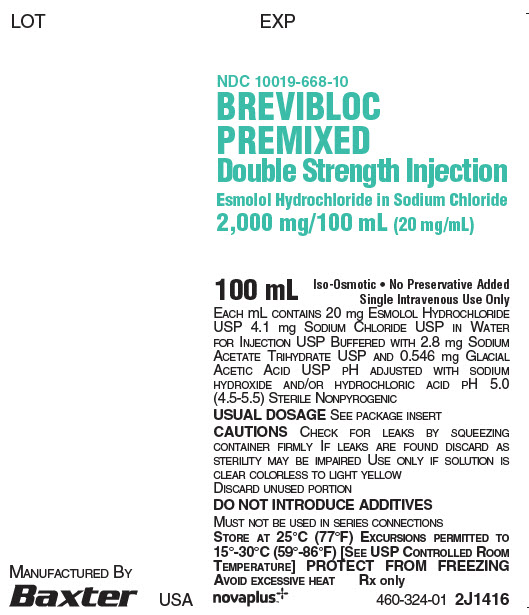
INFORMATION
CONTAINER FIRMLY IF LEAKS ARE FOUND DISCARD AS
STERILITY MAY BE IMPAIRED USE ONLY IF SOLUTION IS
CLEAR COLORLESS TO LIGHT YELLOW
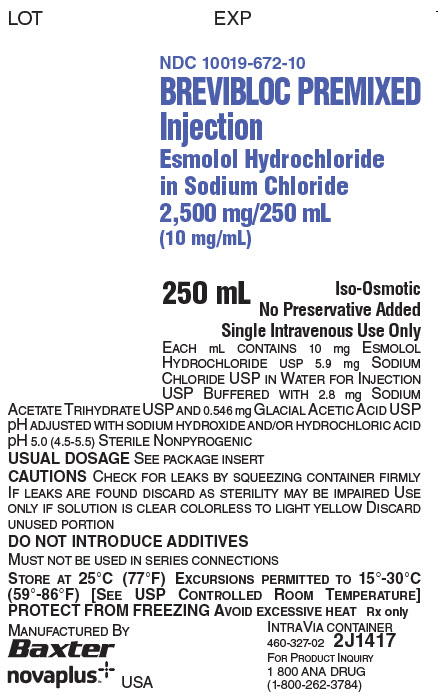
CAUTIONS CHECK FOR LE AKS BY SQUEEZING CONTAINER FIRMLY
IF LEAKS ARE FOUND DISCARD AS STERILITY MAY BE IMPAIRED USE
ONLY IF SOLUTION IS CLEAR COLORLESS TO LIGHT YELLOW DISCARD
UNUSED PORTION
DO NOT INTRODUCE ADDITIVESMUST NOT BE USED IN SERIES CONNECTIONS
STORE AT 25°C (77°F) EXCURSIONS PERMITTED TO 15°-30°C