Generic Name

Roflumilast

Brand Names
Daliresp, Zoryve
FDA approval date: July 01, 2015
Classification: Phosphodiesterase 4 Inhibitor
Form: Cream, Aerosol, Tablet

What is Daliresp (Roflumilast)?

DALIRESP ® is indicated as a treatment to reduce the risk of COPD exacerbations in patients with severe COPD associated with chronic bronchitis and a history of exacerbations. DALIRESP is a selective phosphodiesterase 4 inhibitor indicated as a treatment to reduce the risk of COPD exacerbations in patients with severe COPD associated with chronic bronchitis and a history of exacerbations. Limitations of Use : DALIRESP is not a bronchodilator and is not indicated for the relief of acute bronchospasm. , DALIRESP 250 mcg is a starting dose, for the first 4 weeks of treatment only and is not the effective dose. Limitations of Use DALIRESP is not a bronchodilator and is not indicated for the relief of acute bronchospasm. DALIRESP 250 mcg is a starting dose, for the first 4 weeks of treatment only and is not the effective dose.
Save this treatment for later
Sign Up
Not sure about your diagnosis?
Check Your Symptoms

Related Clinical Trials

Effect of Roflumilast as Add-On Therapy in Rheumatoid Arthritis

Summary: Rheumatoid arthritis is a chronic inflammatory disease that causes joint pain, swelling, and reduced physical function. Although standard disease-modifying antirheumatic drugs are effective for many patients, some individuals continue to have active disease. The purpose of this study is to evaluate the effectiveness and safety of adding roflumilast to standard therapy in patients with active rheum...

Exercise-induced Adrenergic Receptor Signaling as an Immune Adjuvant for Allogeneic Cell Therapies

Summary: This study aims to improve the treatment of blood cancer by using exercise to collect healthier immune cells from donors. Allogeneic adoptive cell therapy is a treatment where immune cells from a healthy donor are given to a cancer patient, usually to help prevent or treat cancer relapse after a stem cell transplant. These donor cells can either be directly infused into the patient or grown in a l...

Clinical Study to Compare the Possible Efficacy and Safety of Roflumilast and Desloratadine as Adjuvant Therapy for Rheumatoid Arthritis

Summary: Rheumatoid arthritis is a chronic inflammatory disease that causes joint pain, swelling, and disability. Although standard disease-modifying antirheumatic drugs (DMARDs) are effective for many patients, some individuals continue to experience active disease and inflammation. The aim of this study is to evaluate the effectiveness and safety of adding either roflumilast or desloratadine to standard ...

Brand Information

    Daliresp (roflumilast)
    1INDICATIONS AND USAGE
    DALIRESP
    2DOSAGE AND ADMINISTRATION
    The maintenance dose of DALIRESP is one 500 micrograms (mcg) tablet per day, with or without food.
    Starting treatment with a dose of DALIRESP 250 mcg once daily for 4 weeks and increasing to DALIRESP 500 mcg once daily thereafter may reduce the rate of treatment discontinuation in some patients
    3DOSAGE FORMS AND STRENGTHS
    • DALIRESP 250 mcg tablets are white to off-white, round, embossed with “D” on one side and “250” on the other side
    • DALIRESP 500 mcg tablets are white to off-white, round, embossed with “D” on one side and “500” on the other side
    4CONTRAINDICATIONS
    The use of DALIRESP is contraindicated in the following condition:
    Moderate to severe liver impairment (Child-Pugh B or C)
    5ADVERSE REACTIONS
    The following adverse reactions are described in greater detail in other sections:
    • Psychiatric Events Including Suicidality
    • Weight Decrease
    5.1Adverse Reactions in Clinical Studies
    Because clinical trials are conducted under widely varying conditions, adverse reaction rates observed in the clinical trials of a drug cannot be directly compared to rates in the clinical trials of another drug and may not reflect the rates observed in practice.
    The safety data described below reflect exposure of 4438 patients to DALIRESP 500 mcg once daily in four 1-year placebo-controlled trials, two 6-month placebo-controlled trials, and two 6-month drug add-on trials
    The population had a median age of 64 years (range 40-91), 73% were male, 92.9% were Caucasian, and had COPD with a mean pre-bronchodilator forced expiratory volume in one second (FEV
    The proportion of patients who discontinued treatment due to adverse reaction was 14.8% for DALIRESP-treated patients and 9.9% for placebo-treated patients. The most common adverse reactions that led to discontinuation of DALIRESP were diarrhea (2.4%) and nausea (1.6%).
    Serious adverse reactions, whether considered drug-related or not by the investigators, which occurred more frequently in DALIRESP-treated patients include diarrhea, atrial fibrillation, lung cancer, prostate cancer, acute pancreatitis, and acute renal failure.
    Table 1 summarizes the adverse reactions reported by ≥2% of patients in the DALIRESP group in 8 controlled COPD clinical trials.
    Adverse reactions that occurred in the DALIRESP group at a frequency of 1 to 2% where rates exceeded that in the placebo group include:
    Gastrointestinal disorders - abdominal pain, dyspepsia, gastritis, vomiting
    Infections and infestations - rhinitis, sinusitis, urinary tract infection
    Musculoskeletal and connective tissue disorders - muscle spasms
    Nervous system disorders - tremor
    Psychiatric disorders - anxiety, depression
    The safety profile of roflumilast reported during Trial 9 was consistent with the key pivotal studies.
    5.2Postmarketing Experience
    The following adverse reactions have been identified from spontaneous reports of DALIRESP received worldwide and have not been listed elsewhere. These adverse reactions have been chosen for inclusion due to a combination of seriousness, frequency of reporting or potential causal connection to DALIRESP. Because these adverse reactions were reported voluntarily from a population of uncertain size, it is not possible to estimate their frequency or establish a causal relationship to DALIRESP exposure:  hypersensitivity reactions (including angioedema, urticaria, and rash), gynecomastia.
    6DRUG INTERACTIONS
    A major step in roflumilast metabolism is the N-oxidation of roflumilast to roflumilast N-oxide by CYP3A4 and CYP1A2
    6.1Drugs that Induce Cytochrome P450 (CYP) Enzymes
    Strong cytochrome P450 enzyme inducers decrease systemic exposure to roflumilast and may reduce the therapeutic effectiveness of DALIRESP. Therefore the use of strong cytochrome P450 inducers (e.g., rifampicin, phenobarbital, carbamazepine, and phenytoin) with DALIRESP is not recommended
    6.2Drugs that Inhibit Cytochrome P450 (CYP) Enzymes
    The co-administration of DALIRESP (500 mcg) with CYP3A4 inhibitors or dual inhibitors that inhibit both CYP3A4 and CYP1A2 simultaneously (e.g., erythromycin, ketoconazole, fluvoxamine, enoxacin, cimetidine) may increase roflumilast systemic exposure and may result in increased adverse reactions. The risk of such concurrent use should be weighed carefully against benefit
    6.3Oral Contraceptives Containing Gestodene and Ethinyl Estradiol
    The co-administration of DALIRESP (500 mcg) with oral contraceptives containing gestodene and ethinyl estradiol may increase roflumilast systemic exposure and may result in increased side effects. The risk of such concurrent use should be weighed carefully against benefit
    7DESCRIPTION
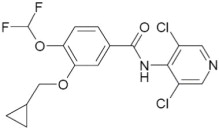
    The active ingredient in DALIRESP tablets is roflumilast. Roflumilast and its active metabolite (roflumilast N-oxide) are selective phosphodiesterase 4 (PDE4) inhibitors. The chemical name of roflumilast is N-(3,5-dichloropyridin-4-yl)-3-cyclopropylmethoxy-4-difluoromethoxy-benzamide. Its empirical formula is C
    The chemical structure is:
    Structural Formula
    The drug substance is a white to off-white non-hygroscopic powder with a melting point of 160°C. It is practically insoluble in water and hexane, sparingly soluble in ethanol, and freely soluble in acetone.
    DALIRESP is supplied as white to off-white, round tablets, embossed with “D” on one side and “250” or “500” on the other side. Each tablet contains 250 mcg or 500 mcg of roflumilast.
    Each tablet of DALIRESP for oral administration contains the following inactive ingredients: lactose monohydrate, corn starch, povidone, and magnesium stearate.
    8PATIENT COUNSELING INFORMATION
    Advise the patient to read the FDA-approved patient labeling (Medication Guide).
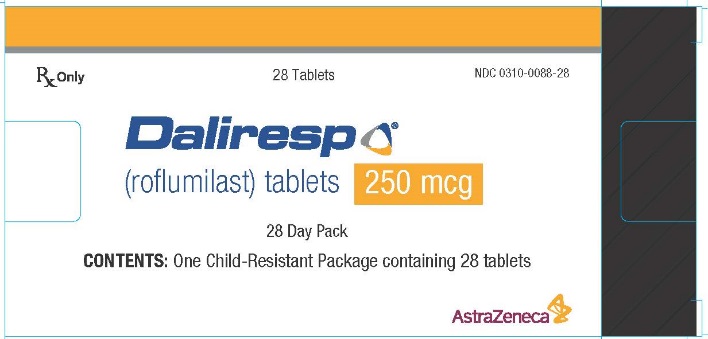
    9PACKAGE/LABEL PRINCIPAL DISPLAY PANEL – 250 mcg
    Rx Only              28 Tablets                NDC 0310-0088-28
    Daliresp®
    (roflumilast) tablets          250 mcg
    28 Day Pack
    CONTENTS: One Child-Resistant Package containing 28 tablets
    AstraZeneca
    dalriesp_250_mcg_28_day_pack
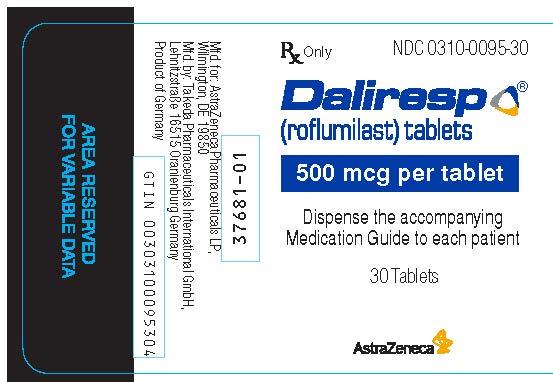
    10PACKAGE/LABEL PRINCIPAL DISPLAY PANEL – 500 mcg
    Rx Only                              NDC 0310-0095-30
    Daliresp®
    (roflumilast) tablets
    500 mcg per tablet
    Dispense the accompanying
    Medication Guide to each patient
    30 Tablets
    AstraZeneca
    daliresp_500_mcg_30_count_tablets